
Holidaymakers and the Kindertransport
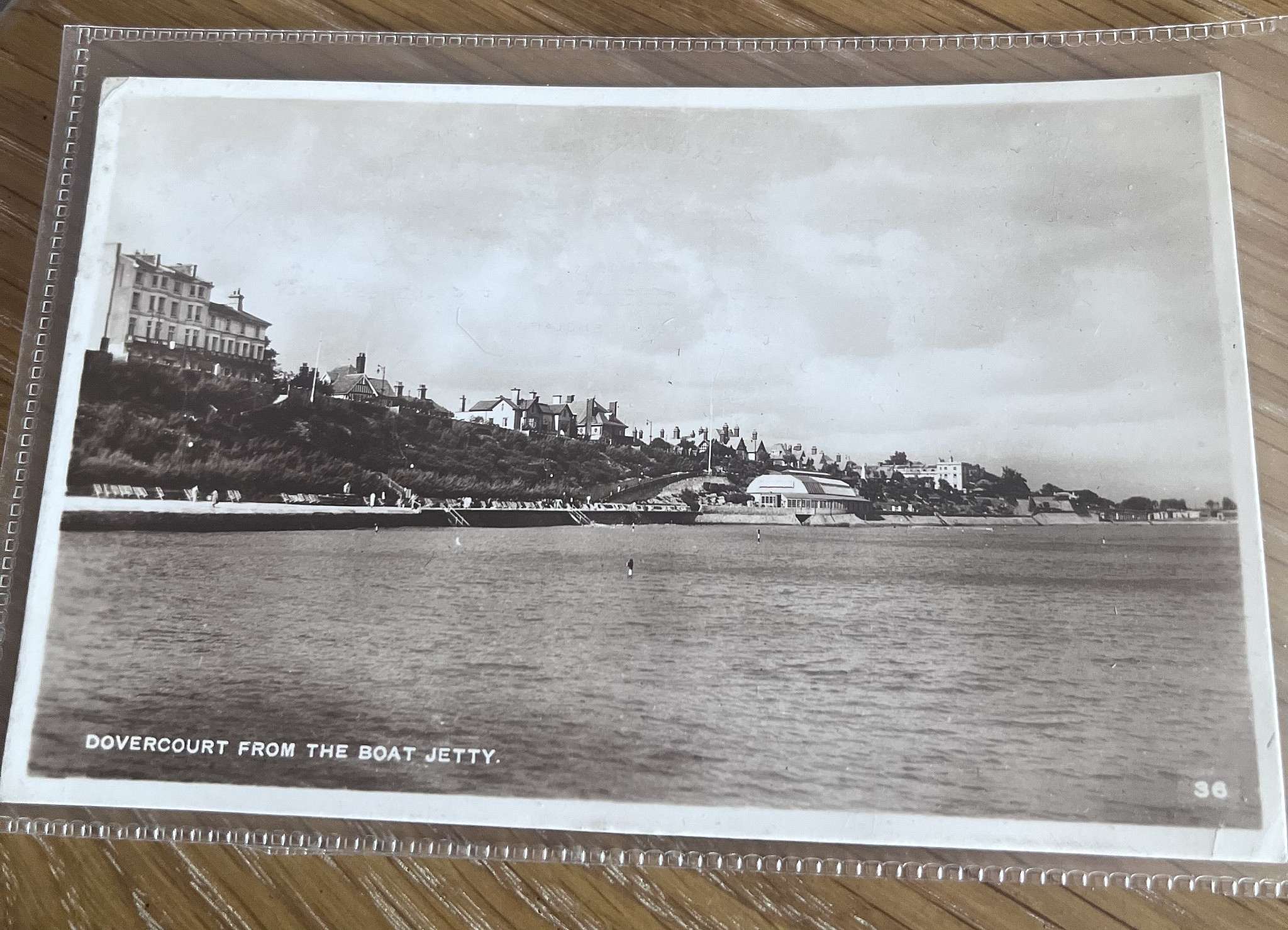
Some British holidaymakers in late 1938 and 1939 must have seen the Kindertransports arrive in Harwich. After recently receiving a postcard of Dovercourt from the boat jetty from Steven Derby (the son of a Kindertransportee and Association of Jewish Refugees (AJR) member) I was inspired to think about these holidaymakers who witnessed history before their eyes. I’d thought about how locals had seen and interacted with the Kinder because my friend, Alan Mann told me that his father, who was a Harwich resident, was a cabin boy on the ferries which brought the Kinder to British shores. He was one of the first British teenagers who welcomed them, spoke to them, and reassured them on their journey across the Channel from the Hook of Holland to Harwich. As Steve gifted me this historical postcard which he had found on the internet, I could see that he had had the same idea as me – was there a Kindertransport on the day the postcard was written?
There is a stamp on the back of the postcard with a date on it. It reads 16th March 1939. I looked in the refugee committee’s July 1939 report and, lo and behold, there was indeed a Kindertransport on this day! According to the report 57 boys and 83 girls were on board. With their arrival, around 3685 Kinder had arrived in the UK at this point. I think that this transport was from Germany as there was a transport which arrived from Prague on 14th March 1939 and another which arrived from Vienna on 15th March 1939. There was also a transport which arrived on 17th March 1939, also probably from Germany. To digress slightly for a moment, it can be hard to determine when the transports arrived and how many children were on them because there are often discrepancies between the Kindertransport lists and the refugee committee files. For example, sometimes there are more children listed than actually arrived, and sometimes a transport is not listed on an official overview list. The Vienna overview list for 15th March 1939 suggests that some 140 children arrived in the UK. But the British overview list states that only 20 children arrived. There is still a lot to uncover when it comes to these lists and committee files.
I’ve looked and looked, but, sadly, at the moment I do not have the list for the Kindertransport which arrived on 16th March 1939. While I’ve found many of the lists, some are still missing. I do however have the list of children who arrived on 17th March 1939. On the evening of 16th March 1939, they were waiting to board their ferry in the Hook of Holland. The Kinder would have looked out to sea across to the UK. The writer of the postcard would have been looking in the Kinder’s direction on that afternoon. According to the refugee report on 17th March 1939, 96 boys and 63 girls arrived in Harwich. That meant that some 159 children arrived but the list I have has 199 children listed. I think 9 chaperones are listed as accompanying this large transport. I use the word “think” because the chaperone list looks like it was sent ahead of the Kindertransport list.
The author of the postcard has addressed the card to an address in West Bridgford, Nottingham – which is rather a coincidence, as I went to university in Nottingham and my PhD supervisor and co-author, Prof. Bill Niven lives near West Bridgford. The author states that she is staying at the Cliff Hotel in Harwich. The hotel is actually pictured in the top lefthand side of the postcard. The writer first states that she enjoyed a “nice sundown yesterday”. Yesterday being 15th March 1939. This was the day that Harry and Gerta Bibring arrived from Vienna on their transport. Michael Bibring, Harry’s son and member of the AJR Kindertransport Committee told me that he still has his father’s ferry ticket. The stamp on the ticket reads: Amsterdam 14th March 1939. There is also a Harwich stamp from 15th March 1939. Thanks to Michael we know that it was the Amsterdam ferry which arrived in the early hours of the morning on 15th March 1939. I wonder if the writer of the postcard was aware of this moment which has become so embedded in British Holocaust memory. I’m amazed to think back that Michael was in the room when Steven gave me the postcard at a joint Barnet Libraries and AJR talk in London. At that moment though we had not connected all the dots.
The author then says that it was a foggy day on 16th March 1939. She actually could not see the sea as the fog was that bad. She had to stand on the cliffs to see it. Here we have an atmospheric picture of the Kinder’s arrival on that day. The author also wrote that “the ships [were] anchored outside, and fog horns [were] going continentally” which also gives us an insight into the noises as well as the scenes the Kinder saw as they were coming into port. The postcard is to her daughter. It is quintessentially British in its tone and content – it is all about the weather and going for a long walk by the sea. It is touching to read that a British mother was doing something so ordinary as she wrote to her daughter about her holiday while Jewish mothers across the sea were saying farewell to their children and wondering what their journeys into the unknown were like. We know that the Kinder were sent with postcards to write to their parents on their journeys because it is stated in the Vienna committee files that the children could take postcards and pencils. They were encouraged to write about their adventure. Some children did just so but many others were too traumatized to write during their journeys. They never wrote their postcards.
This postcard stirs up so many questions such as: did the author see any of the Kinder? Did she see multiple transports arrive during her time in Harwich? Did she write a postcard about the Kinder?
–
If you know of any holidaymakers or locals who saw the Kinder arrive, please do reach out to the AJR and myself: amy@ajr.org.uk as we’d really like to learn about these more unknown stories.