
Holidays at the In-Laws
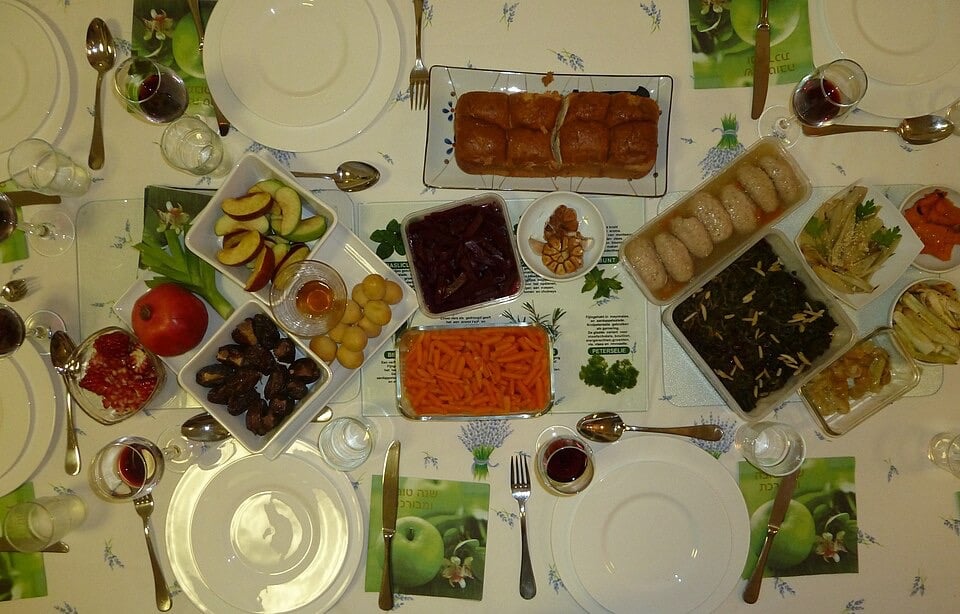
Since making aliyah, I’ve learned that there are many valid ways to spend a Jewish holiday.
You can spend the afternoon reading, taking a walk, and eventually falling asleep on the couch.
Or you can spend it playing Catan, followed by Codenames, followed by Ticket to Ride, followed by another game of Catan because apparently the first game of Catan did not adequately resolve everyone’s need for competition.
For most of my life, I assumed my family’s version of a holiday was simply what a holiday was. This year, I’m getting a chance to see how wrong that assumption was.
I’m spending Rosh Hashana with my husband’s family here in Israel, and Sukkot with mine back in America. Which means that, without really planning to, I’m getting to compare two very different families’ ideas of what makes a chag feel like a chag.
And it turns out there are a surprising number of answers to that question.
For my husband’s family, apparently, simanim are part of it.
As far as I know, simanim aren’t really an American Rosh Hashana thing. That’s a Pesach concept, maybe a Tu B’Shvat one if your family leans a little hippie, but definitely not Rosh Hashana.
When my father-in-law mentioned certain simanim in passing this year, my honest initial response was: I’m sorry, what do you mean, simanim for Rosh Hashana?
Now that I know they exist, I still have some questions. How do leeks and beets represent the destruction of our enemies? How does squash mean throwing away the bad parts of our verdict?
In my family, we do apples and honey for a sweet new year, and that’s the full extent of the symbolic food program, and I had never once questioned it before aliyah. Apparently there is an entire additional curriculum I was never assigned in Jewish kindergarten.
And once you start noticing these things, you realize the differences aren’t limited to what’s on the table.
At shul, some of the women in my husband’s family prefer a small curtained section inside the men’s area, because they say they can hear the tefillah better there than from the regular women’s section, which is a good-sized space off to the side, not a balcony.
Fair enough. But hearing better makes very little difference to me, since my Hebrew still isn’t good enough to follow the service either way, wherever I’m sitting. What I actually care about is being able to see (which I cannot do from behind a curtain within the men’s section).
Funny, the different things we each end up prioritizing without realizing it.
I’m sure Yom Kippur will reveal fewer cultural differences. Our plans are still TBD, but I suspect that one is fairly universal no matter whose family you’re with, and in what country. There is, however, one part I will be monitoring closely: Mareh Kohen. Wherever I end up, they better sing it in the right tune, or I will be truly disappointed.
Some things transcend geography.
Then comes Sukkot, when I’ll be back with my own family in America. And I already know that, in some ways, it will feel immediately familiar.
For one thing, there’s a decent chance we’ll be eating dinner in coats.
For another, I’ll get to see the same sukkah I grew up with, decorated with years’ worth of decorations my parents saved, a few from each of us kids, every year since elementary school. Growing up, we never went anywhere for Sukkot. We hosted my mom’s parents for the first days and my dad’s parents for the last days, following nearly the same choreography every year.
It was so consistent that I assumed for a long time that this was simply what Sukkot was, and that it would never change.
I’m also very excited to see actual fall foliage again. It’s been a long time.
But I suspect the moment I’ll notice the difference most is after the meal.
Because in both families, the meal itself is pretty much what you would hope for: great food, lots of conversation, people sitting around the table for a lot longer than they need to.
It’s what happens when everyone gets up from the table that we seem to disagree about.
My family reads. We nap, unapologetically and often. We take a walk. We come back and probably nap again. Maybe, if we’re really desperate, a Scrabble board appears around five o’clock on day three of a three-day chag.
My in-laws, meanwhile, need what I like to call leisure activity (emphasis on the activity part).
My husband in particular needs to be doing something, ideally something involving resource cards or dice, or he starts getting restless. I, meanwhile, do not know how to relax around my own family with someone nearby cheerfully asking if anyone wants to play Ticket to Ride.
To me, relaxing means having no objectives. To him, having no objectives sounds like purgatory.
I want to sit on the couch with my family and do nothing in particular. He wants to gather everyone around a table and get excited and establish a winner.
I’m sure we’ll figure it out. Possibly a code word. Possibly a designated 40-minute Catan window, negotiated in advance.
Because the funny thing is that neither of us really thinks the other family is doing the holidays wrong. They’ve just each developed their own answer to the question of what makes a chag feel like a chag.
For my family, it’s the sukkah that looks exactly as it did when I was 8, the decorations my parents say they are throwing away every year (but never do), grandparents who always came on the same days, fall colors and scents, and the general understanding that no one needs to accomplish anything for the next several hours.
For my husband’s family, it’s something entirely different, and I’m sure I will be learning what exactly makes chag feel like chag to them for years to come.
And I suppose that’s one of the stranger parts of making aliyah (and of getting married). You spend your whole childhood learning what “normal” looks like, only to discover that normal was really just whatever your family happened to do.
Now I get to make room for both, even if one version involves an indulgent number of naps and the other involves excessive Catan.
Shana tova u’metukah!