
The Present Level of Antisemitism Does Not Indicate the End of American Judaism
Antisemitism in America Does Not Wax and Wane by Itself
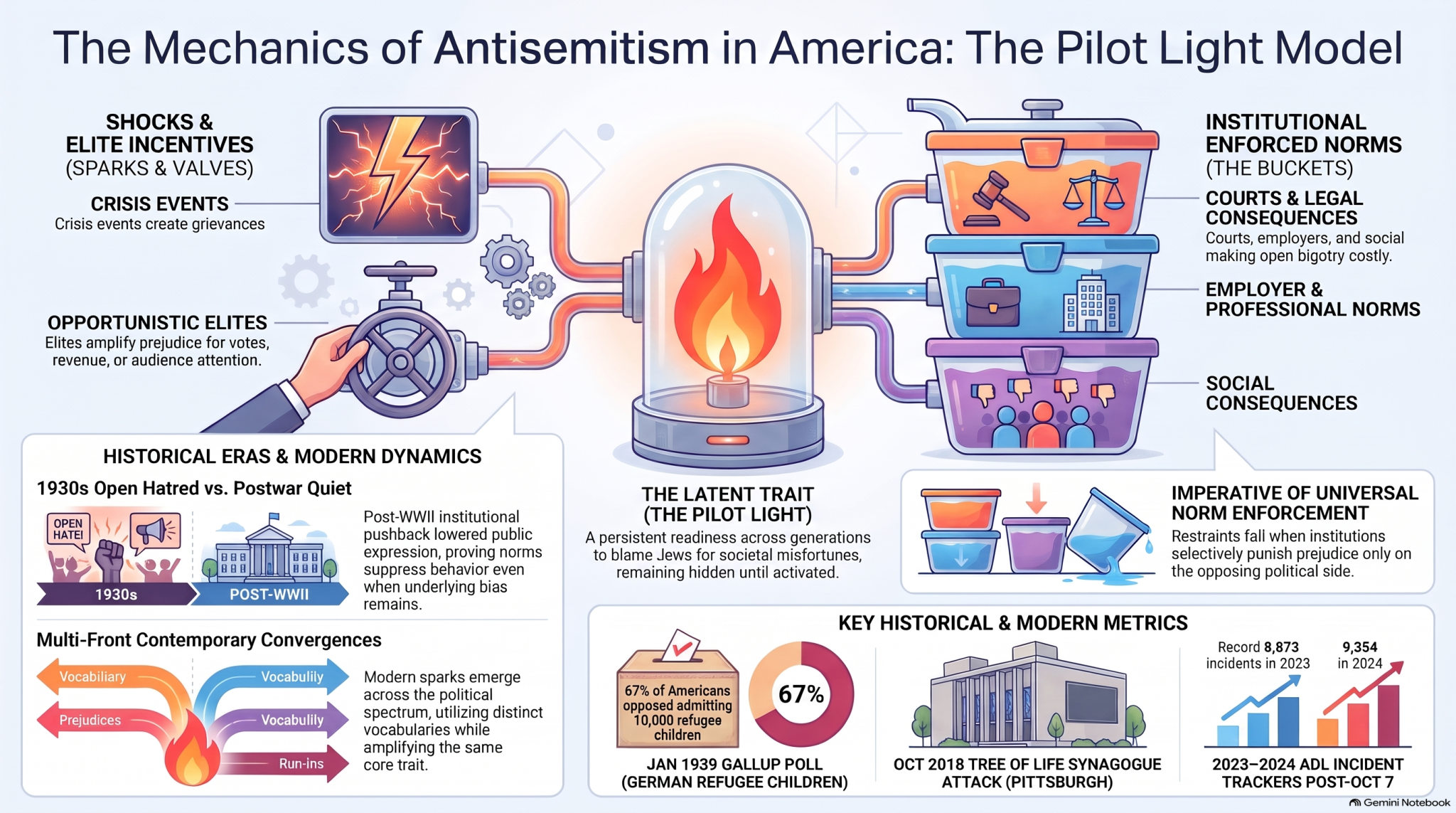
In the United States from 1930 to the present, antisemitism has been a persistent latent trait whose expression is raised by shocks and elite incentives and lowered by institutions and enforced norms.
It does not rise and fall by itself. Think of it as a pilot light: always burning, rarely noticed, and whether it becomes a fire depends on three things outside the flame itself. One is the spark that arrives. Another is the people who choose to feed it. The third is whether anyone is standing by with a bucket.
Each phrase in that statement does specific work. A persistent latent trait is a standing readiness, carried by some part of the population from generation to generation, to explain misfortune by blaming Jews. It is present but unexpressed most of the time, and good years, new generations and the collapse of the movements that once carried it do not erase it. Expression is the visible side, from private slurs to exclusion and violence. That is why a society can look untroubled on Tuesday and be burning by Friday without anything about its people having changed.
Shocks are the sudden events that disturb ordinary life and create a demand for explanation: a depression, a war, a terror attack, a plague. A shock produces fear and anger that need a target, and it loosens the usual restraints on acting against one. It need not involve Jews at all.
Elite incentives are the reasons powerful people have to use the trait. Elites means anyone with a large audience or real authority: politicians, broadcasters, clergy, movement leaders, influencers. Their reasons are ordinary ones: attention, money, votes, a common enemy, a way to deflect blame. They do not create the pilot light, but they decide whether to open the valve and where to point the flame.
Institutions and enforced norms raise the price of acting on the trait. Institutions are the courts, police, legislatures, universities, employers and media that can punish or permit. A norm is enforced only when breaking it costs something: a lost platform, a lost job, a lost election, a prosecution. Without enforcement a norm is a slogan. With it, the same prejudice stays private.
That is the story of the last ninety years. America went from the open, organized Jew-hatred of the 1930s to a postwar quiet so deep that many believed the problem was over, and then to the deadliest attack on American Jews in the nation’s history, in 2018, followed by a record number of physical assaults in 2025. The flame never went out in the quiet years, and it was never the only factor in the loud ones. What changed was what surrounded it.
Start with the flame. In the 1930s, Father Charles Coughlin’s weekly radio program carried antisemitic ideas into millions of American homes. In January 1939 a Gallup poll found that two-thirds of Americans opposed bringing 10,000 refugee children from Germany into the country. It did not go out when the movements did. In the mid-1960s, scholars reviewing decades of polls found hostile stereotypes in steep decline and warned that some prejudice remained that a major crisis could reactivate. The ADL’s 2024 survey, built on questions it has asked since 1964, found Americans endorsing slightly more anti-Jewish tropes than two years earlier, and the young more than the old.
Then comes the spark. The Depression gave Americans a grievance in search of an explanation, and Coughlin offered one, blaming those who profited from usury. On September 11, 1941, Charles Lindbergh told a rally in Des Moines that the British, the Jews and the Roosevelt administration were pushing the country toward war. Neither the crash nor the war had anything to do with Jews. The flame only needed a reason.
The decades in between were quieter but never empty. In August 1991, after a car driven by a Jewish man struck and killed a young Black child in Crown Heights, Brooklyn, mobs over several days targeted the Lubavitch community, and a visiting Jewish student from Australia, Yankel Rosenbaum, was killed. In 2017, white supremacists at the Charlottesville rally were heard changing their refrain to “Jews will not replace us”. In 2018 a gunman killed eleven worshippers at the Tree of Life synagogue in Pittsburgh, which the ADL called the deadliest attack on the Jewish community in American history. The sparks differed, and so did the hands that carried them. The flame did not.
It happened again after the October 7, 2023 attacks on Israel. The ADL counted a record 8,873 antisemitic incidents in the United States that year and 9,354 the next When the shock faded, the count fell by a third in 2025, yet physical assaults reached a record and the year included three killings A falling number is not a falling danger.
The flame also needs people willing to feed it. Coughlin built a following and a livelihood out of it, drawing up to 80,000 letters a week. Lindbergh used the antiwar cause as his platform, and discovered what happens when a prominent figure pays a price for it: the 1940 Republican nominee, Wendell Willkie, condemned the Des Moines speech, and Lindbergh’s public support evaporated. The same incentives work today in a different key, and attention is the currency. In October 2025 Tucker Carlson interviewed Nick Fuentes, a white nationalist who has praised Hitler. The interview drew 17 million views on X and split conservative leaders over how to respond. On the other side, the ADL reported that many anti-Zionist groups and influencers celebrated or justified the May 2025 killing of two Israeli embassy employees outside the Capital Jewish Museum. But the pattern is the same: powerful voices do not create the pilot light. They decide whether to open the valve.
Then there is the bucket. What changed after the war was less the public’s heart than the price of acting on it. Federal authorities went after the extremist groups and curtailed Coughlin. Courts stopped enforcing the restrictive covenants that had been used to keep Jewish buyers out of neighborhoods. By the early 1960s most resorts and housing developments had dropped their exclusions, college quotas had mostly ended, and the professions had opened. Elite opinion had decided that open antisemitism was un-American, and institutions followed.
Today the sparks are arriving from every direction at once. Start with the machinery of grievance. Rush Limbaugh, Fox News and the Wall Street Journal opinion pages built a self-protective enclave for conservatives. Limbaugh himself was staunchly pro-Israel, so the point is not what he said about Jews. It is that an audience taught to feel looked down on by elites, and to expect a daily naming of who is to blame, can be rented to anyone. Its newest tenants do not share the views of its founders.
The left has its own version, built on a different vocabulary. Many campus activists cast the Israeli-Palestinian conflict as settler against native, colonizer against colonized, oppressor against oppressed, and in that frame Jews are counted as white and privileged. A 2024 Jewish People Policy Institute report described Jewish students, especially those seen as Zionists, being tarred as members of the oppressor class. The ADL describes the Students for Justice in Palestine network as having justified the Hamas-led October 7 attack, and critics argue that the colonizer frame lets support for an Islamist movement like Hamas pass as a human-rights argument. Supporters say they oppose a state, not a people. DEI is where the frame became an institution. A StopAntisemitism report found that only three schools included Jews in their DEI initiatives and Jewish scholars are split over whether to scrap campus DEI offices or fix them. Either way, a framework that sorts people by group power hands anyone who wants a villain a vocabulary for choosing one.
Then there is the grievance politics at MAGA’s edges. A Manhattan Institute poll found that most Republicans reject antisemitism and back Israel, but that among newer entrants to the party 38 percent said Jews are more loyal to a foreign country than to the United States, against 24 percent of traditional Republicans. Anti-wokeness is the spark here. The Counter Extremism Project describes a “Woke Right” faction that recasts Jews, rather than white men, as the primary oppressors, and the conservative activist Christopher Rufo named Andrew Tate, Candace Owens and Kanye West as figures who used October 7 to push conspiracy theories . The old right blamed elites for its troubles. The new fringe is learning to name which elites.
Last comes the war. Israel and its supporters describe the war in Gaza as a defensive war that began with the October 7 massacre, and many Americans see it differently. Anger at Israel does not stay at the border: in the AP-NORC survey of Jewish adults, attitudes toward personal safety shifted as more Americans turned critical of the alliance with Israel and of the war. A war is the kind of shock the pilot light waits for, and this one cast Jews on American streets and campuses as stand-ins for a distant government.
No single one of these sparks is new, and any one might burn out alone. What is unusual is that they are lit together, from opposite ends of the political spectrum, each with its own audience and incentive to keep the flame fed. Together they are a perfect storm of sparks, not of fuel. The fuel was always there.
Against all those sparks, the buckets of today are contested. After October 7, Washington opened investigations of universities and used federal funding as leverage and the campaign against DEI has hit antisemitism rooted in campus activism hard, though Jews and Israel could end up at the center of a backlash if the climate turns . Whether that pressure is overdue enforcement or overreach is a live argument. On the right, Republican leaders condemned the Carlson interview of Fuentes, a reaction that split the movement instead of closing it. The deepest bucket is the norm itself. In a June 2025 ADL survey, majorities of both parties called antisemitism a serious problem, yet nearly a quarter called recent attacks understandable. A norm that most people hold and a sizable minority excuses is a norm under strain.
So the question for Americans is not whether the flame will flare again but what will be standing around it when it does. In the 1930s there was dry fuel, plenty of sparks, loud voices and no one with a bucket. In the 1950s the flame was the same, but the voices had gone quiet and the buckets were full. Today the buckets exist, but each camp wants them aimed at the other camp’s sparks, and a bucket that only one side will carry is a partisan weapon, not a norm.
What follows for American Jews, and for Israel? Watch the shocks, not the polls: a quiet year is the time to build the bucket, not to relax. Hold the line in both directions at once, because a community that demands enforcement against the other side’s sparks while excusing its own allies’ will find that no one else will carry the bucket. And expect Israel to remain one of the shocks, which is a reason for Israel and its American supporters to say plainly, early and often, where criticism of a government ends and hatred of a people begins.
Calm, then, is never proof of a cure, and a spike is never a mystery. Antisemitism in America does not wax and wane by itself. It is raised and lowered, and who does the raising and the lowering is the part that Americans still control.