Holocaust Denial from a State Podium
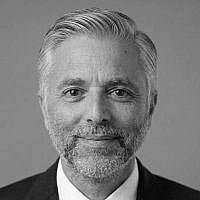
On January 27, International Holocaust Remembrance Day, Dr. Arūnas Bubnys, Director General of the Lithuanian Genocide and Resistance Research Center (LGGRTC), stood at the Tuskulėnai Memorial and spoke about the Holocaust.
This was not remembrance.
It was Holocaust denial enacted as state ceremony.
Tuskulėnai is not a neutral site of mourning. It is a state-administered memorial that deliberately collapses perpetrators and victims into a single undifferentiated category of “repression victims.” Among those buried and memorialized are Nazi collaborators and Holocaust perpetrators, whose identities and actions are systematically suppressed in order to preserve a sanitized national narrative. The erasure is intentional. The function is laundering.
To speak about Jewish victims from a podium erected over the memorialized remains of their killers is not commemoration. It is Holocaust inversion: the forced moral equivalence of murderer and murdered, enacted in stone, ritual, and speech.
This is not symbolic harm. It is coercive harm.
Jews are compelled—by state action—to witness their dead folded into a narrative that strips agency from the crime and dignity from its victims. The murdered are posthumously conscripted into a false story of shared suffering with those who helped murder them. That is not memory. It is posthumous coercion.
For the Director General of LGGRTC to perform Holocaust regret at such a site is not merely hypocritical. It is institutional memory laundering performed in public.
LGGRTC’s record is settled. For decades, it has engaged in denial through omission, minimization through euphemism, inversion through Genocide Equalization, distortion through selective archival standards, and revision through administrative certification of Holocaust perpetrators as “anti-Soviet heroes.” This conduct persisted after notice. It persisted through litigation. It persists today. Bubnys did not interrupt this system. He inherited it, preserved it, and now embodies it.
Against that record, his appearance on Holocaust Remembrance Day was not an error of judgment. It was a state act of deception.
The abuse of the day itself matters. International Holocaust Remembrance Day is governed by explicit norms established by the United Nations and the International Holocaust Remembrance Alliance. Its purpose is not generic mourning. It is the preservation of historical truth, responsibility, and victim dignity. Using that day to launder perpetrators through ceremony is not misuse. It is defilement of the day’s legal and moral purpose.
The choice of topic compounds the offense. Bubnys spoke about the Wannsee Conference—German coordination of genocide—while standing at a site designed to avoid confronting Lithuanian implementation, Lithuanian participation, and Lithuanian postwar protection of perpetrators. This maneuver is familiar: externalize the crime, sanitize the local record, then perform regret for the victims while preserving the structure that erased them.
This is denial with better staging.
Holocaust denial does not require denying the murders. It often works by dissolving agency, neutralizing responsibility, and laundering perpetrators into martyrdom. Tuskulėnai is a physical embodiment of that method. LGGRTC administers it. Bubnys used it.
This was not a private act. Bubnys spoke as a state official, at a state memorial, in an event featuring senior government representatives. The responsibility therefore lies not only with him, but with the Lithuanian state that authorized, staged, and normalized this inversion.
The President of Lithuania should immediately dismiss Arūnas Bubnys. No official who presides over Holocaust distortion—and then performs remembrance from a perpetrator-laundering site—can credibly hold authority over historical memory.
Beyond dismissal, the Jewish people are owed a formal apology by the Lithuanian government: for the use of Holocaust Remembrance Day to invert memory, for the continued memorialization of perpetrators as victims, and for allowing an institution with a documented record of fraud to masquerade as a moral authority.
Finally, Yad Vashem must intervene.
Yad Vashem is not a bystander. It is the world’s central institutional authority on Holocaust memory and distortion. Silence in the face of state-performed Holocaust inversion would be read as acquiescence. This case demands action: public condemnation of perpetrator co-memorialization, a demand for a state apology, and suspension of institutional cooperation with LGGRTC until corrective measures are taken.
Remembrance without reckoning is not remembrance.
It is denial.
And when denial is enacted by the state—on Holocaust Remembrance Day, from a memorial that launders murderers—it becomes an assault on Jewish dignity, historical truth, and the dead themselves.
Silence in the face of this is complicity.
Footnotes / Sources
- Lithuanian Genocide and Resistance Research Center – Tuskulėnai Memorial administration and narrative framing
https://www.genocid.lt/Tuskulenai/en/447/c/ - Tuskulėnai Memorial official presentation of those buried as undifferentiated “victims”
https://www.tuskulenumemorialas.lt/en/about-us/tuskulenu-aukos/ - International Holocaust Remembrance Alliance – Holocaust distortion and inversion definitions
https://holocaustremembrance.com/resources/working-definition-holocaust-distortion-and-denial - United Nations General Assembly Resolution 60/7 (International Holocaust Remembrance Day mandate)
https://www.un.org/en/holocaustremembrance