Journalist
Featured Post
Holocaust distortion disguised as activism
The outline of Gaza around a well-known concentration camp number promotes an historically false and morally bankrupt analogy
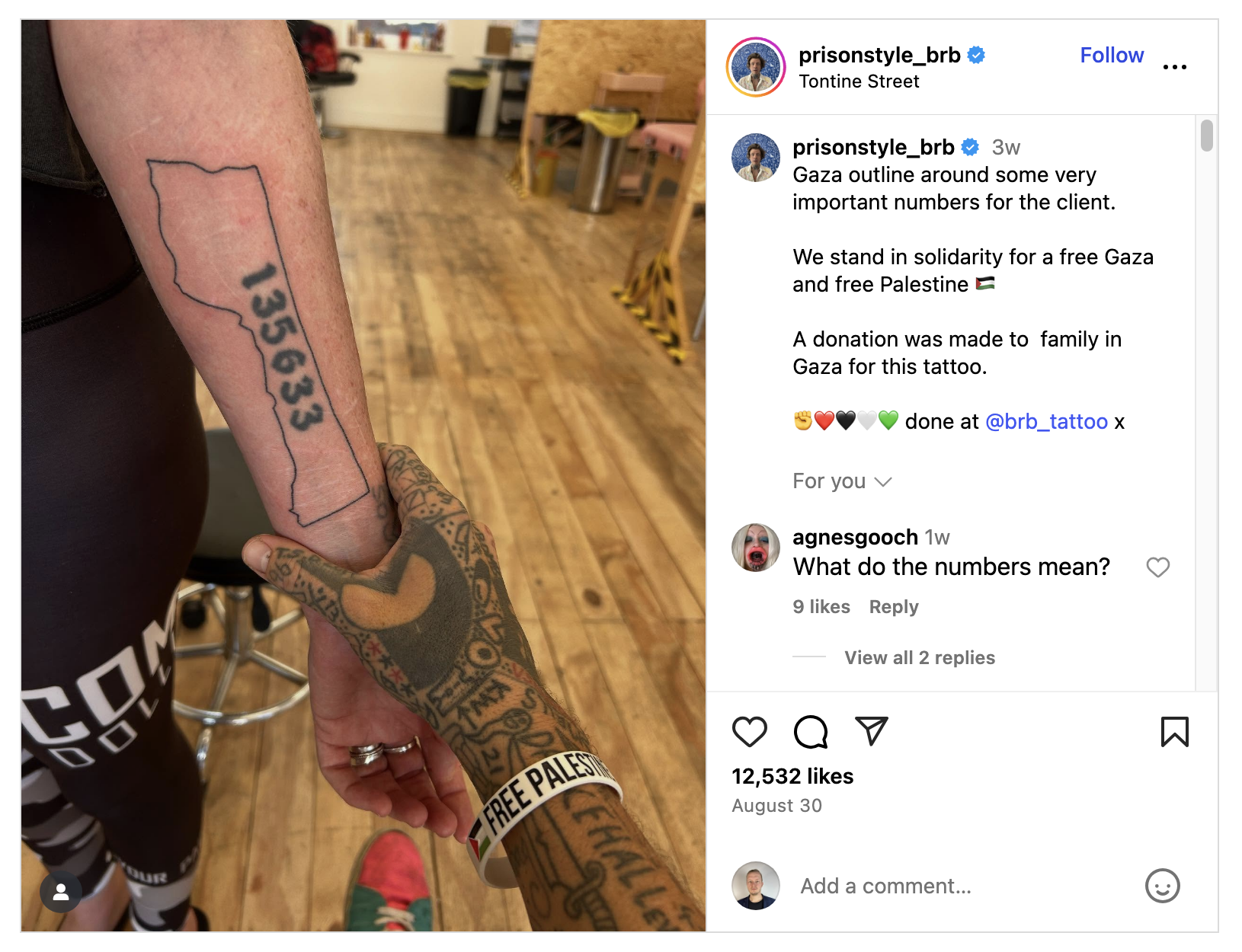
Photo: A Screenshot - Instagram (prisonstyle_brb)
There are moments when you stumble upon an image on social media that shakes you to your core, not because of its artistry, not because of its daring, but because of its brazenness. This week, I came across such an image: the outline of Gaza, tattooed on an arm, with the number 135633 carved inside.
To the casual observer, it may look like another piece of activist ink. But anyone who knows Jewish history recognizes the number instantly. 135633 was the Auschwitz tattoo of Yehiel De-Nur, the Holocaust survivor who became known to the world under the pen name Ka-Tzetnik 135633. His searing books chronicled the inferno of Auschwitz with a raw honesty that testified to the depths of human evil.
Yehiel carried that number not as a symbol of identity, but as a scar of dehumanization. The Nazis stripped him of his name and gave him digits burned into flesh. To see that number repurposed today, inserted into the outline of Gaza, is nothing less than an act of Holocaust distortion.
Gaza is not Auschwitz. Auschwitz was the epicenter of industrialized genocide, where Jews were hunted, starved, gassed, and cremated by the millions. To equate the two is not only historically obscene, but it is a deliberate weaponization of Jewish trauma to delegitimize Israel.
The International Holocaust Remembrance Alliance (IHRA) defines Holocaust distortion as any attempt to trivialize or misappropriate the Holocaust for political purposes. This tattoo is the very embodiment of that distortion. It takes the sacred memory of Jewish suffering and twists it into a propaganda tool, placing Hamas-controlled Gaza in the role of Auschwitz’s victims and casting Israel as Nazi Germany.
Such imagery is not an accident. It is a strategy. By stealing Auschwitz symbols, activists seek to collapse the moral distinction between a genocidal regime and a defensive democracy. They aim to strip Jews of their history, their uniqueness, their grief, and to turn the ultimate atrocity against the Jewish state.
It is theft. It is a desecration of memory. It is an assault on the truth.
Yehiel De-Nur once fainted during his testimony at the Eichmann trial in Jerusalem. He collapsed not from weakness but from the unbearable weight of memory. To think that his number, 135633, is now being displayed as activist body art in solidarity with Gaza is a desecration beyond words.
Holocaust survivors are fading from living memory. Soon only the numbers will remain, etched on arms, engraved in photographs, written in archives. To see those numbers hijacked, stripped of their Jewish essence, and redeployed against Israel is a chilling warning of where antisemitism now resides: cloaked in the language of “activism,” draped in slogans of “freedom,” yet dripping with old hatred.
We cannot allow this distortion to go unanswered. To equate Gaza with Auschwitz is not only historically false, it is morally bankrupt. It denies the singular horror of the Holocaust and turns Jewish suffering into a weapon against the very people who survived it.
When I saw that tattoo, I did not see art. I saw desecration. I saw the theft of memory. And I saw the ugly truth of today’s antisemitism: it no longer needs to wear swastikas.
Related Topics
Related Posts