CEO of Time to Stand Up for Israel
Honestly, Does Israel Have a Future? Part 2
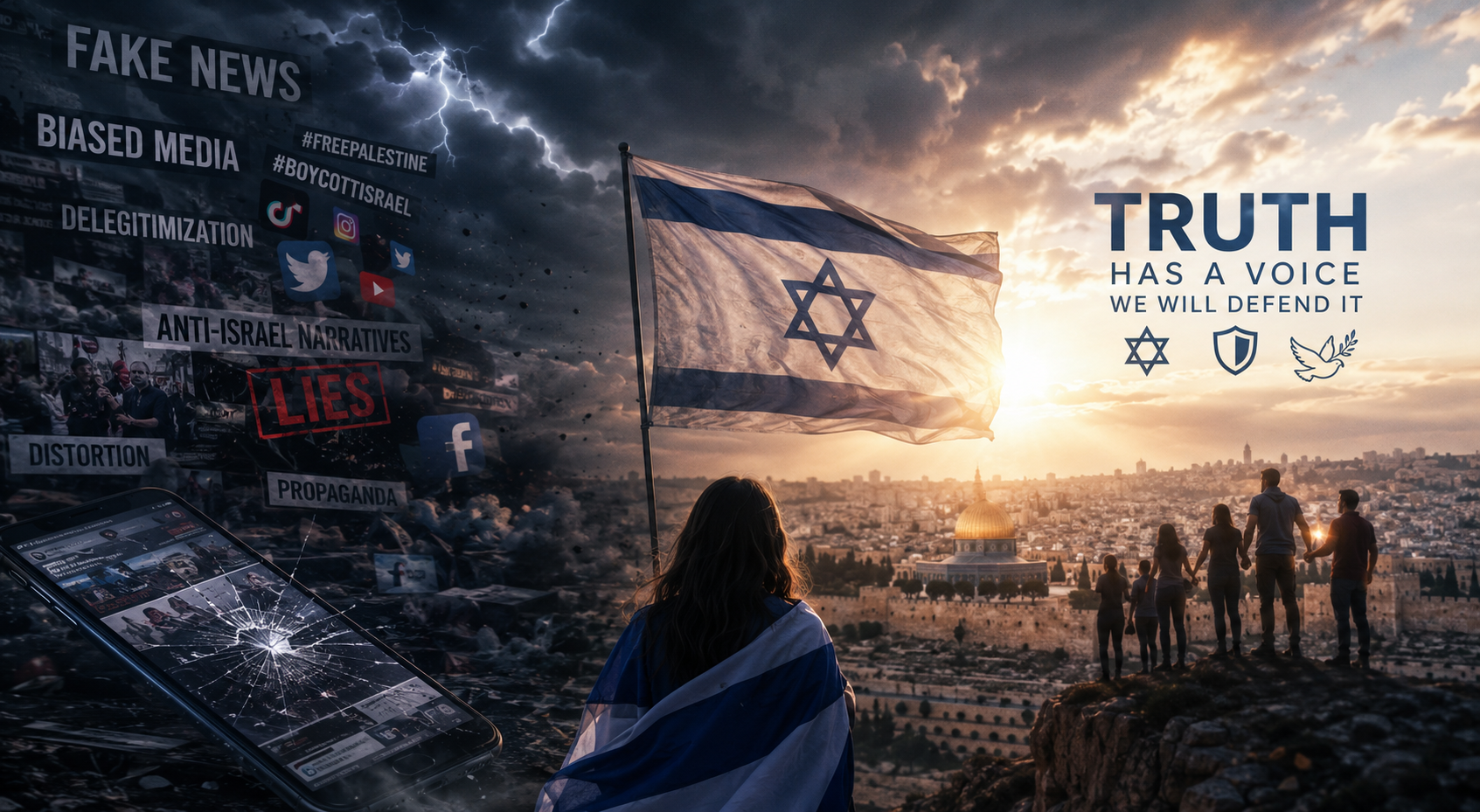
Photo Credits: Sabine Sterk(AI)
The battlefield has changed. Tanks, fighter jets, intelligence operations, and missile defense systems remain essential, but they are no longer enough. The twenty-first century is also fought through words, headlines, hashtags, videos, and narratives. It is fought on social media, in international newsrooms, and in the minds of billions of people.
In my previous article, I argued that the Israeli government still does not take the information war seriously enough. I continue to believe that this may become one of Israel’s greatest strategic mistakes.
There is a mindset that I encounter repeatedly. People say that Israel has always stood alone. They say that Israel has always defeated its enemies. Others simply say that God is on Israel’s side, so everything will be fine.
I understand where this confidence comes from. Israel has repeatedly survived against overwhelming odds. The Jewish people have endured persecution, exile, terrorism, and war, yet they are still here.
History deserves respect. However, history should never become an excuse for complacency.
The world has changed. Israel is no longer fighting only conventional wars. It is fighting an international campaign that seeks to delegitimize its very existence. Every misleading headline, every manipulated video, every false accusation, and every distorted historical claim becomes another weapon.
Ignoring this reality is dangerous.
One area that deeply concerns me is the language used by some of Israel’s own media.
I read both the Jerusalem Post and the Times of Israel. Although they publish valuable journalism, I believe they reinforce narratives that work against Israel’s long-term interests.
Language matters.
When Jewish communities in Judea and Samaria are consistently described as “settlements” while Arab communities are simply called towns or cities, an imbalance is created. Words shape perception. Repetition turns opinion into assumed fact.
The same applies to geographical terminology.
Many supporters of Israel prefer the historical and biblical name Judea and Samaria instead of the term “West Bank”, arguing that the latter became widespread after Jordan controlled the territory from 1948 until 1967. Likewise, some object to the unqualified use of the term “Palestinian” because they believe it carries political implications regarding statehood. Others use the term simply because it is the most widely recognized description for the Arab population of the area. Regardless of where one stands, it is undeniable that language influences how international audiences understand the conflict.
As a blogger for the Times of Israel, I have noticed something that annoyed me to the core. When selecting article tags, there is a predefined tag for “West Bank”, yet no equivalent tag for Judea and Samaria. It may appear to be a small detail, but small details have significant symbolic value.
Another issue concerns editorial emphasis.
In my opinion, articles that are highly critical of Zionism or of Israeli government policy often receive considerable visibility, while strongly Zionist perspectives receive less prominence. Editorial choices naturally differ from publication to publication, and reasonable people may disagree about whether this reflects bias. Still, it is fair to ask whether media organizations should examine how consistently they represent the full spectrum of pro-Israel viewpoints.
Comment moderation also raises questions.
Online discussions can quickly become toxic. Every platform has the responsibility to enforce clear rules against hate speech and abuse. Those rules should be applied consistently, regardless of whom they target. Fair moderation strengthens credibility. Uneven moderation weakens it.
Israel was right to ban Al Jazeera after concluding that it posed serious national security concerns. That was a decision made by the Israeli government based on its own assessment of the risks.
At the same time, vigorous debate inside Israel is one of the country’s defining democratic strengths. Newspapers such as Haaretz publish views that many Israelis strongly oppose. A lot of those publications damage Israel internationally. Some argue that a free press, including harsh criticism of the government, demonstrates the resilience of Israeli democracy.
In times of war, however, relentless internal criticism can become a liability that damages Israel’s standing in the eyes of the world. The real challenge is finding the right balance between safeguarding national interests and preserving freedom of expression. But when Haaretz consistently publishes content that, in this view, harms Israel’s own interests during wartime, it raises the question of whether it should continue to be treated differently from media outlets such as Al Jazeera
The debate should not be avoided. It should be confronted honestly.
The same honesty is needed within the pro-Israel community itself.
Several months ago, I found myself under fierce criticism from another advocate who accused me of being antisemitic because I used the word “Palestinian” in my writing.
The accusation was completely misplaced.
Whenever I write the words “Palestine” or “Palestinian”, I intentionally place them in quotation marks because I want to distinguish my own perspective from terminology that I believe is politically contested. At the same time, I recognize that many readers around the world are unfamiliar with the complexities of the region. If I refer only to Arabs, people may not understand which community I am discussing, especially since there are hundreds of millions of Arabs across numerous countries.
Clear communication matters.
That is why I often write Judea and Samaria, also known internationally as the “West Bank”. My goal is to educate rather than confuse.
Within the pro-Israel movement, we should spend less time attacking one another and more time confronting misinformation. Internal disagreements are inevitable, but they should never distract us from the larger challenge.
I sincerely hope that Israeli children continue to learn the deep historical connection of the Jewish people to Judea and Samaria. I hope they understand why many Israelis reject the label “settlers” and instead see these residents as citizens living in areas central to Jewish history.
Most of all, I hope there will be a genuine wake-up call.
I hope government ministries recognize that the information war deserves the same seriousness as military preparedness.
I hope news organizations carefully consider the power of language.
I hope diplomats understand that narratives influence international policy.
I hope supporters of Israel learn to work together instead of dividing themselves over differences in wording while hostile propaganda continues to spread.
I am only one woman living in the Netherlands.
I am far away from Israel.
Yet sometimes distance offers a different perspective.
From here, I see dark clouds gathering over Israel, not only on the battlefield but across television screens, newspapers, universities, and social media platforms around the world.
Israel has always been a light in a difficult region.
That light deserves to be protected not only by soldiers defending its borders but also by people willing to defend the truth.
The time for complacency has passed.
The time for action is now.
Am Yisrael Chai.
Related Topics
Related Posts