Former Jewish Prison Chaplain / Co-Founder: L’chaim
Honoring Victims Without Killing: The Tree of Life and Israel’s Death Penalty
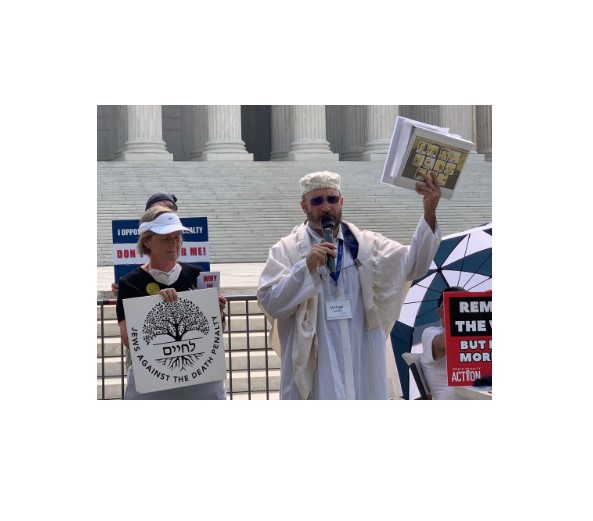
Image: The group L’chaim! Jews Against the Death Penalty protests at the Annual Fast and Vigil to Abolish the Death Penalty on June 29th, 2023, with the traditional Jewish memorial prayer - Eil Malei Rachamim - for the eleven Tree of Life Synagogue shooting martyrs, z’l, of blessed memory, whose pictures Cantor Michael Zoosman holds aloft while chanting the prayer. No copyright.
Joyce Fienberg (Idit Balt’chah bat Abba Menachem), Z’L, 75
Richard Gottfried (Yosef ben Chaim), Z’L, 65
Rose Mallinger (Rayzel bat Avraham), Z’L, 97
Jerry Rabinowitz (Yehuda ben Yehezkel v’Selma), Z’L, 66
Cecil Rosenthal (Sisel Chaim ben Eliezer), Z’L, 59
David Rosenthal (David ben Eliezer), Z’L, 54
Bernice Simon (Bayla Rachel bat Moshe), Z’L, 84
Sylvan Simon (Zalman Schachna ben Menachem Mendel), Z’L, 86
Daniel Stein (Daniel Avraham ben Baruch), Z’L, 71
Melvin Wax (Melvin Gadol ben Yosef), Z’L, 88
Irving Younger (Yitzchak Chaim ben Menachem), Z’L, 69
These are the English and Hebrew names of the eleven martyrs of the Pittsburgh Tree of Life Synagogue synagogue shooting of October 27, 2018. Many of the more than 4,200 members of “L’chaim! Jews Against the Death Penalty,” of which this author is a co-founder, were fervently involved in a national campaign to mobilize the Jewish world against the death sentence that the United States Department of Justice ultimately handed down in August of 2023 to shooter Robert Bowers. L’chaim will continue this advocacy during Bowers’ appeals process, which his legal team has already initiated. Lessons from this prodigious effort apply more than ever now for many L’chaim members and millions of others in Israel and across the globe who stand united against National Justice Minister Ben-Gvir’s proposed death penalty for convicted terrorists, including the perpetrators of the October 7th, 2023, mass murder in Israel. Foremost among these lessons is that a civilized society can indeed honor victims without more killings.
The Jewish world changed forever with the monstrous Hamas terrorist attack of Oct. 7, 2013. The unjustifiable terror unleashed on that day – born of Hamas’ foundational mandate to destroy Israel –undoubtedly was an act of unmitigated horror. In what constituted the worst assault on the Jewish people since the Holocaust, Hamas terrorists murdered 1,195 Israelis and foreign nationals, including 815 civilians, and captured 251 hostages, many of whom eventually died in unfathomable, grotesque conditions in tunnels underneath Gaza.
This unmitigated atrocity and hostage crisis led to a redoubling of L’chaim’s mission to uplift the Jewish value of life. In the immediate months following October 7th, L’chaim marched for the safe return of the hostages, carrying posters emphasizing Judaism’s central tenet of reverence for all life. This action reflected L’chaim’s life-affirming approach to protesting every execution that takes place in the United States. For each state killing event, L’chaim members gather to recite traditional mourning prayers for the victims of the crimes that led to the death sentence being meted out, offering kavanot/prayerful intentions as well for their loved ones in mourning. Members then also chant prayers for the condemned men and women that the state is putting to death for those same crimes, creating new victims in the insane cycle of violence. In the case of the Pittsburgh synagogue shooting. L’chaim members followed this model by publicly intoning the Eil Malei Rachamim traditional Jewish memorial prayer for the eleven Tree of Life martyrs as part of an anti-death penalty protest at the US Supreme Court in Washington, DC.
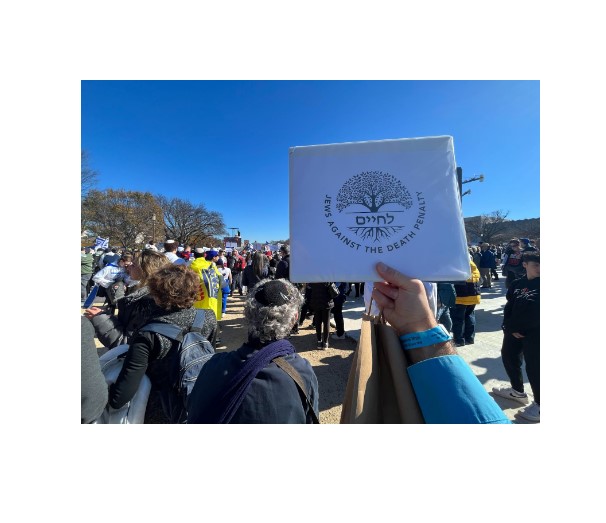
Image: A photo from the March for Israel on the National Mall in Washington, D.C. on November 14, 2023.
Guided by this foundational principle of affirming the value of life, L’chaim’s intentionally absolutist approach to capital punishment has always included convicted Hamas terrorists who perpetrated the October 7th attack. Members, therefore, deplore Israeli National Security Minister Itamar Ben Gvir’s recent moral regression of seeking to resurrect executions in the Jewish state, aiming to put to death those guilty of October 7th’s carnage and other terrorist acts. Doing so would only give ammunition for those who seek to equate the Netanyahu regime with the terrorism of Hamas, whose members continue to employ executions regularly across Gaza. The net result of such a policy would be to increase already rising incidents of antisemitic violence across the world. Far from “deterring” would-be terrorists, the threat of a death penalty would only incite and invite further shaheeds seeking martyrdom.
Just as L’chaim members never deign to speak for the eleven Tree of Life victims while advocating against the death penalty for Pittsburgh synagogue shooter Robert Bowers, so, too, they would never attempt to do so for victims of the unimaginable terror that Hamas perpetrated on October 7th. As a chaplain, I regularly counsel mourners that, when they grieve, they should allow themselves to experience the full range of human emotions, including rage and, where applicable, the desire for vengeance. Let no one ever judge anyone in such a position. If I myself were to lose a loved one to murder, I, too, might find myself advocating for the death of my loved one’s killer. A civilized society has a responsibility to protect and honor all such mourners, while also upholding the fundamental human rights upon which the world stands. Most basic to these liberties is the right to life. This mandate is one of the reasons why more than 70% of the world’s nations have abolished the death penalty in law or in practice.
Israel would do well now to follow the example of the inspiring Jewish community in Pittsburgh, Pennsylvania. In a profound example of that group’s unflagging steel resolve, it hosted a life-affirming parade to celebrate the dedication of a new Torah – known also as an Eitz Chayim (”Tree of Life”) – in loving memory of Joyce Fienberg, Z’L, one of the eleven Tree of Life martyrs, and her late husband, Dr. Steven Fienberg, Z’L. That sacred gathering brought new life to the exhortation that has motivated Jewish people for millennia: “Am Yisrael Chai” – “The People of Israel Live!” To this profound demonstration of the very best of Jewish values and resilience, the resounding response of the thousands of members of L’chaim was—and remains—to chant “L’chaim – to Life!”
To honor the victims of the 2018 Pittsburgh synagogue attack, L’chaim provides annual donations to the Cecil and David Rosenthal Memorial Fund, created in memory of the eponymous brothers who were Tree of Life victims. L’chaim also created a new logo featuring the Eitz Chayim – Tree of Life – itself. That image serves as a reminder of L’chaim’s mission to extend the symbolic ethical roots of that tree of collective wisdom and morality to all human beings who are at risk of state killing, including now the perpetrators of the murderous October 7th antisemitic attack of terror. Indeed, it calls upon the world to reaffirm the sanctity of life,
A longstanding anti-death penalty slogan asks: “Why do we kill people who kill people to show that killing people is wrong?” This paradoxical question has plagued the human condition since time immemorial, during periods of both war and peace. In response, L’chaim stands with rabbinic sages like Rabbis Tarfon, Akiva, and Maimonides, and modern Jewish human rights and philosophy icons Elie Wiesel and Martin Buber – along with countless historical and contemporary voices of reason – in disavowing the penalty of death “in all forms,” replacing these avenues of killing with the proverbial Tree of Life. Jewish liturgy often highlights and reiterates the exclamation of the author of the Book of Proverbs that “she is a Tree of Life to those who grasp her.” (3: 18) May humanity, for the sake of its survival, choose never to let go of that tree’s branches, and may the members of the Knesset firmly grasp hold of it now as they vote with a resounding “no” to Israel’s bill of death.
Cantor Michael Zoosman, MSM, Board Certified Chaplain, Neshama: Association of Jewish Chaplains
Co-Founder: “L’chaim: Jews Against the Death Penalty”
Advisory Board Member: Death Penalty Action
Related Topics
Related Posts