Former Jewish Prison Chaplain / Co-Founder: L’chaim
The Futility of Invoking Nuremberg and Eichmann for Israel’s Death Penalty Bill
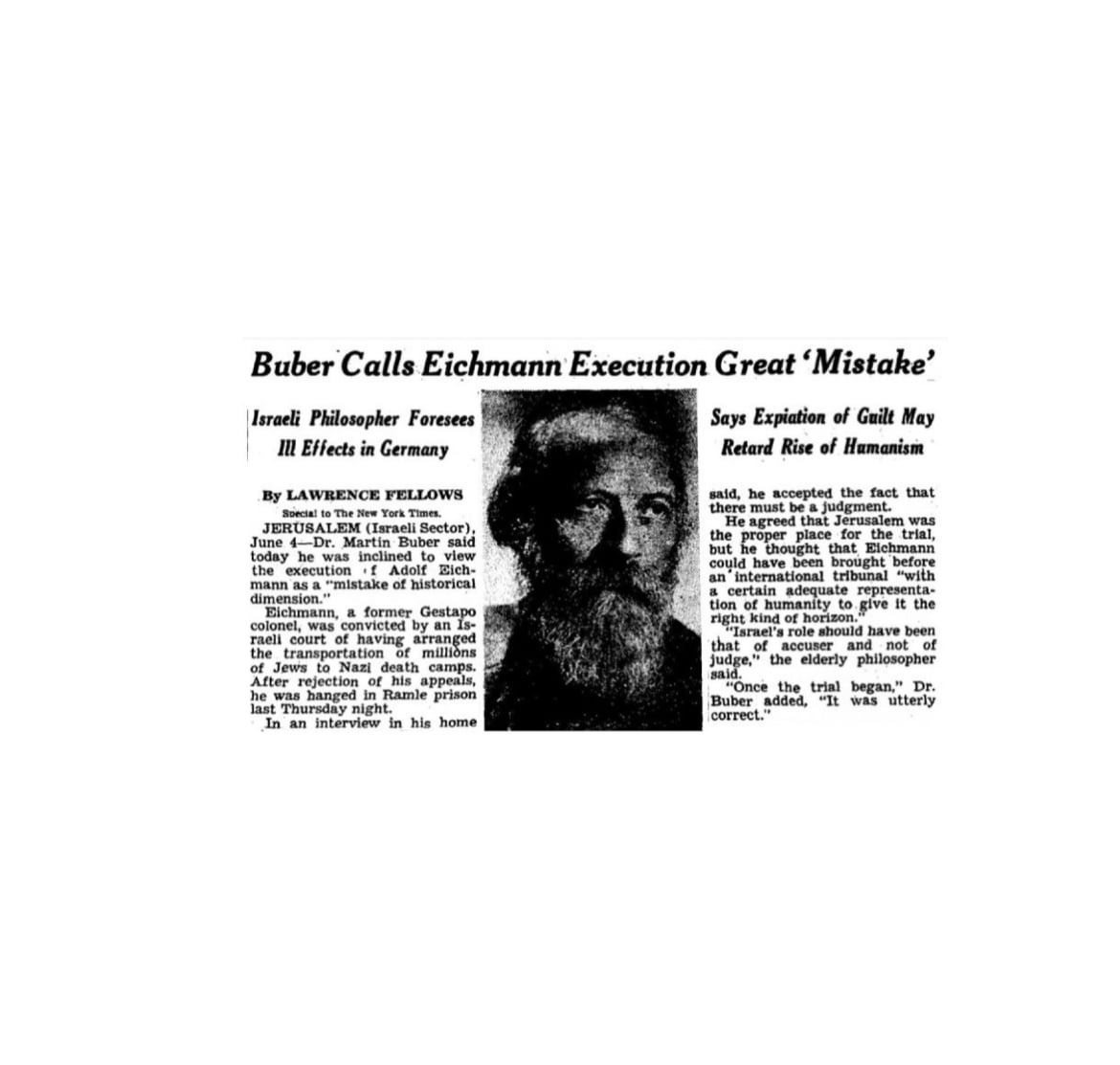
Caption: Headline of the June 5, 1962, New York Times article about Martin Buber’s objections to the execution of Nazi perpetrator Adolph Eichmann.
“What about Nuremberg and Eichmann?”
In the shadow of the Shoah, many death penalty debates in Jewish circles eventually arrive at this question. The thousands of members of “L’chaim! Jews Against the Death Penalty,” – of which this former Jewish prison chaplain is a co-founder – often encounter individuals who cite these two cases as evidence that there are indeed times when the death penalty is an appropriate response to monstrous actions. Now, as National Security Minister Itamar Ben-Gvir’s death penalty bill for convicted terrorists makes its rounds in the Knesset, many conversations throughout Israel and the Jewish world ultimately conjure these potent memories. Death penalty debates for perpetrators of the October 7, 2023, massacre – the deadliest attack on the Jewish people since the Holocaust – naturally strike this nerve, triggering individual, collective, and intergenerational trauma.
The dialogue between death penalty bill proponents and detractors usually begins with supporters parroting the debunked myth of deterrence – that killing captured Hamas terrorists will save Israeli lives. This, of course, is patently false. Opponents of the bill respond to this lie by citing one of the manifold studies that proliferate disproving the deterrence fallacy, adding that executing convicted terrorists would only create more shaheeds (“martyrs”) among Israel’s enemies. Death penalty advocates often brush aside these facts. There are, however, those who can acknowledge this reality. Those individuals inevitably then pose the fateful question: “But what about Nuremberg and Eichmann?”
“Nuremberg” refers to the main Nuremberg Trial (International Military Tribunal), where death sentences led to the hangings of 10 high-ranking Nazis on October 16, 1946, with another scheduled (Hermann Göring) committing suicide. While the court sentenced 12 to death in total, Göring avoided execution, and the tribunal tried Martin Bormann in absentia, enabling him to escape hanging. The second reference is to Israel’s 1962 hanging of Nazi officer Otto Adolf Eichmann for his role as one of the primary architects of the Final Solution. Hannah Arendt covered Eichmann’s trial, during which she famously employed the term “the banality of evil” to describe Eichmann. Proponents of Israel’s death penalty bill today attempt to justify their position by equating perpetrators of the October 7, 2023, massacre with Eichmann and the Nazi mass murderers sentenced to death at Nuremberg. If we could rationalize it for the Third Reich, they argue, surely we can do so for Hamas terrorists, as well. The implication is that such “evil” demands execution, and – perhaps more on point – that there are instances when revenge through state killing is entirely appropriate.
For many L’chaim members like myself whose family members were Holocaust victims, this argument strikes a chord. Indeed, it is the very example of the Holocaust that undergirds much of the L’chaim members’ passion for death penalty abolition. I personally know how difficult it is to transcend the overwhelming longing for violent retaliation. I grew up as an ardent supporter of the death penalty, gripped in the spell of the same vengeful bloodlust that has plagued so many of my species. I therefore strive never to judge others who harbor such feelings, especially not when horrific antisemitic acts of terror, such as the mass murder and violence of October 7th, have victimized them. I hope that a brief review here of my own transformation over time might demonstrate the futility of invoking Nuremberg and Eichmann in the death penalty debate. Instead, I pray that it might help lead to a reexamining of beliefs about vengeful, retributive killings.
The Shadow of the Holocaust and a Jewish Prison Chaplain’s Change of Heart on the Death Penalty
My change of heart regarding capital punishment took place over three decades, and it both began and ended with the Holocaust. Many of my childhood Passover Seders and Jewish/secular holiday gatherings were punctuated by my grandmother and her sister, of blessed memories, sharing details of their harrowing Shoah experiences. Their survival, and by extension, my very existence, would not have been possible without the martyrdom of Mr. Michał Cegielski, a Polish Catholic man who hid them and other members of my family on his farm at the risk of death – a penalty he ultimately received. (My family and I attempted for decades to locate Mr. Cegielski’s whole identity, and now he is rightfully honored in the Garden of the Righteous Among the Nations in Yad Vashem, the Holocaust Museum in Israel.)
During my formative years, I believed firmly that anyone who had tormented and murdered my family members, or, for that matter, Mr. Cegielski, deserved to suffer and die. At times, I even felt that I would be prepared to tear them apart with my own bare hands – as painfully as possible – for what they did to my family and my people. The anger that intergenerational trauma had birthed decades before I entered the world was still palpable and powerful, instilling in my heart a nearly murderous rage. This feeling logically extended in my mind to any human being who committed such heinous acts as murder, and I imagined that many other family members of victims felt the same way I did. As I saw it, the Torah clearly endorsed my feelings with its famous declaration of “ayin takha ayin” – “an eye for an eye.” (Lev. 24: 19-21).
Not until my years of service as a Jewish prison chaplain in Canada did I seriously begin to explore the issue of state killings. I had sought out this unique pastoral care work after spending years visiting my former college roommate and friend, “Levi,” when he was incarcerated at Sing Sing and other notorious prisons across New York state. Previously, while in university with me, Levi had experienced a psychotic break, causing him to assault and nearly kill his mother violently. My visits with Levi over the years made me realize the need for spiritual support for the incarcerated, and exposed me for the first time to others in prisons who had indeed taken human lives.
In my newfound role as a prison chaplain in Canada, which had abolished the death penalty decades prior, I began to witness firsthand many profound examples of transformation in individuals whose vicious crimes might have qualified them for execution in the United States. I became well-acquainted with these men and women, who emerged not as monstrous and unfeeling murderers and rapists, but rather as complex human beings, not so different from my friend Levi – or even from myself. Among them were individuals who, after years of incarceration, showed sincere contrition, offered heartfelt apologies, and demonstrated fundamental behavioral change – a phenomenon that Judaism describes as teshuvah (repentance). Were these really the sort of people I previously envisioned tearing asunder as a righteous avenger?
These experiences created within my heart new conflicting feelings about capital punishment. They finally inspired me to take the time to learn the traditional Jewish understanding of the Biblical “eye for an eye.” I was shocked to discover that, in rabbinic parlance, this phrase referred to financial compensation for the value of those eyes. I learned that in its historical context, this lex talionis was intended to curtail, rather than augment, the collective bloodlust of expansive vengeful massacres that societies practiced in response to killings in ancient times – and still all too often today.
I also discovered the prodigious safeguards that rabbinic Judaism built into Jewish law to make the death penalty virtually impossible to carry out, lest an innocent person be executed. Simultaneously, I watched the televised saga of the execution of Troy Davis as it unfolded in Georgia in 2011, when the reality of the state killing of an innocent human being was laid bare before my eyes. The clarion call of the medieval sage Maimonides, who asserted that “it is better to acquit a thousand guilty persons than to put a single innocent one to death,” began to reverberate in my soul. What, I rhetorically asked, would Maimonides make of the fact that – well before Eichmann – Israel had already failed this rabbinical barometer with the 1948 execution of innocent Israeli Defense Force officer Meir Tobianski, whom the Jewish State hanged and posthumously exonerated? I came to understand as well that the death penalty was racist in its origin and application, and that the notion of capital punishment as deterrence to any would-be murderers, which was a primary justification for keeping it at all in Talmudic parlance, had been disproven time and again.
Nazi Legacies and Abolition Without Exception
Still, some doubts lingered in my mind. What about the so-called “worst of the worst,” such as the Nazis and Hitler’s willing executioners, who had committed deadly acts of terror and killed members of my own family? Paradoxically, it took the shadow of the Holocaust itself to cast off my final misgivings for the light of abolition. In my ongoing study of capital punishment, I discovered to my horror that lethal injection – the primary form of execution used in the US – was a direct Nazi legacy. The Third Reich first implemented this execution method as part of their infamous Aktion T4 protocol, using lethal injection to kill people deemed “unworthy of life.” Adolf Hitler’s personal physician, Dr. Karl Brandt, developed that protocol. I was appalled to learn that the kind of murderous hate that compelled the Nazis to inaugurate lethal injection in this world had overtaken my own spirit in my advocacy for death. The bloodlust that filled my heart effectively blinded me to the unconscionable Nazi legacy that I was unwittingly supporting. In this way, I had become living proof of Gandhi’s famous warning: “an eye for an eye makes the whole world blind.” If this were not enough, I soon witnessed American states gassing prisoners to death with gas masks and chambers, with at least one state planning the use of Zyklon B, of Auschwitz infamy, to kill defenseless inmates against their will.
The long list of celebrated Jewish death penalty abolitionists includes many who lived during the Holocaust. Survivor and Nobel laureate Elie Wiesel and philosopher Martin Buber both grasped the danger of giving the state the power to kill its prisoners long before I was born. As Wiesel professed: “death should never be the answer in a civilized society.” Wiesel even referred to Israel’s highly controversial 1962 execution of Eichmann as “an example not to be followed,” while Buber called it a great “mistake.” Other Holocaust survivors themselves, such as Nobel-prize-winning author Nelly Sachs, voiced strident opposition to Eichmann’s execution. Among the many notables who asked Israeli Prime Minister David Ben-Gurion for Eichmann’s clemency were Samuel Hugo Bergmann, Nathan Rotenstreich, the poet Leah Goldberg, and members of the Department of Philosophy at the Hebrew University.
Realizing that these and other Jewish and non-Jewish human rights luminaries were fully aligned with the death penalty abolition cause made my change of heart complete. The Holocaust had morphed from one of my most significant rationalizations for the death penalty to one of the most critical reasons, as I saw it, to stand against state-sponsored murder in every single case, including for the Tree of Life synagogue shooter in recent years, and now for the perpetrators of the barbaric October 7, 2023 act of antisemitic terror and mass murder.
Principles Over Vengeance: The Example of Robert Badinter
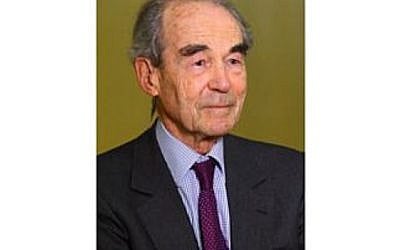
Image: French Minister of Justice Robert Badinter (1928-2024) in 2013 (Wikipedia)
Members of L’chaim and I continue to be galvanized by lofty examples of Jewish death penalty abolitionists born from the embers of the Holocaust as we chant “Never Again!” to state-sponsored murder. One such eminent figure who rightfully received global attention upon his passing in 2024 was the former French Minister of Justice, Robert Badinter, of blessed memory. The Holocaust experience of Badinter’s family was punctuated by the unfathomable murder of his father, Simon Badinter, in the Sobibor concentration camp in 1943. Emboldened by this killing and the lessons of the unparalleled conflagration of the Shoah, Badinter went on in his illustrious legal and political career to successfully advocate for the ultimate abolition of the death penalty in France in 1981. A tribute celebrating his accomplishments poignantly described that when Badinter was confronted with Klaus Barbie, the Nazi who had arrested and sent his father to his death, he proudly “stood by his opposition to the death penalty and did not wish nor seek to have his father’s killer executed. He thereby demonstrated a rare willingness to place principle over the powerful personal desire to avenge the brutal death of a beloved parent.” Badinter’s laudable attitude was reminiscent of the late Eva Mozes Kor, founder of the Candles Holocaust Museum in Terre Haute, Indiana, and champion of Holocaust education and the power of forgiveness.
Like Badinter, Kor, and countless family members of murder victims, I, too, have managed in my own way over time to overcome the bloodlust that had been growing like a cancer within me since before my birth. As a result, I firmly believe that others can do the same. People are capable of change, including those who have vengeance deeply rooted in their hearts, as I once did. As the Knesset decides the fate of convicted October 7th terrorists, the time is now for Israelis and Jews everywhere to unveil the trauma-laden, insidious revenge impulse that drives this death penalty bill, releasing it at last from behind its mask of false notions of deterrence. Only then will the cycle of violence and killing truly have a chance at ending. Only then can true restorative justice and reconciliation begin.
Cantor Michael J. Zoosman, MSM, BCC
Co-Founder: L’chaim! Jews Against the Death Penalty
Advisory Committee Member: Death Penalty Action
Related Topics
Related Posts