
Hormuz, Germany, drones and submarines
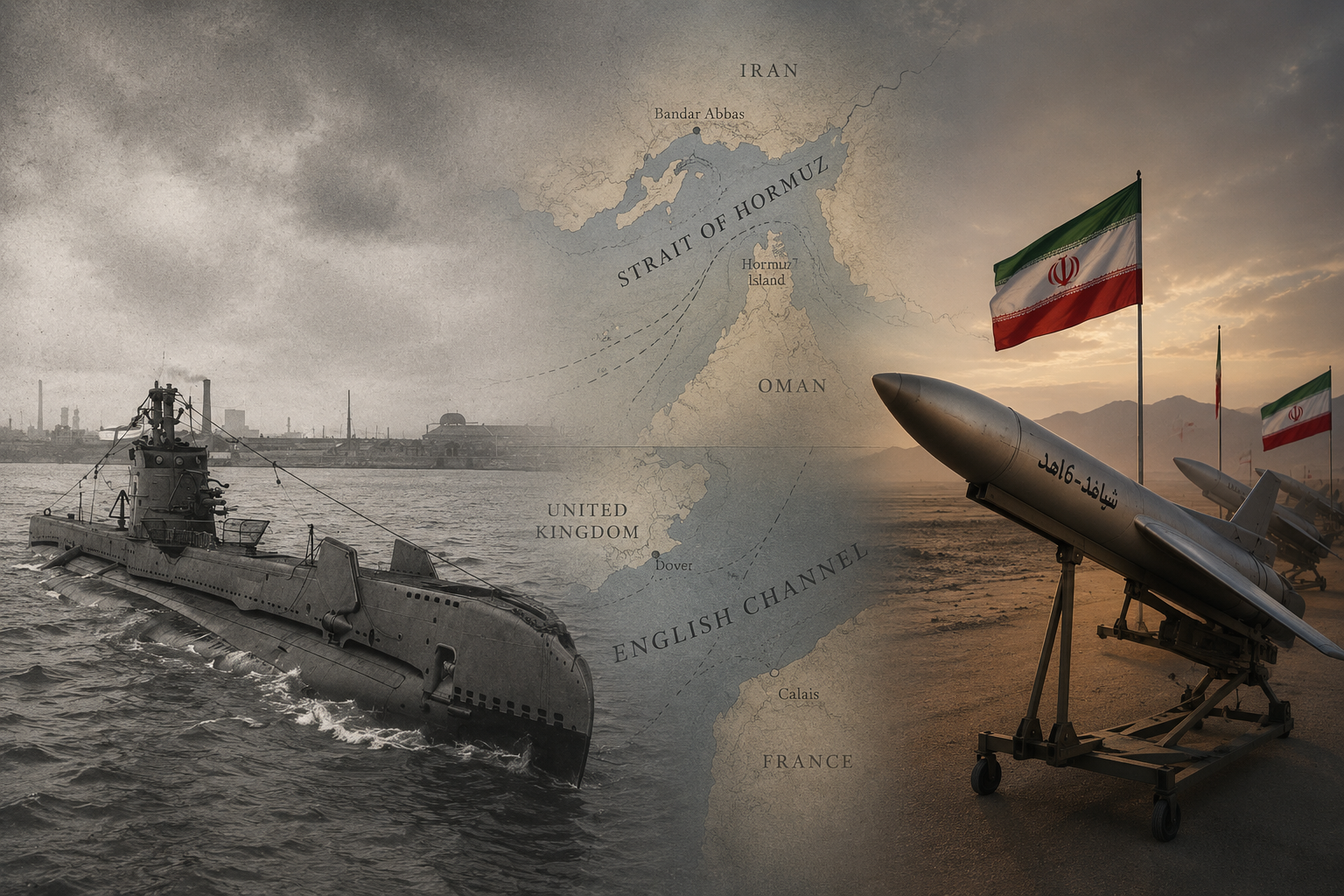
Abstract: The US Navy is without a doubt the strongest naval force humanity has ever seen. Yet it stands opposed by a third-rate military power that can still threaten one of the world’s most important maritime chokepoints and potentially hold the global economy hostage by dominating the waters off its own shores. How can a much weaker naval power deny passage to a vastly larger and stronger fleet? Is the US Navy weaker than we were led to believe? Is this a portent of things to come? It behooves us to remember that during the First World War the strongest navy the world had ever seen, Britain’s Royal Navy, still found itself strategically challenged by a much weaker Germany through submarines, mines, and asymmetric maritime warfare. Worse still, this challenge emerged not in some distant strait, but in Britain’s own backyard. The takeaway is not that we are witnessing a permanent shift in the naval balance of power, but that new technologies can temporarily weaken even the dominant military power of an era before strategic balance is eventually restored through new countermeasures.
Before WWI the idea that a weaker naval power could blockade the ports of a stronger rival was almost absurd. How would that even be possible, after all in order to deny passageway or be a significant threat one needs to at least have a tactical advantage in the balance of power. And while piraterie used to be an issue in the past by WWI that was no longer anything but an occasional nuisance. Nevertheless, Germany managed to sink a massive number of ships off the coast of Britain, at one point threatening to cut it off the supplies it required to run the war against the central powers. It did so while its pride and joy new Dreadnought class battleships almost never left its wharf in Kiel. How? With mines, and submarines. Were German submarines better or more numerous than British subs? No. They actually had fewer of them, and they were not as good as their allied counterparts. None of that mattered however, as Germany was able to use the temporary lack of submarine countermeasures to their advantage. Eventually, the introduction of convoy systems, improved anti-submarine tactics, and new detection technologies significantly reduced shipping losses. By the Second World War, German submarines once again posed a major threat during the Battle of the Atlantic, but advances in radar, sonar, air patrols, and codebreaking ultimately prevented them from achieving the same level of strategic surprise they had enjoyed earlier.
The Strait of Hormuz presents a modern version of the same phenomenon. Iran cannot defeat the United States Navy in a conventional naval war. It does not need to. What it can do is exploit temporary technological and geographic asymmetries in order to impose disproportionate economic and political costs. Cheap drones, naval mines, anti-ship missiles, swarm attacks, and coastal launch platforms allow a relatively weak regional power to threaten global shipping in one of the narrowest and most economically vital waterways on earth.
Current countermeasures exist, but many remain expensive, limited in number, or vulnerable to saturation. A missile costing tens or hundreds of thousands of dollars can force the expenditure of defensive systems costing millions. This does not mean the era of naval supremacy is over any more than submarines rendered the Royal Navy obsolete in 1917. Rather, we are witnessing another temporary disruption in the technological balance between offense and defense.
Eventually, that balance too will adapt. Directed-energy weapons, cheaper interception systems, autonomous anti-drone platforms, AI-assisted targeting, and layered defensive networks will likely reduce the effectiveness of today’s asymmetric maritime threats just as convoy systems and anti-submarine warfare once reduced the effectiveness of the U-boat. History suggests that revolutionary military technologies rarely abolish existing hierarchies permanently. Instead, they create temporary windows of asymmetric advantage before dominant powers adapt and restore strategic equilibrium.
The lesson of Hormuz is therefore not that American naval power is collapsing, but that even the strongest military powers remain vulnerable during periods of technological transition.
This does not mean that nothing will change either, autonomous systems will give advantage to industrial and technological nations over nations with large manpower reserves. (The rise of Southeast Asia as the industrial core of the modern world is something to take into account here) Freedom of navigation will be increasingly challenged until the balance favours defence yet again and that can take a considerable number of years. But it is useful to look back at history to remind ourselves that we have been here before and we will be here again.