The views expressed herein are solely mine.
Hormuz Hostage: The Great American Capitulation
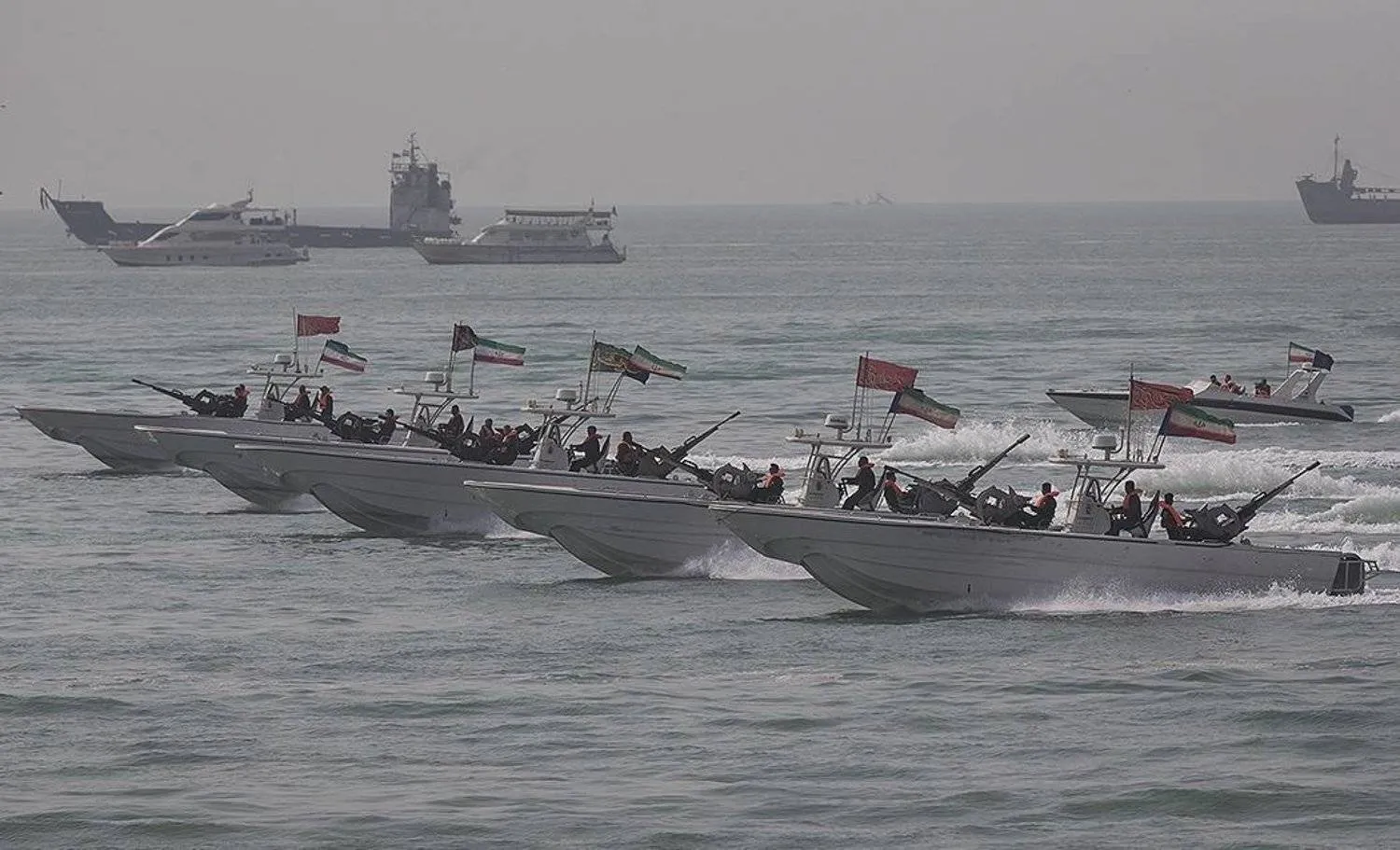
Revolutionary Guard speedboats are seen during maneuvers in the Strait of Hormuz. (Tasnim).
President Donald Trump rightly eviscerated Barack Obama over the 2015 nuclear deal and the $1.7 billion in cash secretly airlifted to Tehran. That agreement—coupled with pallets of cash and over $100 billion in sanctions relief—supercharged Iran’s nuclear program while empowering the IRGC and its regional terror proxies.
Now a new deal threatens to repeat the same catastrophic script by unfreezing $6 billion in Iranian oil revenues held in Qatari banks. The last round of sanctions relief propelled Iranian oil exports from roughly 1.2 million barrels per day to peaks near 2 million. Those revenues flowed directly to the IRGC and its network of militias.
Meanwhile, the nuclear “concession” is purely cosmetic. The IAEA reports Iran retains approximately 441 kilograms of uranium enriched to 60 percent—enough, if further enriched, to fuel roughly 10 weapons. Converting that stockpile to weapons-grade material would take only months.
In return for taking that nuclear material out of the country, Tehran gains immediate liquidity to rebuild its enrichment capacity, rearm its proxies, and upgrade its missile arsenal. Hezbollah alone receives around $700 million annually from Iran; the Houthis receive hundreds of millions more—funding over 200 attacks on U.S. forces in Iraq and Syria since October 2023.
Russia stands ready to accelerate Iran’s program, having sealed a $25 billion deal in September 2025 to construct four new nuclear reactors in southern Iran. China provides the economic lifeline through massive oil purchases (85% of Iran’s oil ends up in the communist country), advanced satellites, and full access to the BeiDou navigation system for the IRGC.
Qatar is no neutral arbiter. While it hosts America’s largest regional airbase at Al Udeid, it maintains deep financial ties with Tehran and shelters Hamas leaders.
Domestically, the deal would vindicate the regime’s ideology of defiance. Supreme Leader Khamenei and the IRGC will portray the cash-for-concessions exchange as proof that aggression pays, further entrenching hardliners and crushing internal dissent.
However, the most immediate danger lies in the Strait of Hormuz, through which roughly 21 million barrels of oil pass daily. A fresh cash infusion would enable Iran to increase naval mining, deploy mobile missiles, swarm fast boats, and impose de facto tolls in the Strait of Hormuz. Insurance premiums would spike, energy markets would shudder, and Gulf leaders already recognize the Strait as Iran’s ultimate economic weapon—one capable of triggering a global shock.
This pressure would force Gulf states into painful choices. If Washington once again appears unreliable, they will hedge toward Beijing and Moscow once again.
Within the administration, this approach aligns with a broader retrenchment. Vice President J.D. Vance champions accepting spheres of influence for authoritarian powers—Russian consolidation in Europe, Turkish expansion, Qatari patronage networks, and Iranian hegemony in the Gulf. Deterrence hawks like Senators Marco Rubio and Lindsey Graham find themselves sidelined. Europe offers no meaningful backup: its militaries are hollowed out, demographics are in decline, and energy dependence cripples its ability to project power.
Even Trump has mused about temporarily living with a nuclear Iran, arguing the U.S. could destroy its infrastructure in hours if needed—yet chooses not to. He has also suggested China might restrain Tehran in return for secure passage through the Strait of Hormuz, ignoring Beijing’s continued support, including the aforementioned satellite technology transfers and the most recent cyber operations against the United States.
Recent Israeli and U.S. strikes degraded Iran’s military and nuclear infrastructure. Nevertheless, this prospective deal -whether to avoid a third military round in Iran or after the end of this hypothetical scenario- would squander those hard-won gains. The $6 billion is modest compared to the tens of billions Iran earns annually through its shadow fleet. Yet symbols matter.
By resurrecting the very strategy it once condemned, Washington is not merely adjusting tactics—it is signaling strategic surrender. Thus, it is imperative to prevent this from happening, preserve the freedom of transit in the Strait of Hormuz, and foster the geostrategic potential of an ‘Abrahamic NATO’ between Israel and the regional Sunni Arab States.
The post-1945 order in the Gulf is not collapsing. It is being deliberately abandoned.
Related Topics
- Anti-Zionism
- Antisemitism
- Bahrain
- Barack Obama
- China
- Europe
- Gaza
- Gaza Border
- Gaza Rocket Attacks
- Gaza Strip
- Hamas
- Hezbollah
- Hostages in Gaza
- Invasion of Ukraine
- Iran
- Iran Nuclear Deal
- Iraq
- Islam
- Israel At War
- Israel-Iran Conflict
- Israel-US Relations
- Jordan
- Lebanon
- Media Bias
- Middle East
- Natural Gas
- October 7 anniversary
- Oman
- Pakistan
- Palestinians
- Qatar
- Russia
- Saudi Arabia
- Syria
- Terrorism
- The Arab World
- Tucker Carlson
- Turkey
- UAE - United Arab Emirates
- Ukraine
- US Politics
- Weapons
- World War II
- Yemen
Related Posts