
The Hormuz pawnshop: Why the ‘budget nuke’ is failing
The 14-day truce announced on Tuesday — implicitly trading a de-escalation for the reopening of the Strait of Hormuz — has triggered a profound schism in global discourse. Headlines are bifurcated: one camp hails a triumph of back-channel diplomacy over ballistic brinkmanship, while the other warns of a strategic capitulation that locks in a more predatory equilibrium. This dissonance reflects a world holding its breath for a reprieve from triple-digit oil prices, even as a parallel current of analysis reflects deep unease over the price of the pause. Yet, a closer look at the Gulf’s desolate horizons suggests we are witnessing something more consequential than a temporary truce. This is not a return to “normalcy”; it is a final inventory of hostages before the global economy concludes its structural exit from the era of geographic determinism.
In recent months, Tehran has perfected a peculiar business model, weaponizing the strait as a “budget nuclear option” — a tool of calibrated uncertainty rather than outright destruction. Beyond the crude mechanics of naval blockades, the IRGC has transitioned the waterway into a laboratory for asymmetric arbitrage. By leveraging the delta between maritime stability and systemic collapse, they have begun to displace the universalism of the Law of the Sea with a bilateral “loyalty economy.”
This shift is now being tentatively echoed even in Western discourse: recent suggestions circulating in Washington, including remarks by President Trump about a potential “joint venture” with Tehran to collect tolls from transiting ships, point to a striking normalization of extraction logic — despite official insistence on restoring unrestricted passage. In this configuration, the chokepoint functions as a toll-gate where predictability itself is the commodity being priced and sold.
The Nasser Trap: Engineering around the Bottleneck
The strategic error in weaponizing a chokepoint is the assumption that the global order is static. History suggests that when a logistical necessity is transitioned into a tool of systemic blackmail, it triggers an irreversible architectural mutation. Tehran is currently navigating a digital-age repetition of the “Nasser Trap.” When Egypt shuttered the Suez Canal in 1967, the intent was to hold the industrialized world to ransom. Instead, the crisis accelerated a permanent pivot toward Very Large Crude Carriers (VLCCs) and the Cape of Good Hope. By the time the canal reopened in 1975, it had been demoted from an existential artery to a high-value operational route.
Today, this “Suez Syndrome” is manifesting through physical redundancy. Every day of “calibrated uncertainty” in Hormuz provides the definitive ROI justification for projects once deemed too ambitious, such as the expansion of the Saudi Petroline to its 7-million-barrel capacity. When an artery becomes toxic, the system does not endure it—it engineers around it. This flight from Hormuz is part of a broader shift toward logistical sovereignty. From China’s investment in overland corridors to bypass the “Malacca Dilemma” to the industry’s reaction to the Houthi campaign in the Bab-el-Mandeb, the lesson is uniform: expensive stability is now preferable to cheap risk.
Resilience after October 7th
The strategic pivot of 2026 is anchored in a diversified infrastructure of bypasses, of which the India-Middle East-Europe Economic Corridor (IMEC) remains a central, albeit politically stressed, pillar. While the cataclysm of October 7th was intended to shatter the regional normalization that underpins IMEC, the long-term effect has been a hardening of its strategic rationale. The war demonstrated the limits of a purely diplomatic resolution to the “Hormuz Dilemma”; it requires a physical, iron-clad alternative.
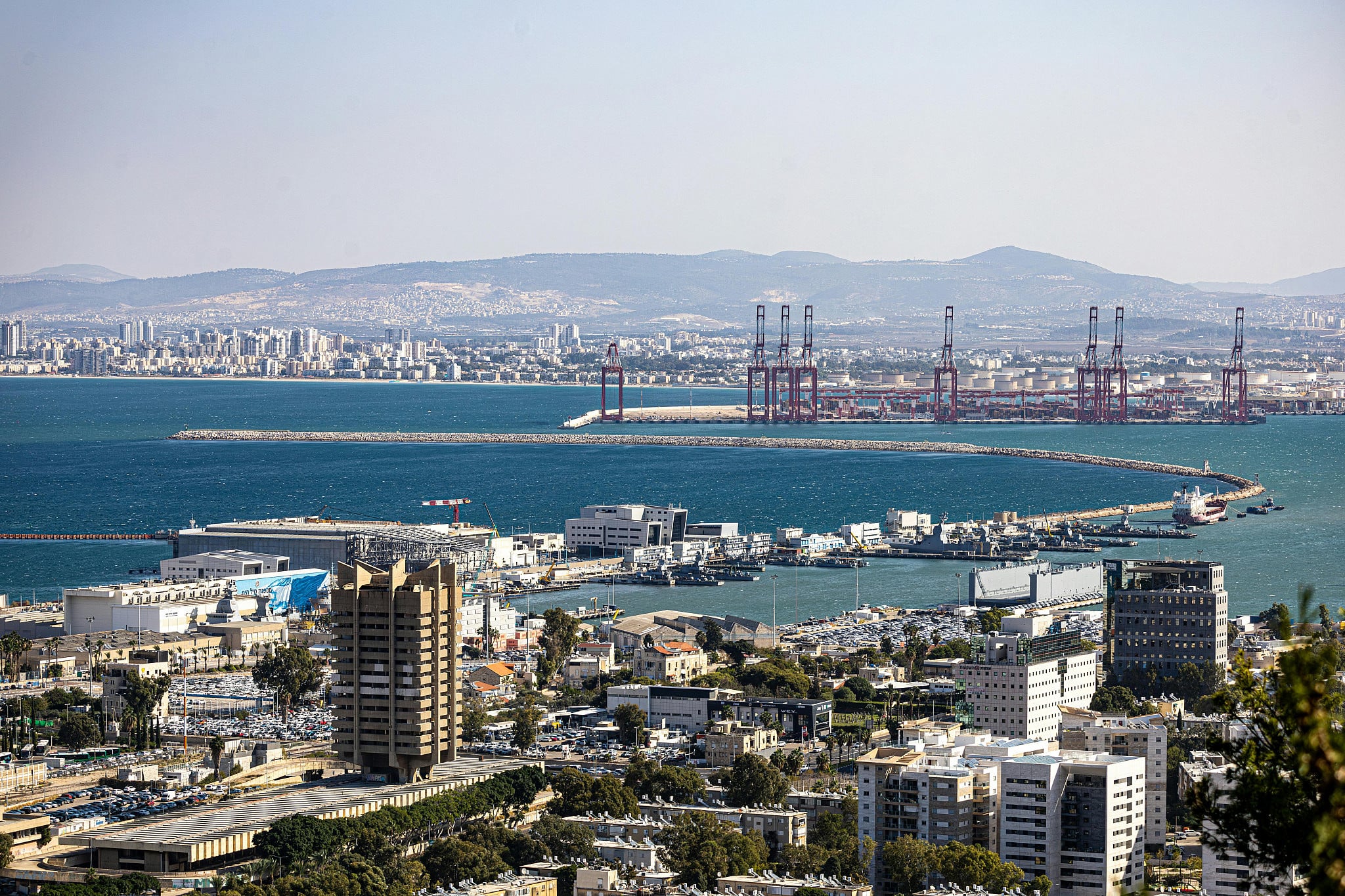
Haifa, as the Mediterranean terminus, now represents more than just a logistical hub—it has emerged as a symbol of connectivity under stress. This is part of a broader transition to a multi-modal grid, buttressed by projects from the Iraq-Turkey Development Road to the integration of the Omani-Emirati Hafeet Rail. These are no longer mere trade routes; they are the immune system of global commerce, designed to reduce the risk that a localized explosion triggers a systemic shock.
The emergence of these land-based bypasses is already triggering a counter-reaction from those left behind by the new geography. The April 8th declaration by Pakistan’s Defense Minister, branding India and Israel as “eternal enemies,” reflects an attempt to ideologically delegitimize the IMEC framework. Behind the religious rhetoric lies a cold existential anxiety for the future of Gwadar: if the regional axis shifts toward a Haifa-centered corridor, Pakistan’s multibillion-dollar gateway faces terminal obsolescence.
Yet, the final irony of this ideological stand is that Islamabad’s primary patron, Beijing, has already effectively hedge-funded its exposure by investing across competing corridors. While Pakistan decries the “eternal enemies,” Chinese state-owned enterprises continue to operate the very terminals — from Haifa Bayport to Abu Dhabi’s Khalifa Port — that will process the IMEC’s volumes. Beijing understands what the ideologues do not: in the post-geography world, owning the bypass is more profitable than guarding the bottleneck.
The IRGC’s Hollow Hegemony
This infrastructure surge coincides with the internal metamorphosis of the Iranian state. Following the era of supreme clerical authority, the IRGC has completed its transition from a praetorian guard to what increasingly resembles a direct military-industrial autocracy. In this emerging power structure, religion remains only as a thin veneer of legitimacy for what is effectively a corporate-military entity obsessed with survival.
Tehran’s reliance on the “budget nuclear option” is a symptom of this transition. As the IRGC leadership grapples with the chronic devaluation of the rial and a crippling capital flight, the weaponization of the strait has become one of the few remaining strategic currencies. Yet, by overplaying this hand, they have prioritized tactical extortion over strategic viability. The threats intended to force concessions have instead secured the political will and funding for the very pipelines and rails that render Iran’s primary asset progressively less central. The IRGC has achieved the impossible: it has made the massive costs of continental logistics look like a bargain.
The Illusion of Exit: Distributed Exposure
Yet, the notion of a clean systemic exit from the Iranian chokepoint remains a strategic mirage. What is emerging is not immunity, but a transition from concentrated vulnerability to distributed exposure. As Hormuz loses its status as a singular lever, the IRGC is not being disarmed; it is being forced to adapt.
The same logic of asymmetric arbitrage that once privileged geographic control now incentivizes network disruption. If the strait becomes a less reliable point of pressure, instability is likely to be projected outward — into the adjacent corridors, insurance markets, and the broader architecture of maritime risk. The chokepoint is not disappearing; it is beginning to dissolve into the very system it once constrained.
Furthermore, redundancy is not a panacea; it is an expensive pivot. The overland grids designed to circumvent the strait impose a structural “stability premium.” What they offer is not economic efficiency, but engineered predictability — a fragile substitute that remains conditional on regional cooperation. As the strategic value of Hormuz erodes, the incentive for the IRGC to extract maximum leverage in the present intensifies. A declining asset rarely produces restraint; it accelerates risk-taking.
The Pawnshop’s Empty Vault
As we navigate this 14-day window of silence, the irony of the IRGC’s position is absolute. By proving they could weaponize the strait, they ensured that the world would accelerate efforts to no longer depend on it. The “budget nuclear option” has been spent to the point of structural exhaustion.
The Strait of Hormuz will remain on the map, but it is fast becoming a geopolitical pawnshop with an empty vault. The leverage is steadily eroding, the global economy has begun to escape via a network of land-based bypasses, and the gatekeepers are left guarding a corridor whose strategic premium is no longer guaranteed. The April 2026 truce is not a reprieve; it is the quiet before a transition toward a post-geography reality — one where the power of the chokepoint is gradually buried under the permanence of the bypass. The system has not escaped the chokepoint; it has outgrown its monopoly.