Horses of Central Park, Human Bias, and Broken Thinking
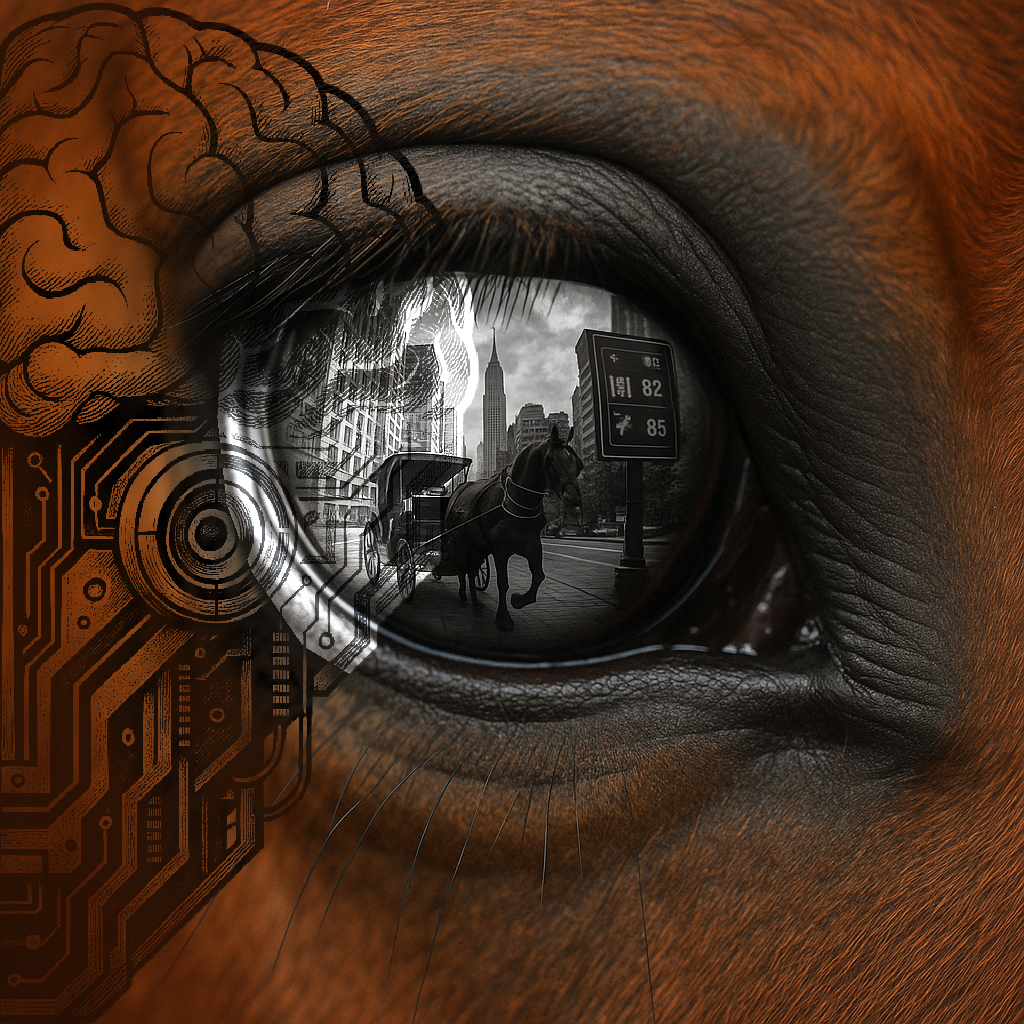
On a sunny afternoon, Spirit collapses on a Manhattan street. Within hours, the internet had judged, convicted, and executed the presumed guilty.
For years, activists and city officials have debated whether to ban horse-drawn carriages from Central Park — a conflict that seems, on the surface, to be about animal welfare. But beneath it lies something deeper and far more universal: the inability of humans to think beyond extremes.
Current views can be narrowed to two camps — ban it or keep it. A battle between cruelty and tradition, progress and nostalgia. Yet, while both sides fight for their “absolute truth,” practical solutions sit invisible in plain sight: reducing carriage hours during extreme heat, restricting routes to shaded areas, mandating rest periods, upgrading stable conditions, and/or implementing real-time safety and welfare monitoring. These measures could preserve welfare alongside tradition. But they require something neither side wants to concede — that the other camp might have a legitimate concern.
It’s what psychologists call binary bias: our deep tendency to compress complex realities into either/or categories. This bias is cognitively efficient, emotionally satisfying, and politically useful. But it’s also profoundly dangerous — because binary thinking makes us fight over narratives instead of outcomes, symbols instead of substance.
This same reflex drives the current social and political polarization — and even shapes how we approach emerging technologies like artificial intelligence.
To some, AI is the key to human progress; to others, it’s the end of civilization. Major scientific publishers and universities ban AI-generated text outright. Academic establishments impose blanket prohibitions instead of crafting guidelines for responsible use. In scientific literature, this bias is called algorithmic aversion.
And once the anxiety subsides, we often swing to the opposite extreme: blind trust in algorithmic outputs, surrendering judgment to “what the machine says.”
Algorithmic aversion and machine dependency are two poles of the same problem. They spare us the harder work of integration — understanding that AI is merely another tool, capable of enhancing or undermining human judgment depending on how we deploy it.
Paradoxically, the more information we have, the more polarized we become. We don’t seek truth as much as we seek coherence — a story that keeps our moral self-image intact. For decades, psychologists treated motivated reasoning as another cognitive flaw. But the pattern runs deeper. This isn’t bad reasoning; it is reasoning optimized for a different goal.
I call it Homobiasos. Unlike the rational actor of economic theory — Homoeconomicus — we are creatures whose utility includes not just outcomes but psychological equilibrium. We use distorted reality not due to cognitive limitation but because of cognitive priority: coherence preservation trumps accuracy when the two conflict.
Thus, the challenge is not that our problems are too complex to solve, but that our minds, influenced by politics and social groupings, resist the complexity required to solve them. We have optimized for coherence over accuracy, and social acceptance and psychological comfort over rationality.
Technology only amplifies this tendency. In an age of unlimited data and instant feedback, each of us can construct an illusion of certainty — a personalized moral reality. Governments do it with policy. Citizens do it on social media. Scientists do it with their models. What connects them all is not ignorance but motivated moral reasoning — the will to preserve one’s self-image as virtuous while helping maintain social solidarity — even when complexity begs for humility.
New York once pioneered bold, nuanced public health policy. The city’s smoking ban wasn’t an absolute prohibition but rather a careful zoning and enforcement strategy that balanced freedom with harm reduction. It worked because it rejected the false choice between total ban and total freedom.
Today’s horse-carriage debate shows the opposite: how broken thinking can paralyze even the most capable societies. When every issue becomes a moral test rather than a design challenge, polarization grows and progress dies. Horses are no longer horses; they’re symbols in our endless war between virtue and vice. And the digital world rewards the same pattern — outrage over nuance, reaction over reflection. We designed and trained it that way.
The horse-carriage question isn’t complicated; it’s a straightforward design problem with obvious middle-ground solutions. But we’ve turned it into a moral crusade. If we can’t navigate this simple case, the more consequential dilemmas ahead — from algorithmic justice to climate adaptation to global peace — don’t stand a chance.
The danger isn’t that AI will outthink us. It’s that we will out-bias ourselves, building a digital mirror that reflects our moral simplifications back at us, faster and louder than ever — only this time, with authority.
Reality isn’t black or white, and shades of gray aren’t only for the bedroom. “Us” aren’t all good, and “Them” aren’t all bad. Unless we learn to live in the gray, we’ll keep turning every complex question into a binary battle — and every opportunity for wisdom into a moral failure.
Reality doesn’t bend to our wishes — not on the streets of New York, and not in the algorithms of our machines.
The real challenge of this century isn’t artificial intelligence. It’s artificial certainty.