Houdini, My Bubby, and the Secret to Living Forever
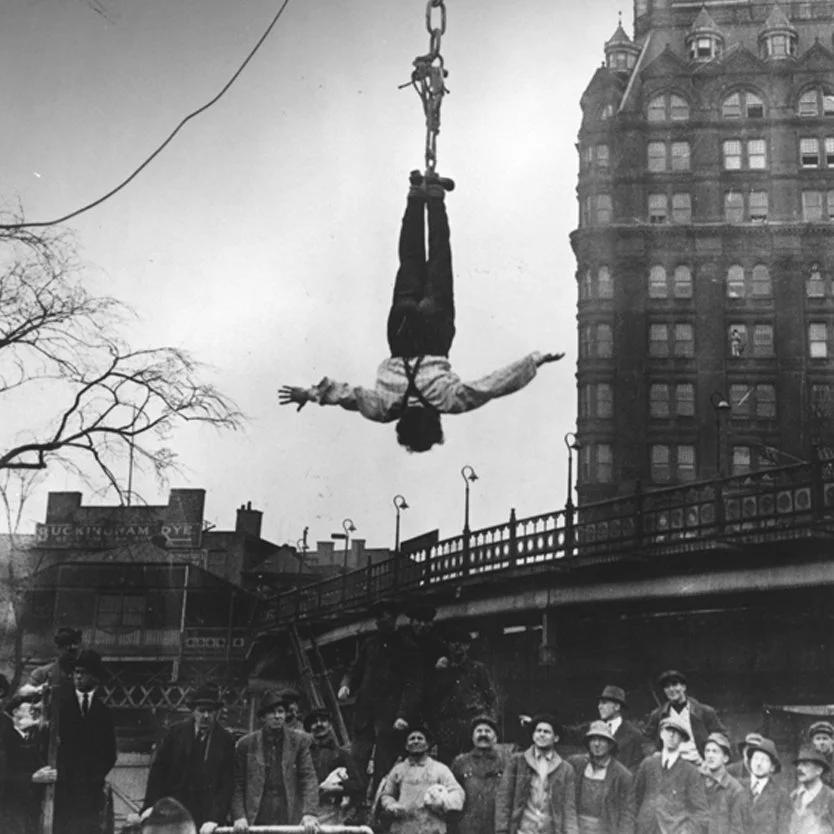
One hundred years ago, on October 31, 1926 (the 23rd of Cheshvan), the world lost a man who had spent his life convincing audiences that nothing could hold him captive.
Harry Houdini escaped handcuffs, chains, locked trunks, and even tanks of water while suspended upside down. A century later, his name is still so famous that we call anyone who manages an impossible escape a “Houdini.”
This past week, as the world marked the centennial of his passing, I came across something about him that I suspect many people don’t know.
Harry Houdini was the son of a rabbi.
He was born Erik Weisz in Budapest in 1874. His father, Rabbi Mayer Samuel Weiss, immigrated to America and served a Jewish congregation in Appleton, Wisconsin, where the family began its new life.
Houdini grew up amid the struggles of a poor Jewish immigrant family. He eventually exchanged Erik Weisz for the stage name Harry Houdini and became one of the most celebrated entertainers in the world, but his Jewish roots remained part of his story.
Although he was not publicly known as a religiously observant Jew, he maintained a meaningful connection to his Jewish identity. There are letters that mention his saying Kaddish for a full year after his mother’s passing, and in 1918 he founded an organization for Jewish performers who were sons of rabbis.
He was a member of the Jewish Theatrical Guild, and when he died, his funeral at Machpelah Cemetery in New York included two rabbis.
In fact, it was his personal request to be buried beside his beloved mother, Cecilia, with a packet of her letters placed beneath his head in the coffin. Which is quite ironic, that the man the world remembers for breaking free of every chain was still a Jewish boy who could never escape the pull of his Yiddishe Mama!
Surprisingly, there is a debate about when Houdini actually died. His passing was officially recorded on October 31. The fact that the world’s most famous magician died on Halloween only added to his mystique. Some historians think he actually died a day earlier and that his passing was kept secret so the official date of death could preserve his mysterious persona, although others strongly dispute this.
Whatever the truth about his actual yahrzeit, Houdini most definitely cultivated a public image carefully built around his extraordinary feats of magic. And he succeeded. A hundred years later, we still know his name.
Reading about Houdini and the extraordinary legacy he created, I found myself thinking about the legacy of my own beloved Bubby Denburg, who passed away last week.
Houdini’s legacy was his magic. My Bubby’s legacy was her family.
She lived for her family, and nothing gave her greater happiness than watching that family grow.
The pride and joy she had, from her children, grandchildren, and great-grandchildren were her life. She loved each of them, took pride in their accomplishments, and cherished every opportunity to be together. I can’t count how many times she would thank me for calling her, telling me that we were what she lived for.
And she didn’t just have nachas. She shared it, loud and proud, to anyone she would meet. It could have been a cashier in Walmart or a nurse at the doctor’s office, soon enough they would know all about her grandkids.
She was a woman of enormous love and of convictions just as strong. She lived with a deeply rooted faith in G-d, and her commitment to her unshakable Jewish identity was obvious to anyone who knew her.
And that is precisely why the family she leaves behind is so much more than a large family tree filled with names. It is a living family, carrying forward the faith, the values, the kindness, and devotion to G-d that were so central to her life. Every single one of her many grandchildren is as deeply committed to their Judaism as she was. As she would say, “Kain Ayin Hara”.
Her legacy is the natural continuation of the way she lived.
Which brings me to this week’s Torah portion and a fascinating question about what it really means to leave behind a legacy.
The portion is called Chayei Sarah, “The Life of Sarah.” Yet the very first thing it tells us is that Sarah has died. The Torah describes her burial, then moves on to the search for a wife for her son Yitzchak and the beginning of the next generation.
Why call this portion “The Life of Sarah” when Sarah herself is no longer alive?
Because Sarah is present throughout the story, even when she is no longer physically there. Her life continues in the home she built, in the son she raised, and in the values she planted so deeply that they would shape the future of the Jewish people.
When Yitzchak marries Rivkah and brings her into his mother’s tent, the Torah tells us that he was finally comforted after Sarah’s passing.
Because now, Sarah’s tent was no longer just a place filled with memories of the past. It had now become the home of the next generation, where the faith, kindness, and holiness that defined Sarah’s life would continue to flourish.
Sarah’s legacy was not simply a memory that people cherished, or a beautiful story they told. It was a way of living that took root in another person, and through that person would continue to influence generations not yet born.
The Torah doesn’t call this portion “The Memory of Sarah.” It calls it “The Life of Sarah,” because her life had not merely left behind memories. It had produced more life.
This is the most extraordinary thing about a life well-lived. We have the ability to create something that continues long after we leave this world. Not just because people remember what we did, but because what we did continues to shape who they are.
I think about my many cousins, my Bubby’s grandchildren, and her many more great-grandchildren, each with their own lives, personalities, and paths. And yet, so much of what she lived for continues through them. The strong family values she lived with, the faith she demonstrated, and the generous love she gave so freely, did not end with her passing.
They continue to live inside all of us.
Which brings us to a question that we need to ask ourselves. What do I want my legacy to be after I’m gone?
The answer lies in the way we live right now.
Not everyone will have a family of many grandchildren, great-grandchildren and even a great-great grandchild. Not everyone will become famous for escaping chains and coffins, breaking world records. But every one of us can influence the people around us, and every one of us has the ability to leave something meaningful behind.
If I want to be remembered for kindness, am I living with kindness today? If I want my family to carry a strong Jewish identity, am I showing them through my own choices how deeply I value my Judaism? If I want to inspire faith, generosity, and devotion to G-d, are those the things that guide the way I live now?
Our legacy isn’t something we suddenly create at the end of our lives. We are creating it every day.
Houdini left a world still fascinated by his magic. Sarah left a nation that would carry her faith into the future. And my Bubby left behind a beautiful, loving family that continues to carry so much of what she lived for.
She is proof that the way we live is what will continue to live on after us.
Good Shabbos,
Rabbi Yankie & Chana Denburg