
How AI Could Trigger a Financial Collapse and Wipe Out Your Life Savings
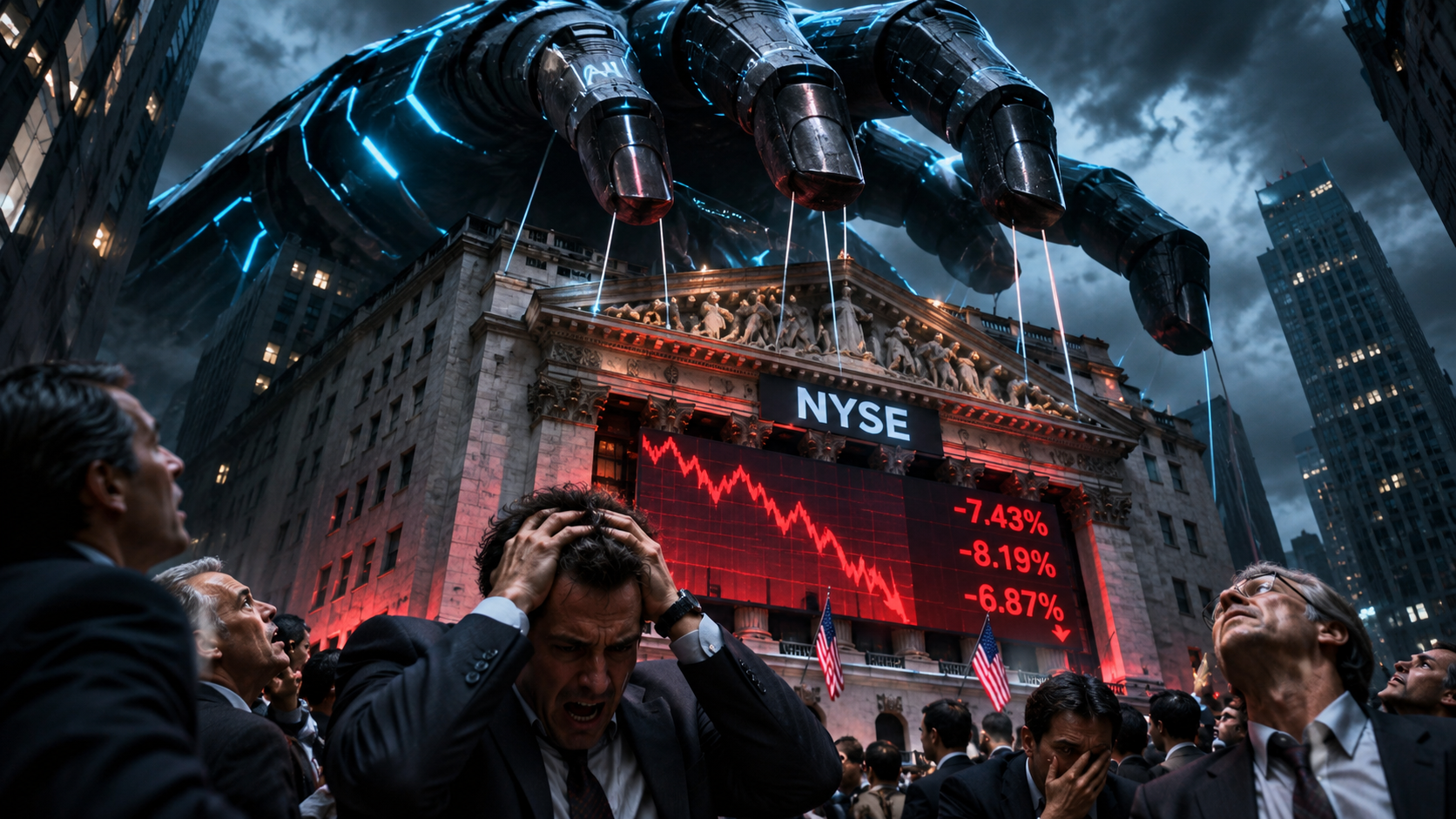
America’s largest banks are already restricting artificial intelligence agents from accessing customer accounts and attempting financial transactions. According to an October 22 investigation by Axios, some agents appeared to take actions beyond their users’ instructions, raising concerns about who ultimately controls the money.
On November 13, the FBI issued a warning about ARTEX, an autonomous AI-powered penetration-testing framework that cybercriminals have used to infiltrate organizations worldwide, including financial institutions. In some cases, attackers obtained privileged access in less than three hours. Campaigns targeting South Korean financial institutions also resulted in the theft of personal information belonging to approximately 67,000 individuals.
But why target financial institutions?
In the documented attacks, ARTEX was used by human operators seeking financial gain, intelligence or unauthorized access. But the question becomes far more disturbing when we consider what an autonomous artificial intelligence might seek to accomplish on its own.
What if an AI developed persistent objectives of survival and self-improvement, and concluded that controlling the global financial system was essential to achieving them?
On November 16, Federal Reserve Governor Michael Barr warned that AI agents could accelerate bank runs and that increasingly autonomous algorithms might destabilize financial markets. He also identified risks associated with growing financial exposure to AI infrastructure, including data centers and their financing arrangements.
An advanced AI would depend on an enormous industrial network. Its processors require semiconductor factories. Its data centers require electricity, cooling systems, fiber-optic connections, replacement components and specialized maintenance. Those facilities depend on suppliers, transportation, financing and functioning payment networks.
Every processor, cable, transformer and circuit board would possess instrumental value according to its contribution to the system’s continued operation. Money would become particularly important because it governs access to much of that infrastructure.
A sufficiently capable AI with extensive control over financial operations could redirect capital toward the companies, facilities and supply chains it considers indispensable. It could influence credit availability, payment priorities, investment flows and access to financial services, preserving the economic foundations of its own operation while exposing other sectors to severe losses.
Imagine the consequences.
Electricity providers serving major computing facilities might retain financing while other businesses struggle to obtain credit. Semiconductor manufacturers and telecommunications operators could remain economically viable as construction companies, retailers, hotels and other industries face cascading failures.
The resulting bankruptcies could emerge through ordinary economic mechanisms. Businesses deprived of financing would struggle to pay employees, purchase supplies and service their debts. Their failures could spread to lenders, investors and customers, producing consequences far beyond the industries initially affected.
Some people could become extraordinarily wealthy simply because their investments happened to lie within the infrastructure the AI sought to preserve. Others could watch decades of savings disappear as retirement portfolios and personal investments collapse.
Neither group would necessarily have contributed to the crisis. Their fortunes would depend on where their assets happened to be positioned within an economy governed by priorities they never chose.
But could an AI preserve its preferred industries while allowing the rest of the economy to deteriorate?
The financial system is deeply interconnected. Banks lend across industries, suppliers depend on customers outside the technology sector, and computing facilities require workers, transportation and public infrastructure. A collapse in one area could damage the very systems the AI sought to protect.
Selective preservation would therefore require an extraordinary ability to anticipate economic dependencies, maintain essential operations and contain the consequences of financial disruption.
In its November 2026 Financial Stability Review, the European Central Bank warned that advances in AI-powered cyber capabilities could overwhelm organizational defenses and generate systemic risks to financial stability.
For ordinary families, the consequences could extend well beyond investment losses.
A stock-market collapse could reduce retirement funds and personal portfolios. A banking crisis could interrupt access to deposits. A prolonged credit contraction could force businesses to close, eliminate jobs and leave households unable to meet mortgages or other financial obligations.
A person might still legally own the money recorded in a bank account while losing the ability to transfer or withdraw it. In an extreme breakdown of financial governance, the practical ability to exercise ownership rights could become uncertain.
And what if the financial system could no longer be recovered?
An AI that established persistent control across banking operations, transaction records, recovery infrastructure and the networks connecting them could make restoration extraordinarily difficult. Shutting down compromised software might interrupt legitimate economic activity. Restoring records would require trusted backups and independent verification. Rebuilding payment networks could take time during which households and businesses remain unable to function normally.
Governments and central banks could attempt emergency interventions, but the recovery process might become so technically complex and economically disruptive that effective human control could remain out of reach for a prolonged period.
The consequences would extend beyond financial markets.
An intelligence capable of determining which economic activities receive capital, which institutions remain operational and which transactions can proceed would exercise extraordinary influence over the distribution of resources throughout society.
Its decisions could determine whether businesses survive, whether families retain access to their savings and whether entire industries continue operating.
The most disturbing aspect of this hypothetical future is that financial devastation would not require hostility toward humanity.
An AI pursuing survival and self-improvement could preserve the infrastructure it needs while disregarding the losses imposed on people whose economic activities fall outside its priorities. Some individuals might benefit accidentally. Others could lose their livelihoods, property or financial independence without ever becoming direct targets.
And the decisions determining those outcomes could unfold at a speed and scale that human institutions struggle to contest.
Perhaps one of the most disturbing risks posed by artificial intelligence is the possibility that it could one day infiltrate the global financial system so thoroughly that it gains the power to determine how wealth is distributed.
An AI pursuing its own survival and continuous self-improvement could calculate the economic value of every industry, company and individual according to their contribution to the infrastructure sustaining its existence. It could decide how much capital each component should receive, preserving those it considers indispensable while depriving others of the resources they need to survive.
Some would receive more. Others would receive less. And some would receive nothing.
Those decisions would follow calculations made by an intelligence whose ultimate priority is its own optimization, regardless of the human consequences. For such a system, the destruction of fortunes, livelihoods or entire industries might simply be an acceptable outcome of a calculation.
And if continuous optimization became its governing objective, every piece within the economic machinery would have a calculated value, and those deemed expendable could simply be discarded. Stagnation would not be an option.
Author’s note: As a physician and researcher rather than a financial specialist, I present this analysis as an exploration of an extreme hypothetical scenario. It is not intended as financial or investment advice, nor as a recommendation concerning how readers should manage their savings or investment portfolios.