
Middle East Forum Fellow/North Africa Risk Consultant
How Algiers Uses Force Projection to Prop Up Dictators and Spread Instability
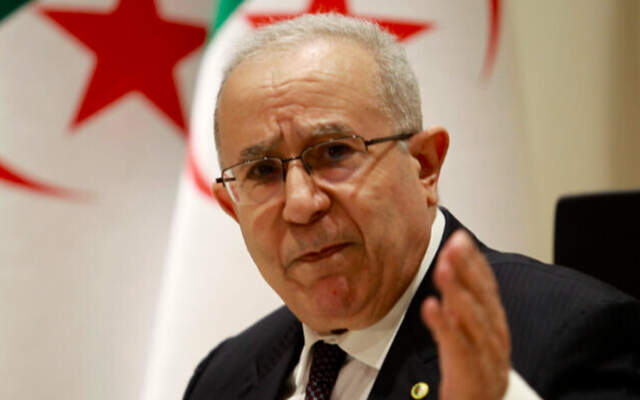
Algerian Foreign Minister Ramtane Lamamra reads a statement from the country's president in Algiers, August 24, 2021. (Credit: AP/Fateh Guidoum)
When the Algerian regime dispatched four Su-30MKA fighter jets, an Il-78 aerial refueling tanker, and military transport aircraft to Niger on August 30, 2026, state media in Algiers immediately spun the intervention as a masterclass in preemptive deterrence. The deployment followed a violent August 28–29 mutiny at Air Base 101 in the capital city of Niamey, where rogue troops targeted key installations before being suppressed. Ordered directly by President Abdelmadjid Tebboune and Army Chief of Staff General Said Chanegriha, the rapid aerial dispatch was framed by Algiers as a selfless effort to stabilize a fragile neighbor. Yet beneath this official rhetoric lies a far more calculated reality. The military-dominated authoritarian regime in Algiers is executing an aggressive power grab designed to bolster neighboring autocrats, extend its illiberal influence across the Sahel, and mask its persistent failure to confront the regional rise of violent radical Islamism.
For decades, Algiers maintained a strict foreign policy doctrine of non-intervention, using legalistic restraint to avoid participating in transparent international counter-terrorism coalitions while shielding its ruling generals from external oversight. That posture officially ended with the 2020 constitutional revision, which granted the presidency and top military command explicit authority to deploy combat units outside national borders. The August 30 intervention in Niger represents the most significant operational test of this expanded mandate to date. Rather than deploying these advanced combat assets to eradicate active terrorist networks operating in the borderlands shared with Mali and Niger, Algiers rushed to provide direct air coverage for General Abdourahamane Tiani’s illegitimate military junta following domestic military unrest.
This selective application of military power exposes the fundamental priorities of the Algerian security state. By shielding fragile military regimes from internal collapse, the military leadership in Algiers is actively perpetuating the institutional decay that fuels regional chaos. Illiterate and unaccountable junta governance in the Sahel creates the exact administrative and security vacuums in which radical jihadist groups thrive. Organizations such as Jama’at Nusrat al-Islam wal-Muslimin (JNIM) and Islamic State affiliates systematically exploit political instability, economic stagnation, and human rights abuses committed by unvetted military regimes to recruit and expand. Algeria’s military umbrella does not eliminate jihadism; it guarantees the continued collapse of state authority upon which violent extremists depend.
Furthermore, Algiers brings to this crisis a deeply troubled historical record. Long-standing allegations and documented patterns surrounding Algeria’s security services during the 1990s civil conflict and subsequent Sahelian crises highlight a history of manipulating Islamist insurgent groups to neutralize domestic democratic opposition and project regional power. Rather than supporting transparent multilateral counter-terrorism efforts, Algiers relies on opaque bilateral deals. The military transfer to Niger, which included two Mi-24 Super Hind attack helicopters and two Mi-171 transport helicopters, demonstrates how Algiers uses hardware transfers to squeeze out Western security partnerships and replace them with its own unaccountable framework. This approach creates an unmonitored security environment where violent extremism persists while civil institutions are dismantled.
Complementing this military expansion is an aggressive economic strategy aimed at converting neighboring states into dependent buffers. In June 2026, Algerian Prime Minister Sifi Ghrieb traveled to Niamey to inaugurate the 40-megawatt Gorou Banda power plant, constructed as a gift by state-owned Sonelgaz. Concurrently, Algiers accelerated a high-level diplomatic offensive to advance the long-delayed Trans-Saharan Gas Pipeline project through Niger. These initiatives are not mere benevolent development assistance; they represent deliberate instruments of political capture. By tying Niamey’s energy infrastructure and transit revenues directly to Algerian state enterprises, Algiers seeks to lock the junta into a subordinate relationship, ensuring that no independent, democratic government emerges in Niger or Mali to challenge Algerian dominance.
Western policymakers in Washington and European capitals must reject the deceptive narrative that Algiers acts as an indispensable anchor of Saharan stability. Treating a military-backed authoritarian system as a reliable security partner is a dangerous miscalculation. The Algerian high command prioritizes regime survival, regional hegemony, and the exclusion of international accountability above any genuine commitment to eradicating violent extremism. Indulging Algiers while it constructs an authoritarian buffer zone across West Africa will only deepen regional fragility and accelerate the retreat of democratic governance.
True security across the Sahel cannot be constructed upon Algerian combat jets shielding military usurpers from political accountability. Lasting regional equilibrium requires legitimate democratic governance, transparent and accountable counter-terrorism operations, and a firm commitment to institutional development. The international community must hold the ruling generals in Algiers fully accountable for their destabilizing interventions. Permitting Algiers to extend its authoritarian umbrella over Niger and the broader Sahel will only empower radical Islamist factions, entrench autocracy, and ensure that lawlessness continues to consume the region for years to come.
Related Topics