
The views expressed herein are solely mine.
How an Israel-Venezuela Pact Can Curb Iran’s Reach
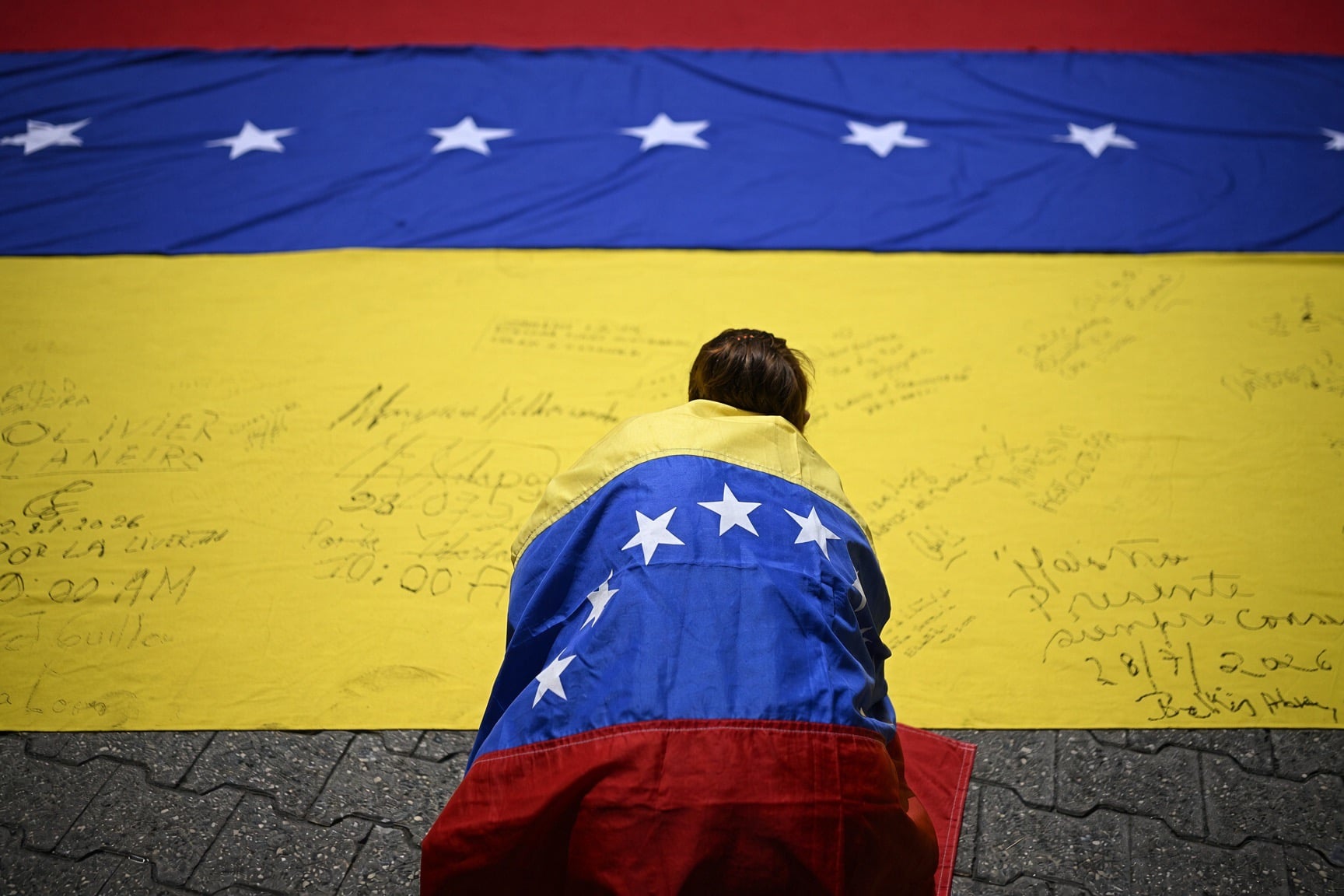
Illustrative: A unionist wrapped in a Venezuelan national flag, signs another Venezuelan national flag during a march in Caracas on July 28, 2026. (Federico PARRA/AFP).
Following the 1973 Yom Kippur War and the Arab oil embargo, Israeli leaders—under the periphery doctrine—deliberately cultivated non-Arab partners to secure energy supplies and deny adversaries strategic depth. Today, that same cold-eyed calculation points directly to Venezuela. Throughout 2024, Acting President Delcy Rodríguez repeatedly condemned Israeli operations in Gaza and described them as “genocide,” a “systematic plan of extermination,” and “Zionist fascism.” Yet after she assumed power following the January 2026 U.S. operation that removed dictator Nicolás Maduro, Caracas’s behavior shifted dramatically. First, Venezuela shipped its first crude cargo to Israel’s Bazan Group refinery in Haifa since 2020. Next, when double earthquakes of magnitudes 7.2 and 7.5 struck the Caribbean nation on June 24, 2026, Israeli Home Front Command engineers and aid teams were allowed to deploy to assess damaged buildings and transfer recovery protocols, prompting Rodríguez to thank the mission publicly. Building on this goodwill, the two governments restored consular services after a 17-year rupture dating back to 2009. Then, on November 16, 2026, a Venezuelan technical delegation arrived in Israel for the IPRED VII conference, marking the first official Venezuelan presence in the country since Hugo Chávez’s regime severed ties.
This diplomatic opening arrives at a critical economic moment, as Israeli drivers currently pay among the world’s highest petrol prices. Specifically, mid-November 2026 figures place Israel fourth or fifth globally, with pump prices near $2.55 per liter (roughly 185 pence)—more than 60 percent above the global average and the highest in the Middle East. Consequently, securing preferential access to Venezuelan heavy crude has the potential to reduce this acute economic burden that consistently affects the lives of Israelis.
To lock in these strategic and economic gains, Israel should restore full diplomatic relations by reopening its embassy in Caracas, appointing an ambassador, and stationing military attachés. Rather than policing Venezuela’s domestic political arrangements, Jerusalem should focus exclusively on measurable, enforceable deliverables. Under a proposed five-year offtake agreement, Venezuela must commit to delivering at least 60,000 barrels per day of heavy crude FOB to Haifa (or an agreed intermediate port), priced at a fixed $8–12 discount to dated Brent and verified by joint independent inspection at both loading and discharge. In exchange, the Jewish state should supply modular construction equipment and dual-use AI systems to accelerate post-earthquake reconstruction. Simultaneously, Israeli trainers should replace aging Russian and Chinese inventories—specifically coastal radars, older air-defense radars, and basic UAVs—with advanced Israeli systems in electronic warfare, persistent surveillance drones, and precision munitions, while standing up two interoperable coastal and counter-narcotics units. Crucially, failing to meet volume or inspection thresholds for any two consecutive months would automatically suspend further equipment deliveries and training rotations until compliance resumes.
Beyond energy and defense hardware, any bilateral pact must dismantle Tehran’s regional foothold. Accordingly, Caracas must expel all remaining Iranian, Hezbollah, and Hamas networks that have long treated Isla Margarita’s duty-free zone as a logistics and training node, while extraditing individuals wanted for terrorism offenses to Israeli or allied jurisdictions. Once Israeli special-operations advisors and intelligence liaison officers clear those networks, they should establish a permanent joint interdiction cell on Margarita itself. Operating on the ground, this initiative would conduct continuous maritime surveillance of the island’s approaches, execute joint document and financial investigations, and command a small, Israeli-trained Venezuelan rapid-reaction unit dedicated to countering smuggling and proxy financing. To prevent backsliding, Israeli personnel would retain independent access to the surveillance feed alongside the unilateral right to pause cooperation if designated terrorists remain on the island.
To ensure Caracas can uphold these commitments without fearing internal coups or Iranian retaliation, Israel would also install a compact protective architecture for senior Venezuelan leadership—replacing the low-capability Cuban detail that failed to protect Maduro with a system that improves upon earlier Israeli programs designed for Morocco’s king and Cameroon’s Paul Biya. Specifically, former IDF officers and specialized contractors should deploy a Continuum Lattice integrating three core layers: a persistent high-altitude pseudo-satellite network fused in real time with a ground sensor mesh of acoustic, seismic, and optical nodes; AI behavioral classifiers trained on Israeli close-protection datasets to flag anomalous movement around protected principals; and three pre-positioned, Israeli-led rapid-reaction cells equipped with organic medical and extraction capabilities. Furthermore, this lattice must operate under a dual-key protocol with CIA counterparts, allowing either side to trigger an elevated alert or an immediate extraction without prior public coordination. By maintaining continuous sensor coverage and automatic escalation thresholds, the Continuum Lattice would also provide dual-use capabilities that bolster national disaster response.
Ultimately, these coordinated steps extend Israel’s classic periphery doctrine into the Caribbean without requiring Jerusalem to endorse any domestic Venezuelan political outcome. By securing guaranteed crude volumes from the country with the biggest oil reserves in the world, physically uprooting Iranian proxies from a vital hemispheric soft underbelly, and replacing Chinese and Russian hardware with Western-aligned systems, the State of Israel advances its most concrete national security interests. In international politics, states that lock in tangible, verifiable gains steadily expand their strategic options, while those paralyzed by past rhetoric remain dangerously exposed to both price shocks and distant threats. Jerusalem must act now in Venezuela.
Related Topics
- Africa
- AI Artificial Intelligence
- Anti-Zionism
- Antisemitism
- Antizionism
- China
- Gaza
- genocide
- Hamas
- Hezbollah
- IDF
- Iran
- Israel-Africa Relations
- Israeli Foreign Policy
- Israeli Politics
- Israeli society
- Latin America
- Middle East
- Morocco
- Palestinians
- Russia
- Tech Israel
- Terrorism
- Venezuela
- Weapons
- Yom Kippur War
Related Posts