
Author of 'Juggernaut: a Paradigm Shift on Antisemitism'
Jew-hatred is a profitable industry
Antisemitism pays the bills (AI)
Myron Gaines, the podcaster behind Fresh & Fit, told his audience that the Holocaust is a lucrative business. That line is not new. It is the old story that the Jews profit from their own suffering, dressed up for the podcast age. I didn’t want to argue with him. I wanted to check. So I followed the money the way an accountant would, then counted the followers, the clicks, and the views, because online that is considered money too.
I came back with a different answer. The Holocaust is not the business. Jew-hatred is.
Start with his claim. The United States Holocaust Memorial Museum runs on about $150 to $180 million a year, roughly 40 percent of it from Congress. Admission is free. The Museum of Jewish Heritage in New York brought in about $12.9 million, and less than two percent came from tickets and programs. Put the whole American sector together, and you get perhaps $300 to $400 million a year. These are nonprofits. There are no owners and no shareholders. A business works by selling. These places work by giving it away for free.
Then there is the money Gaines is really referring to: the reparations. Since 1951, the Claims Conference has secured more than $90 billion for survivors. For 2026, Germany allocated $1.08 billion for home care alone, because the survivors are now, on average, 88.5 years old. That money buys nursing, food, and medicine for dying old people. And yes, there was fraud: insiders stole money and created thousands of bogus claims. It was the Claims Conference itself that brought it to the FBI in 2009. The survivors did not steal anything. They were the ones robbed.
Now turn the ledger around and look at who makes money from actually hating Jews.
Let’s start at the top. Nick Fuentes is a Holocaust denier who has praised Hitler. A Washington Post analysis of more than 1,400 hours of his streams found that since early 2025 about 11,000 donors sent him nearly $900,000 in “superchats.” On top of that he sells $100-a-month subscriptions and merchandise. After Tucker Carlson interviewed him in October 2025, drawing more than 7 million views on YouTube and 17 million on X, his monthly donations rose by 10 percent. One of his most devoted donors was an Air Force veteran in Ohio who kept sending him money from her food truck income after she was diagnosed with stage 3 pancreatic cancer. After she died, he praised her on his stream. Impact Wealth, cited by Blue Square Alliance, puts his net worth at $1 million to $2 million. Fuentes himself said he had profited from the Israel-obsessed content flooding social media, ideologically and financially.
A Center for Countering Digital Hate investigation found eleven Instagram accounts selling antisemitic and Nazi-themed “hate merch,” with 1.5 billion views and an estimated $1.3 million in sales. Instagram’s own algorithm recommended every one of them. The Goyim Defense League sells “swastika soap” for $10 a bar and takes crypto because the card companies won’t touch it. Ye bought a Super Bowl ad in 2025 that sent viewers to a $20 swastika T-shirt. Then come the small fish. A UK meme-page owner told Fortune he made over £10,000 selling T-shirts; a teenager in Pakistan told Fortune he earns $800 to $900 a month. An AI-generated “Rabbi Goldman” gathered 1.5 million followers and claimed 4,000 buyers for a $9 manual called How to Make and Invest Money Like the Jews. The machine produces the lie, and the lie produces the money.
Then come the big names. Candace Owens‘s following grew by more than 80 percent in 2025, to over 24.5 million, with YouTube ad revenue estimated at about $100,000 a month. Jackson Hinkle gained 244,571 followers in the four months before October 7 and 2,036,957 in the four months after, 8.3 times faster, while he pushed anti-Jewish conspiracy theories. He has disclosed X payouts, sells subscriptions, and raises money on GiveSendGo. The TikTok influencer Guy Christensen gathered more than 3 million followers peddling antisemitic conspiracy theories.
The most telling part is who they were before. Gaines was a former federal agent running a dating podcast; by 2023, he was hosting Fuentes and bragging that “it’s JQ time.” Hinkle was selling “MAGA communism.” Dan Bilzerian built 29 million Instagram followers on yachts and bikinis; now he calls America “a colony of Israel,” denies the Holocaust, and in April 2026 filed to run for Congress. Sneako says the Nazis “had drip.” The Tates pivoted from misogyny to Israel and from Israel to the blood libel. Blue Square Alliance tracked eleven manosphere accounts with 27.9 million followers on X; by 2026, Jews and Israel had overtaken gender as their main subject. A Middlebury study followed influencers with 65 million followers who moved from lifestyle content to Holocaust denial. They didn’t discover the Jews. They discovered that the Jews pay.
The platforms take a cut of everything. CCDH found 679,584 antisemitic posts on X viewed 193 million times, and estimated X could be earning up to $141,000 a year from ads next to just ten accounts. By my estimate, X makes $200,000 to $900,000 a year from the traffic researchers have measured, and Meta, which paid nearly $3 billion to monetized accounts in 2025, makes $4 to $9 million. CyberWell found ads running on 72 of 302 antisemitic YouTube videos. GoFundMe, by my estimate, took about $600,000 in fees and $900,000 to $1.7 million in tips from Gaza campaigns. Amazon has sold The Protocols of the Elders of Zion as a bestseller, and Amazon UK, Etsy, and Walmart were caught selling shirts glorifying Sinwar and Nasrallah.
Get fired for it, then get paid for it. A Burger King worker fired after telling an Israeli-American customer “Free Palestine” raised more than $255,000. The sex industry took its share too. On October 7, Mia Khalifa told the “freedom fighters in Palestine” to film horizontally; Tablet reported her posts brought her hundreds of thousands of dollars in OnlyFans revenue. The documented sex-industry slice comes to $400,000 to $900,000, before a single view of the antisemitic porn that stays up on the big sites is counted.
The war became a career. Motaz Azaiza went from about 25,000 Instagram followers to 17.5 million, roughly 700 times more, and toured America with UNRWA USA, raising more than $1.4 million. Saleh Al-Jafarawi (the famous Mr. FAFO), raised more than $10 million in five days with other Gaza influencers for a children’s hospital; the Palestinian Health Ministry denied any connection, and critics allege the money never arrived. Tax records show Khaled Beydoun was paid $2,040,887 for “professional fundraising services” by Human Appeal for Gaza initiatives; he says he did not keep it personally. One investigation alleges that nearly $500 million raised in Gaza’s name vanished into Muslim Brotherhood-linked organizations.
Then come the outright frauds. Lily Jay, an Australian convert with nearly three million followers, ran a foundation whose aid videos ABC News Verify found used AI-generated children; its own website admitted it is not a charity. She calls the reporting an “Islamophobic smear campaign” and has not been charged. In San Diego, Reda Sabassi is charged with raising about $600,000 for Gaza “humanitarian aid” and sending $116,000 to a Hamas member. A Hamas operative allegedly raised more than $1.7 million in the US and France “for the poor and orphans in Gaza.” In Israel, a resident of Tamra was indicted for sending more than 1.5 million shekels to Islamic Jihad as “donations for Gaza’s children.” German investigators found fake profiles using photos of a legless boy from Gaza to collect PayPal money, long after he had been evacuated to Italy. More than 12,000 GoFundMe campaigns for Gaza raised over $77 million. Nobody can say how much reached anyone.
Then came the boats. The Global Sumud Flotilla sailed with more than 80 boats in 2026. Italy’s Libero found 177,000 euros it could not account for. Israel’s Foreign Ministry released Hamas documents it says prove Hamas funded and ran the flotilla. The documented flotilla money is about $600,000. Count 80 used boats and about 1,500 delegates, and the flotilla economy is worth $10 to $20 million. Even inside the movement, they accuse each other: Nerdeen Kiswani accused the actor Jacob Berger of “grifting off a genocide.” He denied it. When the haters accuse each other of making money off the cause, you don’t need me to prove the cause makes money.
The organized movement runs through pipes most people never see. NGO Monitor mapped 157 groups in the American anti-Israel network; Israel’s Diaspora Ministry found about 20 of them raised more than $250 million over five years. WESPAC, the fiscal sponsor for Within Our Lifetime and National SJP, grew from $635,678 in 2021 to $3,988,831 in 2024. George Soros’s Open Society Foundations has given more than $15 million since 2016 to groups behind the October 2023 protests, according to a New York Post tally.
Europe pays with taxpayer money. NGO Monitor calculated that Western governments gave about $1 billion to anti-Israel organizations over a decade. The EU sends about €5 million a year to boycott NGOs, and in 2024 committed a million euros to Sabeel. Palestine Action raised more than £300,000 to fight being banned. In France, Alain Soral sells the Protocols and Mein Kampf next to mugs and lighters, a business French reporters called “facho business.”
And the street has a payroll. Neville Roy Singham and his wife Jodie Evans gave more than $20.4 million to The People’s Forum, which organized a protest in New York on October 8, 2023, the day after the massacre. Its revenue jumped 803 percent in a year. A federal grand jury has subpoenaed Singham’s records, and Fox puts his network at $278 million. In Canada, the National Post reported protesters paid $150 per event. Amnesty advertised Gaza canvassing jobs at up to $30 an hour. The documented protest money comes to about $15 million.
The media runs on the same fuel. Al Jazeera’s own director general estimated that “90% maybe” of its budget comes from Qatar. Middle East Eye has an estimated revenue of about $8 million a year; Mondoweiss raised $1,435,778 in 2024, and Eye on Palestine, a “volunteer-led” account, has more than 6 million Instagram followers. Qatar’s money doesn’t stop at television. Researchers found about $3 billion in hidden Qatari funding to American universities and schools, and Texas A&M alone received more than $1 billion from the Qatar Foundation.
The politicians cash in too. This is a record of what followed, not a claim about anyone’s motives. Rashida Tlaib had raised $928,931 for the whole cycle before the massacre; in the three months after, she raised $3.7 million, the best quarter of her career, from 32,600 donors, 22,700 of them first-time givers. Ilhan Omar raised $4.9 million that cycle. Zohran Mamdani, whose campaign ran mainly on the cost of living and who has called Israel’s war a genocide, raised about $4 million, which public matching turned into $17 million. In Britain, Corbyn and Zarah Sultana launched a new party and raised £800,000 to £850,000 in weeks, then threatened each other with lawyers over the money.
Culture is a market too. Kneecap’s Spotify listeners tripled in 2025. Norman Finkelstein, who coined “the Holocaust industry,” gained about 300,000 followers in three months. Macklemore’s “Hind’s Hall” became his highest-charting solo song ever and sent more than $509,000 to UNRWA USA. In September 2025, the Film Workers for Palestine boycott pledge went from 1,300 signatures to 4,500 in a week: Emma Stone, Mark Ruffalo, Javier Bardem, Joaquin Phoenix, Tilda Swinton, Jonathan Glazer. No Other Land won the Oscar and sold more than $2 million in American tickets with no distributor. NAZA, executive produced by Jonathan Glazer, has grossed more than $14 million. Then there is the shopping: Palestine Drinks moves three to four million cans a month, Amazon’s keffiyeh sales rose 75 percent, and Etsy has more than 11,000 listings for “Gaza.” By my estimate, the boycott soda alone is a $20 to $50 million a year business.
The mainstream rewards it too. None of the people in this paragraph have been charged with anything; they are here because the market paid them. Rashid Khalidi’s book spent 39 weeks on the New York Times bestseller list. Ta-Nehisi Coates’s The Message became a number one bestseller. Mehdi Hasan’s Zeteo grew to over 50,000 paying subscribers. Hasan Piker would take in about $218,000 a month from Twitch subscriptions alone, according to Dot Esports. Bassem Youssef’s Piers Morgan interview drew 22 million views and launched a global tour. The Hind Rajab Foundation sued Israeli soldiers in eight countries and publishes no financial data at all, and its chairman once called himself a “very proud” former Hezbollah member. The UN’s own rapporteur, Francesca Albanese, toured Australia and New Zealand in 2023 on a trip that pro-Palestinian groups said they sponsored; a UN committee confirmed “partial external funding” but found no breach. Northwestern bought the end of its encampment with scholarships worth about $1.8 million by my estimate. On Steam, a game called Fursan al-Aqsa sells for $14.99 and lets you play a Palestinian killing Israelis. By my estimate, the new media, the deals and the speaking circuit add $12 to $16 million a year.
And the queen of climate change, Greta Thunberg, moved her brand to Gaza. Her account, with over 16 million followers, went on to share a post about Palestinian prisoners that turned out to show Evyatar David, an Israeli hostage Hamas was starving. Her own foundation, which has received and donated €1,235,000 in prize money, began sending money to the cause: €50,000 to the Red Cross for “Lebanon and Gaza” in December 2024. The foundation says it does not pay her, and nobody has shown that it does. She doesn’t need a salary. The cause gave her a second career.
The newspapers play the same game: the headline first, the correction later. On October 17, 2023, the New York Times bannered “Israeli Strike Kills Hundreds in Hospital, Palestinians Say,” based on the Hamas-run health ministry. The rocket came from inside Gaza. Six days later, the Times admitted it had “relied too heavily on claims by Hamas.” Ofcom found the BBC’s Gaza: How to Survive a Warzone “materially misleading” because its narrator was the son of a Hamas deputy minister. MSNBC broadcast a claim that a Gazan boy had been gunned down at an aid site; the boy was found alive, and MSNBC quietly deleted the report. The Washington Post deleted a post about an aid-site killing because it “didn’t meet Post fairness standards.” The lie travels first; the correction travels quietly. And the market is visible: on TikTok, pro-Palestinian posts outnumbered pro-Israel ones 17 to 1. A creator choosing a side is choosing a market.
Then comes the bill. American Jewish institutions now spend $1.02 billion a year just on security, up 33 percent in a year. More than 4,500 synagogues, schools, community centers and camps each spend an average of $225,000 a year on guards, cameras and bollards. And above it all sits UNRWA, which raised $1.4 billion in 2024.
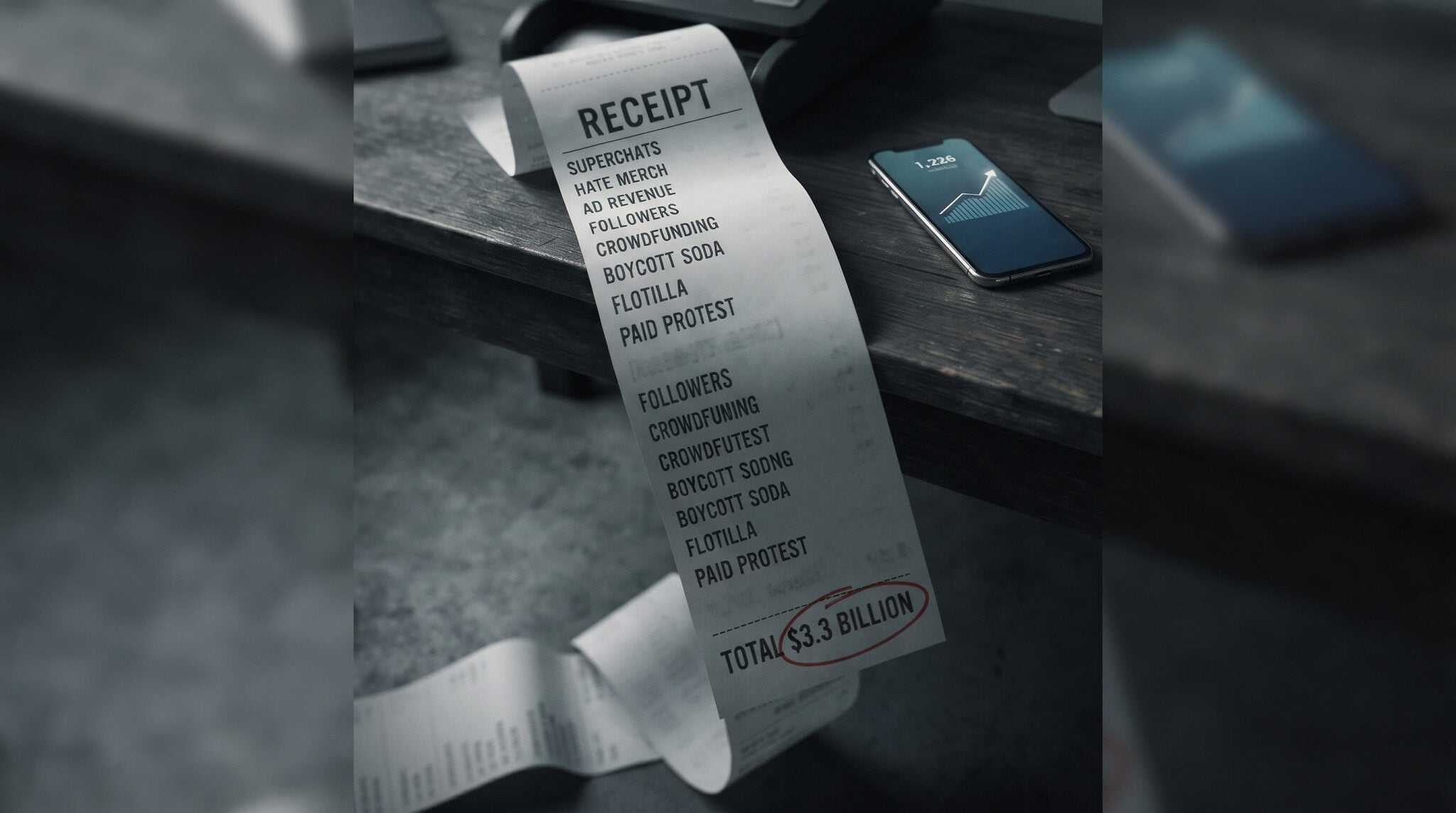
Add up only the slices someone has bothered to document, and leave Israel’s own government out of it: a state defending itself is not an industry, while foreign governments paying for a war against someone else’s existence are. Some of this money ended up in charity, and I count it anyway, because what is being sold is the cause itself. The haters and the anti-Israel side come to about $825 to $855 million that I could document, or $325 to $355 million without the alleged $500 million diversion that no court has yet tested. Add the long-term government money, UNRWA and the Jewish response, and it is an ecosystem of roughly $3.3 billion a year, or $3.55 billion counting everything. And that is before Qatar’s $3 billion poured into Western classrooms, and with maybe a fifth of the data.
In Juggernaut: A Paradigm Shift on Antisemitism (pub. March 2026), I argued that antisemitism is not a social attitude but a mechanical law of history. The money is just the latest proof. Hatred of Jews has outlived every empire that used it, because every era finds a way to make it pay. In the age of the algorithm, it pays by the click, by the subscription, by the vote, by the boat and by the hour.
So Myron Gaines was half right. There is a lucrative business. He is standing inside it. The business is in hating living Jews, while mocking dead ones.
A note on sources: Every figure in this article is quoted from the source named in the text; where a number is my own estimate, it says so. Inclusion in this article is not an accusation that any named person is antisemitic or has committed a crime. Allegations are described as allegations, and anyone charged is presumed innocent until proven guilty. Corrections and responses from anyone named are welcome and will be published.
–
This post was coauthored by Orr Leschziner and Paige Davidoff.
Related Topics