
Geopolitical Advisor | Foreign Policy | Defense & Security
How Authoritarian Powers Weaponize Antisemitism to Deflect and Disrupt

Spreading misinformation about Israel
Beyond the Jew, whether as an individual, a people or through Israel as the Jewish state, there are two often-overlooked participants in the spread of antisemitism: the person who creates and promotes the narrative, and the person who receives it, accepts it, and then passes it on to others.
The second category is particularly important. Not everyone who spreads antisemitic narratives necessarily considers themselves antisemitic. Some may even be convinced that they are fighting injustice, exposing corruption or challenging the powerful. Yet, by accepting and retransmitting allegations without scrutiny, they become part of the same machinery.
A recent example illustrates how this works.
From Nvidia to Israel: an extraordinary leap
Nvidia and its CEO, Jensen Huang, recently became the subject of international attention following reports concerning an alleged Chinese intelligence operation, Huang’s personal relationship with a business executive suspected by US intelligence of gathering information for Beijing, and the potential US and global security implications.
Nvidia’s board initiated an independent investigation. Huang subsequently resigned as CEO, with the company announcing that CFO Colette Kress would become interim CEO.
This is a story about a major American technology company, the strategic competition between the United States and China, the security of advanced AI technology and the increasingly important role of semiconductors in global economic and military power.
Yet, look at how some social media personalities chose to frame it:
Ian Carroll, whose audience numbers in the millions across platforms, circulated a narrative suggesting Israeli involvement in what was being presented as an extraordinary corporate conspiracy.

James Li, with an audience numbering in the hundreds of thousands, used the framing of an alleged Israeli coup.
Another account, Ginnysaidso, drew attention to the Israeli connections of Nvidia executives in a manner that invited suspicion rather than offering substantiated evidence.
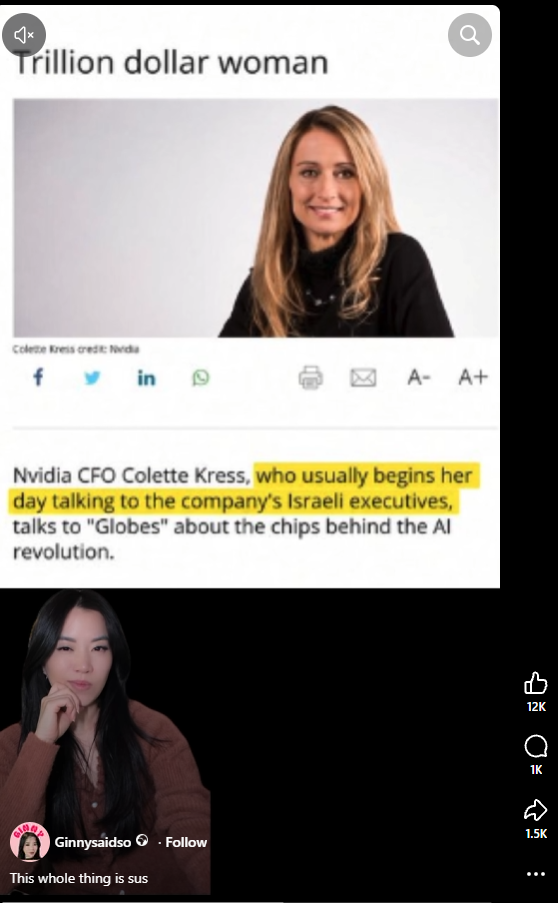
These are not merely examples of people questioning corporate governance or discussing Israel’s relationship with the technology industry. The problem is the insinuation that Israel, or Israelis, are somehow behind an alleged espionage operation involving a Chinese intelligence target, without evidence establishing such a connection.
The leap from a complex US-China national-security story to an Israeli conspiracy is precisely what deserves examination.
Why Israel? Why the Jews? And why is this explanation so readily accepted and distributed by people who might otherwise reject conspiracy theories?
The geopolitical value of an old prejudice
Let’s put the pieces together, without falling into the very conspiracy-driven thinking we are trying to examine.
China has a strategic interest in acquiring advanced American semiconductor technology. AI chips are not simply commercial products. They are critical to economic competitiveness, technological supremacy and military capabilities.
The allegations surrounding Nvidia therefore belong to a much wider geopolitical confrontation between Washington and Beijing.
But there is another dimension to this confrontation: information warfare.
China, Russia, Iran and other hostile states have every reason to exploit existing divisions within Western societies. They do not necessarily need to manufacture those divisions. They can identify them, amplify them and redirect public attention towards narratives that weaken trust in democratic institutions.
And few subjects offer such a historically established reservoir of prejudice, suspicion and conspiratorial thinking as antisemitism.
Foreign adversaries do not need to invent antisemitism. They exploit the antisemitism that is already there in our societies.
They can benefit from existing accounts, audiences and communities that are predisposed to accept narratives involving Jewish control, hidden Israeli influence or supposedly coordinated Jewish interests.
Some of these accounts may be ideologically committed antisemites. Others may simply be opportunists chasing engagement. Still others may be entirely unaware of the historical tropes they are reproducing. And some may even knowingly participate in influence operations originating from, or serving the interests of, states such as China, Russia, Qatar and Iran.
The result is the same: a narrative that serves the interests of an adversarial state, while being distributed voluntarily by people in the very societies that state seeks to weaken.
An old Russian invention, a modern information weapon
This is hardly a new phenomenon.
The Russian Empire provides a particularly disturbing example of how this mechanism worked. Antisemitic propaganda was used to redirect popular anger towards Jews, turning them into convenient scapegoats for wider political and social grievances. In April 1903, the Kishinev pogrom demonstrated the horrific consequences of this manufactured hatred. Later that same year, the first version of the Protocols of the Elders of Zion was published in a newspaper owned by Pavel Krushevan, a notorious antisemite whose publications had helped incite the pogrom. The fabricated text would go on to become one of history’s most enduring antisemitic conspiracy theories.
Its influence extended far beyond the circumstances in which it was produced. It became one of the most enduring instruments of modern antisemitism, repeatedly recycled by movements and individuals seeking to blame Jews for developments they could neither understand nor control.
Today, the distribution mechanism has changed dramatically. Social media can take an insinuation, give it an enormous audience and make it appear credible through repetition. An allegation published by one account is picked up by another, then another. Each repetition creates the impression of independent confirmation. Eventually, the original claim may become almost irrelevant. What remains is the suspicion.
This is particularly effective when the audience already has a predisposition to believe it.
We saw similar patterns during the Wuhan originating, COVID-19 pandemic, when conspiracy narratives involving Jews, global control circulated widely. China, Russia and other actors also exploited the pandemic to deepen existing divisions and undermine trust in Western institutions.
The forgotten responsibility
There is a reason I began with the distinction between those who manufacture antisemitism and those who receive and redistribute it.
We tend to concentrate on the first category. We identify the extremist, the propagandist, the politician or the media personality who openly promotes antisemitic ideas. We condemn them, expose them and, quite rightly, hold them accountable.
What about the millions of people who share a video because it confirms something they already suspect? Those who repeat an allegation because it comes from an account they follow? Those who would never describe themselves as antisemitic but have no difficulty accepting that Israel, or the Jews, must somehow be behind an unrelated international development?
They may not have created the prejudice. They may not even recognize it. But they help it travel.
And in an age of information warfare, that makes them useful.
The danger is not limited to the world’s approximately 15 million Jews or to the State of Israel. A society that can be persuaded to abandon evidence in favor of conspiratorial explanations is a society that becomes easier to manipulate, divide and destabilize.
Antisemitism is one of the oldest tools for achieving precisely that.
We are not simply witnessing the spread of an ancient hatred. We are witnessing how that hatred can be repurposed as a modern instrument of geopolitical influence.
And those who distribute it, knowingly or unknowingly, should understand the role they are playing.
You Don’t Have to Hate Jews to Spread Antisemitism.
Related Topics
Related Posts