
CFO | Empower Society for Good I Author
How Do We Make Sure We Never Lose the Land Again?
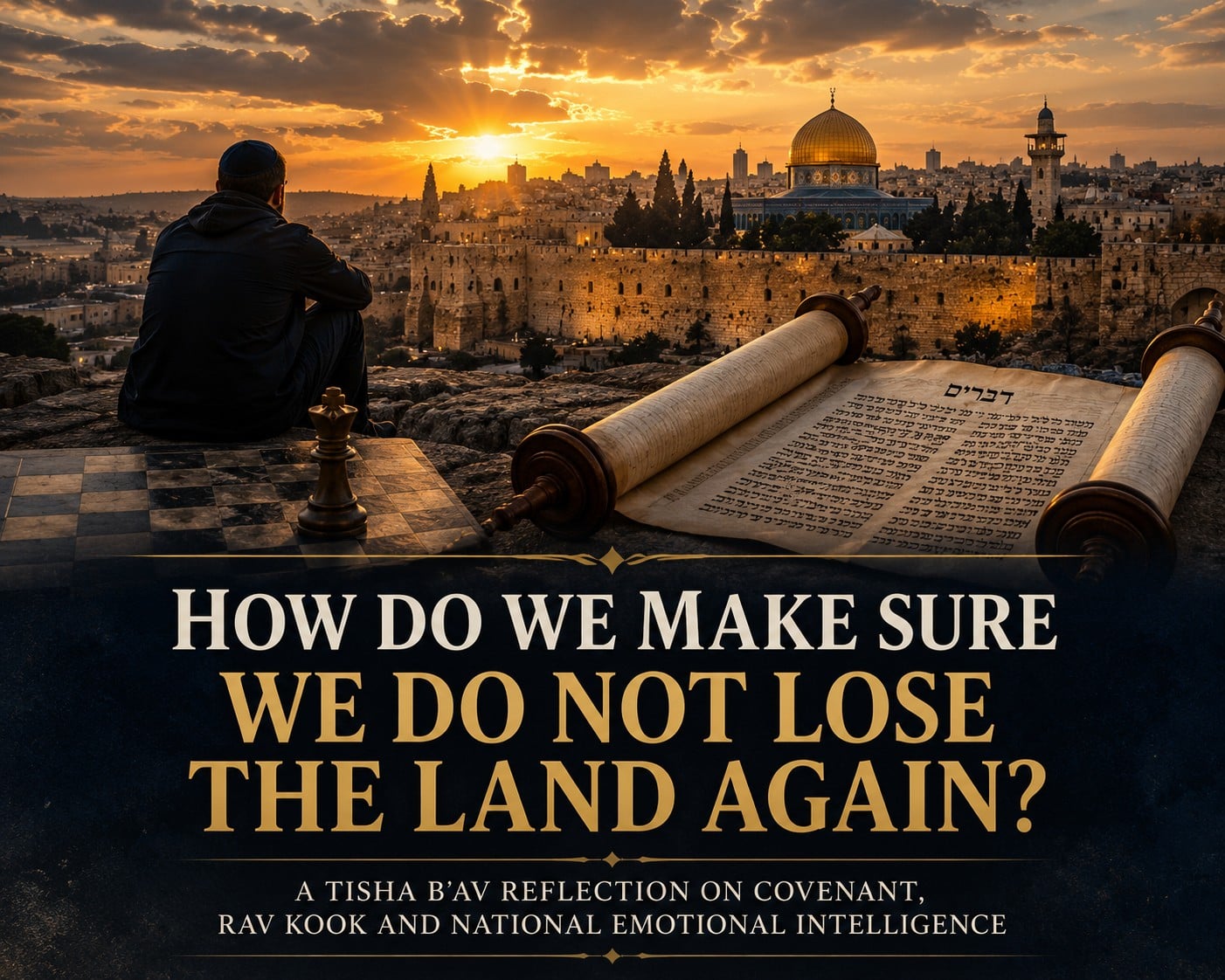
This question hit home when I attended the recent Zohar Conference in Tel Aviv. During one of the sessions, Yael Leibowitz posed this as the fundamental question, and every other question is secondary.
“How do we make sure we never lose the Land again?”
At first, it sounded like a question about military strength, diplomacy or national security. But as I reflected on it, I realised she was asking something much deeper. It was the very question that lies at the heart of Tisha B’Av.
Every year we mourn the destruction of the First and Second Temples. We sit on the floor, read Eichah and recite the Kinnot, remembering exile, persecution and loss. Yet Tisha B’Av is not simply about remembering what happened. It challenges every generation to ask why it happened—and, more importantly, what we must become to ensure that history does not repeat itself.
The Torah’s answer is both inspiring and demanding. The Land of Israel is not merely an inheritance; it is a covenantal responsibility. Again and again, Moses reminds the Israelites that remaining in the Land depends not only on military victories or political sovereignty, but on the kind of society they build. Justice, compassion, responsibility for the vulnerable, humility before God and fidelity to the covenant are not optional virtues. They are the conditions for remaining in the Land.
As I left the conference, I found myself approaching Yael’s question from an unexpected direction—not as a theologian or historian, but through my original reflection that I had prepared for Tisha B’Av. Without knowing, I probably had answered it.
It starts with a lesson I had learned years earlier in a corporate boardroom.
As a CFO, I have worked with many exceptional CEOs. I have also worked with one whose leadership style made every meeting unpredictable. Discussions could change direction without warning, criticism often arrived unexpectedly, and conversations frequently became emotionally charged. Eventually, it was decided that both the CEO and I should undergo executive coaching.
I entered those sessions convinced I was there to learn how to manage someone else’s behaviour. Instead, I discovered that the person whose reactions I first needed to understand was myself.
My coach introduced me to emotional intelligence. She explained that effective leadership is rarely about winning the immediate argument. It is about recognising your own emotions, understanding the motivations of others and resisting the temptation to react impulsively. Good leaders pause before responding. They ask what lies beneath the surface, consider the consequences of their actions and only then decide how to act.
Those lessons resonated deeply because, as a teenager, I played provincial chess. Chess is never simply about the next move. Strong players think several moves ahead, anticipating not only what their opponent might do but what the entire board will look like several moves later.
Leadership, I realised, follows the same principle.
This week I came across a paragraph from Rav Abraham Isaac Kook’s “LeNevuchei HaDor”. I encountered an idea that suddenly connected those coaching sessions with the story of the Jewish people.
Rav Kook argues that national life resembles individual life. Just as a healthy individual brings all of his or her abilities into action, so too does a healthy nation. A nation paralysed by fear, despair or confusion loses the capacity to fulfil its purpose.
His understanding of bitachon is equally profound. Trust in God is not passive optimism. It is confidence that empowers purposeful action. Faith should never lead to paralysis. Rather, it obligates us to use every faculty God has given us—our wisdom, courage, morality and strategic judgment—in the service of the covenant.
Reading Rav Kook, I found myself asking a question I had never considered before.
We speak about military intelligence, political intelligence and economic intelligence.
But do nations also require emotional intelligence?
Perhaps Tisha B’Av suggests that they do.
The First Temple was not destroyed overnight. Long before Babylon breached Jerusalem’s walls, the prophets warned that injustice, corruption and abandonment of the covenant would eventually cost the people their land.
Among the tragedies remembered on Tisha B’Av is the death of King Josiah. He was one of Judah’s greatest kings, restoring the Temple, rediscovering the Torah and renewing the covenant. Yet despite his righteousness, he made a catastrophic strategic mistake. Ignoring prophetic warnings, he confronted Pharaoh Necho at Megiddo and was killed. His death accelerated Judah’s decline towards destruction.
The lesson is both timeless and uncomfortable. Great leaders do not fail only because they lack courage. Sometimes they fail because they misread reality. They fail to recognise the moment in which they are living.
Faith without strategic wisdom is not enough.
The destruction of the Second Temple teaches a different, but equally painful, lesson.
The Sages attribute it to sinat chinam—baseless hatred. We often understand this simply as a moral failing, but perhaps it can also be seen as a collapse of national emotional intelligence.
The problem was never disagreement. Judaism has always celebrated vigorous debate. The problem was that disagreement hardened into contempt and ideological certainty replaced covenantal responsibility.
During the siege of Jerusalem, the Zealots became so consumed by their own uncompromising vision that they burned the city’s food supplies, believing that desperation would force the population to fight Rome rather than seek another course. Instead, they deepened famine, weakened their own people and hastened Jerusalem’s destruction.
Alongside this stands the story of Kamtza and Bar Kamtza, where a private humiliation escalated into a national catastrophe because no one possessed the humility or empathy to stop the cycle of resentment and revenge.
Rome destroyed the Temple.
But long before Rome breached Jerusalem’s walls, the covenant that held Jewish society together had already begun to unravel.
As I reflected on these lessons, I could not help thinking about Israel before October 7.
The judicial reform debate exposed profound divisions within Israeli society. Families, friendships and communities became polarised. Too often we questioned one another’s motives instead of trying to understand one another’s concerns. Whether one supported or opposed the reforms is almost beside the point. The deeper question is whether we were beginning to lose the ability to remain one people despite profound disagreement.
October 7 exposed another painful failure.
For years we interpreted Hamas through our own assumptions rather than taking seriously what it repeatedly declared about its intentions. We mistook temporary quiet for strategic transformation. We failed to read the map.
Today, as Israel continues to wage a long and difficult war, the debates surrounding military service and the sharing of national responsibility continue to test our unity. Hundreds of thousands of reservists have sacrificed careers, businesses and family life to defend the country.
Their burden and sacrifice deserve recognition and gratitude from every sector of Israeli society.
At the same time, genuine empathy also requires understanding the deeply held religious convictions and historical fears that shape much of the Haredi community. Empathy is not agreement. It is the willingness to understand another person’s reality before asking them to understand yours.
That distinction extends beyond Israel.
Much of today’s international conversation is rich in sympathy but poor in empathy. Sympathy expresses emotion. Empathy seeks understanding. It asks why Israelis, after centuries of persecution culminating in the Holocaust and now October 7, see security not as a political preference but as a condition of national survival.
Looking back, I now realise my executive coach was teaching me something far greater than how to navigate a difficult workplace.
She was teaching a principle that applies equally to individuals and nations.
When emotions run high, pause.
Read the room.
Read the map.
Seek first to understand.
Think several moves ahead.
Only then act.
Perhaps that is precisely what Rav Kook meant. Bitachon does not diminish human responsibility; it deepens it. Trust in God gives us the confidence to bring all of our strengths—military, economic, moral, spiritual and emotional—into the service of the covenant.
As I think back to Yael Leibowitz’s question in Tel Aviv, I have come to believe that the Torah’s answer is both timeless and urgently relevant.
We do not keep the Land simply because we are strong enough to defend it.
We keep it because we build a society worthy of it.
That has always been the covenant.
Military strength is indispensable. Economic resilience matters. Technological innovation has become one of Israel’s great blessings. But Moses warned that none of these, on their own, would guarantee our future. A covenantal society is sustained by justice, responsibility, mutual obligation and faith.
In our generation, I would add one more indispensable quality: what I have come to think of as national emotional intelligence.
We need the wisdom to read reality clearly, as King Josiah failed to do.
We need the empathy to preserve our unity, unlike the generation that witnessed the destruction of the Second Temple.
We need the courage to reject the destructive absolutism of the Zealots, remembering that ideological certainty without covenantal responsibility can destroy a nation from within.
We need the strategic clarity to understand our enemies, a lesson brought home with devastating force on October 7.
Above all, we need the confidence that Rav Kook describes as bitachon—not passive faith, but the courage to bring all of our national strengths into action in the service of the covenant.
Tisha B’Av is therefore not only a day of mourning. It is a day of national self-examination. Every year it asks us the same question:
What kind of society are we becoming?
The answer to that question will determine far more than the outcome of the next election or the next military campaign.
It will determine whether we remain worthy of the extraordinary gift that previous generations could only dream of: a sovereign Jewish state in the Land of Israel.
If we truly wish to ensure that we never lose the Land again, we must do more than defend its borders.
We must renew the covenant that binds us to one another, to our land and to God.
Questions to Ponder
- If the covenant, rather than conquest, secures our place in the Land, what does that demand of Israeli society today?
- What can King Josiah teach modern leaders about strategic judgment?
- What does the story of the Zealots teach us about ideological absolutism and internal division?
- Is sinat chinam best understood as a failure of morality, empathy—or both?
- What lessons should October 7 teach us about understanding both our enemies and ourselves?
- How do we balance bitachon with human responsibility and strategic wisdom?
- What would genuine national emotional intelligence look like in Israel today?
- If Tisha B’Av asks why we lost the Land, what must we become to ensure we never lose it again?
Related Topics
Related Posts