French-Israeli Visual Artist and Writer
How Do We Remember What is Kept in Silence?
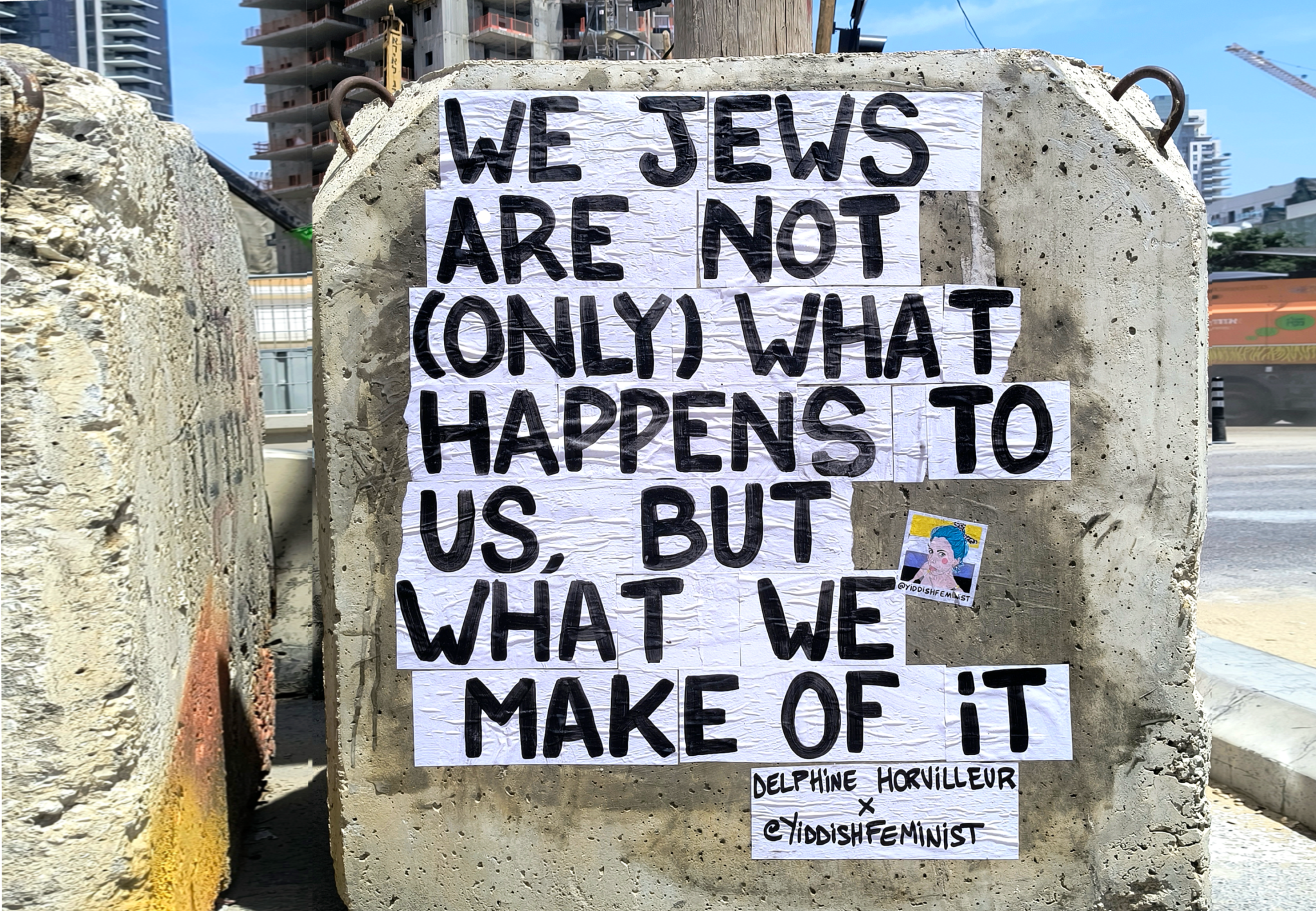
Credit : YiddishFeminist, Morgane Koresh, Delphine Horvilleur
What We Remember And What We’re Never Told
I come from a family of survivors.
My grandparents lived through the Shoah. But like so many Jewish families, what we passed down wasn’t always the full story. It was more often a silence, a tremor in the voice, a sense of heaviness without words. A command to ’remember – but to remember what, exactly, if we are not told?
The trauma was so great that it swallowed the language. And yet we, the grandchildren, grew up with the duty to carry the memory forward. What memory, we quietly wondered. The names? The places? The pain? The strength?
I was lucky in one way. In the 1990s, my great uncle was interviewed by the USC Shoah Foundation – The Institute for Visual History and Education, a nonprofit organization dedicated to preserving audio-visual testimonies of survivors and witnesses of the Shoah before their stories vanished with them. For the first time in his life, he shared his story fully and on record. He never did that with family, or at least not to that extent. And maybe he couldn’t.
That testimony became a doorway. Because my grandfather, his brother, died when I was not yet six. He never had the chance to share his memories directly with me, and perhaps never would have. But hearing his brother’s words helped me access a dimension of my family I would never have known otherwise. I heard their voices. Our voice.
It’s a strange and sacred thing: to receive your own past as something newly revealed.
Memory Is Not Automatic, It Must Be Preserved and Protected
The Shoah Foundation’s mission has since expanded, not only to preserve the stories of the Shoah, but also of other genocides and forms of antisemitism worldwide. Today, it continues to build one of the most important archives of human resilience, suffering, and survival in the world.
Now, in partnership with the American Jewish Committee (AJC), the Foundation is undertaking a new and vital project:collecting testimonies from individuals affected by contemporary antisemitism.
This effort is part of the Countering Antisemitism Through Testimony (CATT) initiative, which will become the largest-ever archive of firsthand accounts of antisemitism from 1945 to the present.
But this isn’t just about preservation. It’s about visibility. About education. About truth. About making sure our experiences are not erased or distorted. It’s about being heard – by the present, and by the future.
You may not think of your own story as “historic”, but it matters more than you know.
Perhaps you know someone whose experience deserves to be recorded. Or maybe it’s your own: your voice, in your own words, might one day help a grandchild, a student, a future historian understand what you lived through. They’ll be grateful you spoke.
At this stage, testimonies are being sought from:
● Jews who have experienced antisemitism in North Americapost-1945, especially in institutional settings (housing, education, employment, etc.)
● Sephardi, Mizrahi, or Yemenite Jews who were displaced from Arab countries in the mid-20th century
If this describes you or someone in your family, please consider sharing your story.
You can fill out this form directly online or reach out to testimonies@ajc.org
And if you’re not a direct witness but want to contribute to this work, you can volunteer to be trained as an interviewer. It’s a powerful way to participate in Jewish continuity, one testimony at a time.
There’s Pride in Telling Even the Hardest Stories
My own work focuses on the richness of Jewish life, both in Israel and in the Diaspora. I’m interested in joy, in creativity and in the depth of an identity that goes beyond survival. But survival is part of it. And so is memory.
We don’t only remember to mourn, we remember to connect. We remember to say: We were there. We endured. And we are still here.
Sometimes it’s easier to speak to an interviewer than to your children. Sometimes a grandchild will never know what a grandparent lived through unless someone else asks the right questions, with care, training and patience.
Initiatives such as this partnership between the American Jewish Committee (AJC) and the USC Shoah Foundation make this vision a reality.
This is not just about archiving pain. This is about truth-telling in an age of distortion. It’s about safeguarding knowledge in a time when ignorance and denial are rising again.
It’s about giving future generations the chance to know where they come from, in their own family’s voice.
And for those of us who grew up with more silence than story, it’s about finally understanding the weight we’ve been carrying, and the strength that lies underneath it.
Related Topics
Related Posts