London based entrepreneur, cybersecurity analyst doing a PhD in AI
How does Allah describe himself in the Quran?
How Allah Describes Himself: His Names, His Attributes, His Actions
Three ways of reading God’s self-description in the Qur’an
We often encounter religion through the behaviour of its followers. We meet their kindness or harshness, their learning or ignorance, and draw conclusions about the God they worship. Yet believers can misrepresent their beliefs. A different starting point is to ask what their scripture actually says.
How does Allah describe Himself?
For Muslims, the Qur’an is divine speech: God making Himself known through revelation. This article takes its scriptural examples from the Qur’an, without suggesting that Islam itself rests on the Qur’an alone.[1] English renderings convey meanings of the Arabic; they do not exhaust them. The reflections connecting these passages with everyday life are my own.
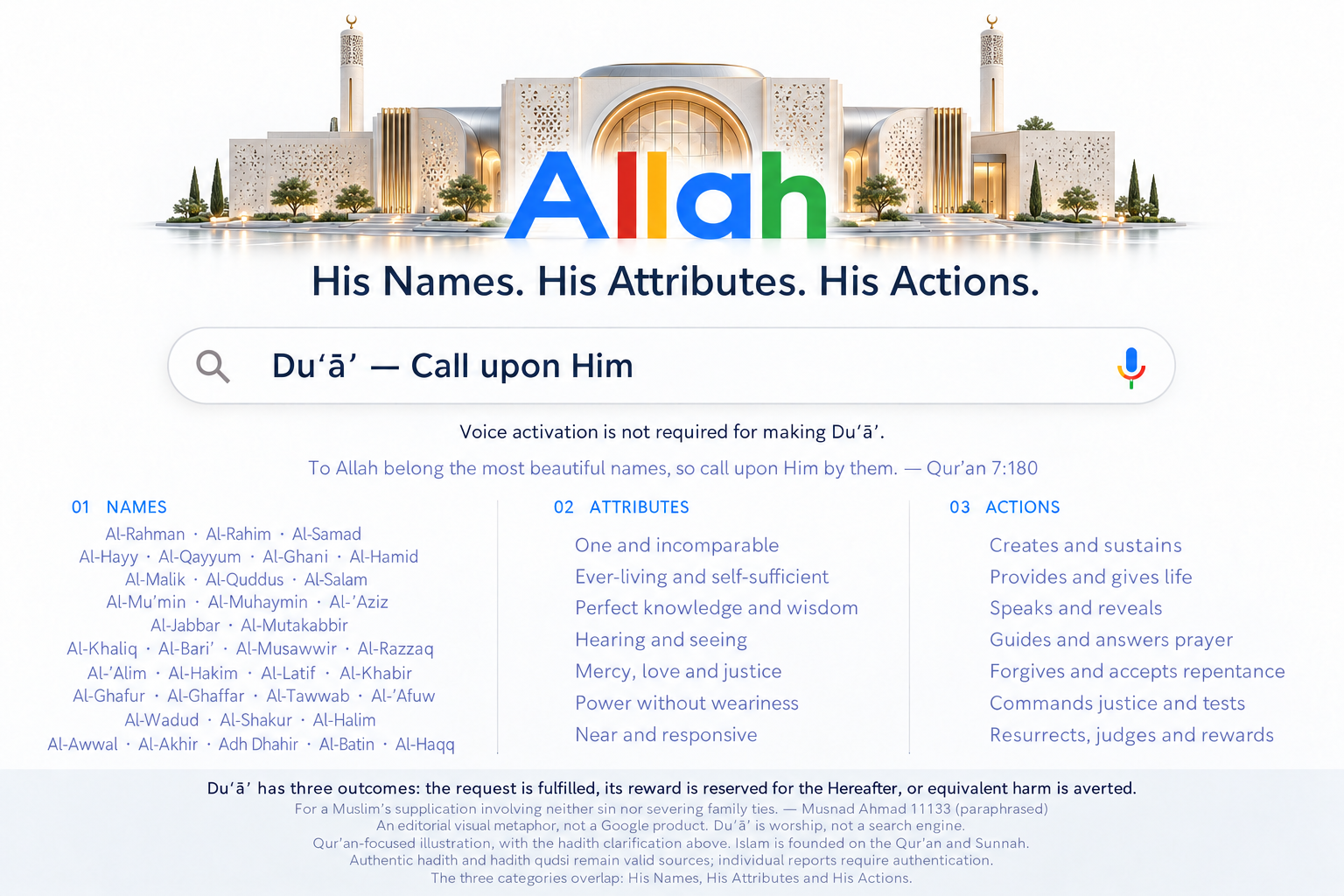
For this article, we can organise these passages under three overlapping headings: His Names, by which He makes Himself known; His Attributes, the perfections affirmed of Him, alongside the deficiencies denied of Him; and His Actions, what He tells us He does.
These are helpful reading categories, not three separate aspects of God or a numbered classification announced by the Qur’an. A name can express an attribute, and an action can reveal that attribute in relation to creation. These headings help us read related passages together. What follows is a selective introduction, not an exhaustive catalogue or an attempt to encompass God’s reality.
I. His Names: How Allah identifies Himself
The Qur’an declares that the most beautiful names belong to Allah and instructs people to call upon Him through them (7:180). Names are therefore part of worship and relationship. They teach the believer whom they are addressing.
The Qur’an does not itself supply a numbered catalogue of ninety-nine names. Its names appear throughout revelation, connected to particular teachings, promises and events. Reading them in those settings reveals more than memorising a list of English equivalents.
The opening chapter introduces Allah as Rabb al-‘alamin, Lord of all worlds, and Ar-Rahman and Ar-Rahim, commonly rendered the Most Compassionate and the Most Merciful (1:2–3). These Arabic names overlap in meaning; no simple English distinction exhausts them.
Mercy appears at the beginning of this encounter. But the same chapter names Him Master of the Day of Judgement (1:4). The reader meets compassion and accountability together, before travelling far into the book.
Al-Ikhlas identifies Him as Ahad, One, and As-Samad, the One upon whom all depend and who depends upon none (112:1–2). These names establish a relationship of dependence without suggesting any corresponding need in God.
Ayat al-Kursi names Him Al-Hayy, the Ever-Living, and Al-Qayyum, the Self-Subsisting Sustainer (2:255). Elsewhere, He is Al-Ghani, the Self-Sufficient, and Al-Hamid, the Praiseworthy (35:15). Human existence is received and sustained; divine existence is not borrowed.
Among the richest concentrations of names is the closing passage of Al-Hashr. Allah is Al-Malik, the King; Al-Quddus, the Holy; As-Salam, the One free from imperfection; Al-Mu’min, the Granter of security; and Al-Muhaymin, the Guardian (59:23).
The passage continues with Al-‘Aziz, the Almighty; Al-Jabbar, the Compeller, supreme in might; and Al-Mutakabbir, the Supremely Great. These names describe sovereignty and majesty. They must be read alongside the Qur’an’s insistence that God does no injustice (4:40), rather than through the character of a human despot.
Nor do they authorise believers to claim divine prerogatives. The Qur’an expressly warns human beings against arrogance (31:18). Recognising God’s greatness gives us a reason to question our own self-importance.
The following verse names Him Al-Khaliq, Al-Bari’ and Al-Musawwir: the Creator, the Originator and the Fashioner (59:24). The vocabulary draws attention both to existence itself and to the forms in which creatures exist. He is also Ar-Razzaq, the Provider (51:58).
Other names direct attention towards knowledge and wisdom. In the Qur’an’s account, the angels address Allah as Al-‘Alim, the All-Knowing, and Al-Hakim, the Wise (2:32). He is also Al-Latif, the Subtle, and Al-Khabir, the All-Aware (6:103). Knowledge is presented together with wisdom and awareness extending beyond what creatures can perceive.
For the person who has failed, the Qur’an offers Al-Ghafur, the Forgiving; Al-Ghaffar, the Repeatedly Forgiving; At-Tawwab, the Accepter of repentance; and Al-‘Afuw, the Pardoning (39:53; 20:82; 2:37; 4:149).
These names do not make wrongdoing insignificant. They tell us that wrongdoing need not become an irreversible identity. Return remains meaningful because the One addressed is described through forgiveness and pardon.
He is also Al-Wadud, the Loving (85:14). In a passage encouraging generosity, He is described as Shakur, Appreciative, and Halim, Forbearing (64:17). The Qur’anic vocabulary includes love, recognition of goodness and forbearance, alongside power and judgement.
Finally, Allah is Al-Awwal and Al-Akhir, the First and the Last, and Adh-Dhahir and Al-Batin, commonly rendered the Manifest and the Hidden (57:3). He is Al-Haqq, the Truth (22:6). These English equivalents are aids to understanding, not complete definitions. The passage ends by affirming His knowledge of everything (57:3), placing our brief lives within a reality exceeding our beginnings, endings and understanding.
The names are not decorative additions to belief. Each changes the meaning of prayer: the fearful seek protection, the remorseful seek forgiveness, the confused seek guidance, and the grateful acknowledge their Provider.
II. His Attributes: What Allah affirms and denies about Himself
If the names identify the One being addressed, the attributes deepen our understanding of what those names mean. The Qur’an describes divine perfection through affirmations, while also denying dependence, deficiency and resemblance to creation.
Its governing statement is strikingly concise: “There is nothing like Him” (42:11). The same verse affirms that He hears and sees. God is knowable through what He reveals, yet cannot be reduced to an enlarged version of ourselves.
Al-Ikhlas states that He neither begets nor is begotten, and that nothing is comparable to Him (112:3–4). He does not inherit existence or acquire divinity. His uniqueness is more fundamental than merely being the greatest member of a class.
His life is free from the vulnerabilities of ours. Neither drowsiness nor sleep overtakes Him, and preserving the heavens and earth does not burden Him (2:255). The creation of the heavens and earth brought Him no weariness (50:38).
Human care falters because carers become exhausted, distracted and mortal. The Qur’an places the foundation of existence beyond those limitations. Allah’s sustaining power is not an overstretched resource.
His knowledge is equally unrestricted. A falling leaf is known to Him; no grain hidden in the earth escapes His awareness (6:59). The passage moves from the immensity of creation to details human attention would overlook.
That knowledge also reaches inward. Allah knows what the soul whispers (50:16). The reader’s inner life is not inaccessible to its Creator.
For someone carrying private grief, this offers consolation: what cannot be explained to another person is not unknown to God. For someone concealing cruelty behind respectability, the same knowledge demands accountability.
His nearness is expressed in a passage about supplication: when His servants ask about Him, He declares that He is near and responds to the caller (2:186). The same verse calls them to respond to Him and believe in Him. This is a relationship of worship and response, not a measurement of physical distance. Transcendence does not mean indifference to the individual.
His mercy is described as encompassing all things (7:156). The same verse speaks of punishment and of mercy ordained for those who are mindful of Him, give zakat and believe in His signs. Its breadth must not be detached from its moral context. Elsewhere, He declares that He has prescribed mercy for Himself (6:12). Mercy is part of how He makes Himself known; it does not cancel accountability.
His justice is likewise explicit. Allah does not wrong anyone even by the smallest weight (4:40). Power and justice belong together in the Qur’anic account. Divine authority is never presented as permission for arbitrary wrongdoing.
His love has ethical content. Allah loves those who do good (2:195), those who repent and purify themselves (2:222), the patient (3:146), those who trust Him (3:159), and those who act justly (5:42).
Conversely, He does not love those who transgress (2:190), does not love corruption (2:205), and does not love the arrogant (16:23). Belonging to a religious community does not turn these behaviours into virtues. The qualities God commends must scrutinise the believer’s conduct.
The Qur’an also uses expressions concerning His Face (55:27), His two Hands in the creation of Adam (38:75), and His being established over the Throne (20:5). A faithful account should neither conceal these passages nor turn them into a physical diagram of God.
They must be read alongside His incomparability and the statement that human beings cannot encompass Him in knowledge (20:110). This article does not attempt to settle theological debates about how such expressions should be understood.
The Qur’an also describes Allah as the Light of the heavens and earth, gives a parable of light, and speaks of His guiding whom He wills to His light (24:35). This profound passage should not be reduced to a claim that God is a measurable physical phenomenon. Nor should a brief article pretend to exhaust its interpretation.
The Qur’an establishes a discipline for all such reflection: it forbids speaking about Allah without knowledge (7:33). Confidence in His wisdom does not authorise certainty about every hidden purpose.
That restraint matters beside another person’s suffering. We may affirm that God knows and is just without pretending to know exactly why a particular tragedy occurred. Faith should make our explanations more careful, not less compassionate.
III. His Actions: What Allah tells us He does
Names and attributes become especially vivid when the Qur’an describes divine action. Allah creates, provides, speaks, guides, responds, forgives and judges. The relationship between Creator and creation is presented through these acts.
He creates the heavens and earth and describes human development in the womb (39:5–6). He sends rain and brings vegetation from the ground (16:10–11). He provides for living creatures (11:6).
The signs of His activity therefore surround ordinary life. Eating, drinking, planting and observing the world can become occasions for gratitude. Creation is not discussed only as a remote event at the beginning of time.
Allah also sustains what He creates. He holds the heavens and earth from passing away (35:41). Existence is presented as dependent upon Him, rather than as something that has outgrown its need for its Creator.
He speaks and sends revelation. The Qur’an states that Allah spoke to Moses (4:164), and describes communication through revelation, from behind a veil, or through a messenger (42:51).
He sends messengers bearing good news and warning (4:165). Guidance addresses human moral need: how to live, what to worship, how to distinguish good conduct from wrongdoing, and how to understand responsibility.
This guidance is not permission to surrender thought. The Qur’an repeatedly calls people to reflection, including reflection upon the book itself (38:29). Receiving instruction and exercising understanding belong together.
Allah responds to prayer (2:186). The promise invites trust, but it should not be expanded into a guarantee that we can dictate an outcome or timetable.
In a passage specifically concerning prescribed fighting, the Qur’an reminds its hearers that they may dislike something beneficial or love something harmful, while Allah knows what they do not (2:216). The broader lesson about the limits of human judgement is relevant here: asking God does not make our own assessment infallible.
He accepts repentance and pardons wrongdoing (42:25). Those who have transgressed against themselves are told not to despair of His mercy (39:53). The following verse calls them to return and submit to Him (39:54).
That sequence is important. Hope opens the possibility of change; repentance asks the person to enter it. Forgiveness cannot honestly be invoked as an excuse to continue harming others.
Another passage connects repentance, belief and righteous conduct with evil deeds being replaced by good (25:70). The Qur’an’s moral imagination reaches beyond permanent disgrace. A damaged life can become a changed life.
Allah also commands. He directs people towards justice, excellence and generosity to relatives, while forbidding indecency, wrongdoing and oppression (16:90). Divine action includes moral instruction, not merely intervention in events.
These commands interrupt our loyalties. Believers must uphold justice even against themselves and their families (4:135), and must not allow hatred of others to produce injustice (5:8). God’s authority cannot honestly be invoked only when it supports our side.
He tests human beings. Death and life are created as a test of conduct (67:2); both hardship and prosperity can be tests (21:35). Comfort is therefore not automatic proof of divine approval, nor suffering automatic proof of rejection.
He gives life, causes death and brings people to life again (30:40). Human mortality appears within a larger movement of creation and return. Death does not erase the moral significance of what happened before it.
He judges with justice. The Qur’an describes scales being established so that no soul suffers injustice (21:47). Even the smallest good and evil will be seen (99:7–8).
This gives significance to what public life overlooks: the quiet kindness, the concealed exploitation, the private sacrifice. Reputation is not the final measure of a human being.
Allah multiplies good deeds (4:40), forgives, and rewards. He also punishes. The Qur’an places the declaration of His forgiveness and mercy beside a warning about painful punishment (15:49–50). An honest account must retain both.
Without accountability, the powerful could mistake impunity for innocence. Without mercy, the remorseful could mistake failure for a final identity. The Qur’an addresses both dangers.
The three categories therefore belong together. His Names teach us how to call upon Him. His Attributes teach us what He affirms about Himself. His Actions show how He creates, sustains and addresses His creatures.
To call upon the Forgiving is to approach with repentance. To invoke the All-Seeing is to examine what we do when nobody else watches. To believe in His justice is to accept scrutiny of our own behaviour.
This also explains why the same passage may belong under more than one heading. When Allah identifies Himself as the Forgiving, a name conveys an attribute; when He describes forgiving a servant, the text describes an action. The overlap strengthens the account rather than making the distinctions useless.
For readers encountering Islam from outside, these connections can prevent a fragmented impression. Selecting only passages about punishment obscures mercy; selecting only promises of forgiveness obscures responsibility. Our understanding must attend to what the text says across these themes.
For Muslims, the demand is more personal. Names spoken in prayer should remain present in conduct after prayer. A person who asks the Merciful for compassion should examine their treatment of the vulnerable. A person who seeks pardon should take responsibility for harm. A person who trusts divine knowledge should remember how much remains beyond their own understanding and judgement of others.
The question is not simply whether we can recite a description of God. It is whether that description changes us: whether it makes the arrogant humbler, the despairing more hopeful, and those who profess belief more honest, merciful and just.
[1] A note on sources, interpretation and belief.
Taking this article’s scriptural examples from the Qur’an is a choice of scope, not a rejection of the Sunnah. Islam is founded on the Qur’an and the Prophet Muhammad’s ﷺ Sunnah; authentic hadith, including authentic hadith qudsi, remain valid sources. Hadith qudsi are reports in which the Prophet ﷺ attributes a saying to Allah. They are distinct from the Qur’an, and individual reports require authentication.
For readers from other traditions, Rabbinic Judaism’s distinction between Written and Oral Torah offers a limited comparison for understanding the importance of more than a written scriptural text. The Christian Gospels likewise preserve accounts of Jesus’ actions as well as his words, although this is a different kind of comparison. These traditions do not have identical understandings of revelation, transmission or religious authority.
The Qur’an affirms that Allah revealed the Torah and the Gospel (3:3). It also condemns falsely attributing human writings to Allah (2:79), twisting speech so that it is mistaken for scripture (3:78), and distorting words from their proper places (5:13). Muslim discussions of alteration and distortion draw on these passages; they should not be paraphrased as saying that every sentence of existing Jewish and Christian scriptures is false. These are Islamic theological claims, not judgements Jews and Christians share about their scriptures.
Muslims believe that the Qur’an is divinely preserved, citing the promise to preserve the Reminder (15:9). That conviction does not make every transmitted report, translation, interpretation, institution or Muslim action incorruptible.
Throughout this article, English descriptions are translations or explanatory paraphrases, rather than claims to reproduce every shade of the Arabic. References identify the relevant chapter and verse. The selection and practical reflections are not themselves revelation. Any accompanying illustration is a conceptual aid, not a depiction of Allah; no arrangement of words, shapes or symbols can encompass Him.
Related Topics