
The views expressed herein are solely mine.
How Israel Can Turn Assad Into Diplomatic Leverage
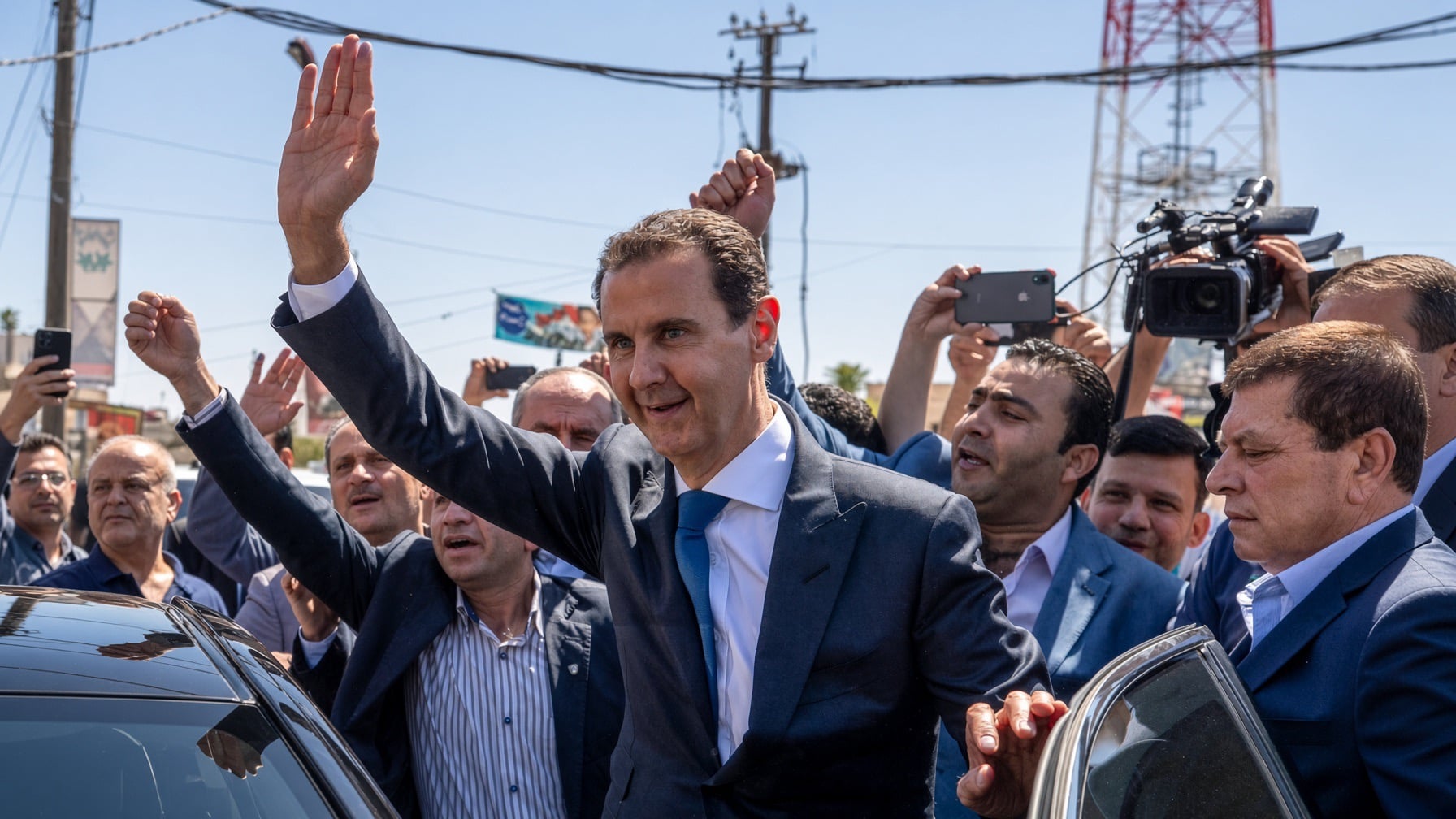
Then-president Bashar al-Assad, center, waves to his supporters at a polling station during presidential elections in the town of Douma, near the Syrian capital of Damascus, May 26, 2021. (AP Photo/Hassan Ammar, File).
Global institutions and major media outlets devote relentless energy to the claim that Israel “commits genocide” in Gaza. Yet those same institutions maintain near-total silence on the systematic destruction that Bashar al-Assad perpetrated against his own population. By early 2025, the Syrian Observatory for Human Rights had documented more than 650,000 deaths in the Syrian civil war, while the Syrian Network for Human Rights attributed roughly 202,000 civilian deaths—and 87 percent of all documented civilian casualties—to al-Assad’s forces and their Iranian allies.
Barrel bombs, chemical weapons, and industrial-scale torture in facilities such as Sednaya produced those staggering figures. By contrast, Gaza’s Hamas-run health ministry reports roughly 70,000 total deaths without separating combatants from civilians. Israel Defense Forces assessments attribute more than 25,000 of those fatalities to terrorists from Hamas, Palestinian Islamic Jihad, and 10 allied factions—putting the estimated civilian death toll at up to 45,000. Nevertheless, this vast disparity in scale, intent, and method receives almost no sustained international examination.
Hafez al-Assad’s 1982 assault on Hama established the family’s blueprint. Syrian forces surrounded the city for nearly a month, subjected it to continuous artillery and air bombardment, and killed between 10,000 and 40,000 people, according to Amnesty International and the Syrian Network for Human Rights. Decades later, Bashar al-Assad applied the same logic nationwide, conducting more than 200 chemical attacks, dropping tens of thousands of barrel bombs, and displacing over 12 million Syrians. However, this sustained campaign of state terror never generated a fraction of the annual General Assembly or Human Rights Council resolutions aimed at Jerusalem.
Other conflicts expose the exact same selective blindness. In Yemen, direct and indirect war deaths approach 377,000 according to United Nations Development Programme modeling. In contrast, Sudan’s civil war has killed tens of thousands—including mass atrocities in El Fasher—without triggering comparable institutional outrage. According to UN Watch data, the General Assembly moved to adopt 11 country-specific resolutions against Israel in 2026 compared with just 8 against the rest of the world combined, continuing a decade-long pattern in which the Jewish state faces roughly twice as many condemnations as every other nation put together. Meanwhile, Ukraine’s November 2026 naval-drone strike against a Russian corvette in Benghazi immediately prompted a joint probe by Moscow and eastern Libyan authorities alongside calls from the UN Support Mission in Libya to keep the country out of foreign wars—even as regimes that slaughter their own citizens by the hundreds of thousands escape meaningful diplomatic consequence.
Jerusalem should stop complaining about this asymmetry and start exploiting it—beginning with Bashar al-Assad himself. Rather than viewing the deposed dictator as a closed chapter, Israel should design a high-value targeting and extraction operation that treats his capture as a premier strategic asset. Assad has already been the subject of two separate reported targeted-killing attempts by poisoning during his Russian exile—first in late December 2024 and again in September 2025—proving that Moscow’s security bubble is neither impenetrable nor permanent. By exploiting fractures in his exile network to isolate and extract him, Jerusalem would seize the ultimate bargaining chip over Damascus. Israel should hand over Assad to Ahmed al-Sharaa—who has already sentenced him to death in absentia—only after the new Syrian government signs a binding security agreement, concludes a formal peace treaty, and joins the Abraham Accords. Beyond securing northern border stability and permanently dismantling the logistical architecture that once enabled Iranian and Hezbollah entrenchment, capturing Assad would establish an unmistakable precedent: great-power sanctuary no longer guarantees impunity for architects of mass murder.
To reinforce hard leverage with information dominance, the Jewish state should next establish a permanent, multilingual open-source intelligence platform aggregating verified casualty records, satellite imagery of mass graves, and primary-source documentation from Syria, Yemen, Sudan, and other neglected theaters. Rather than letting anti-Israel voting blocs monopolize the narrative at Turtle Bay and Geneva, this archive would supply real-time regional briefings, interactive forensic maps, and verifiable datasets directly to journalists, prosecutors, and diplomats worldwide. Ranking conflicts by absolute civilian deaths, percentage of casualties inflicted by state forces, and volume of UN resolutions would expose—in hard numbers—the moral inversion governing international diplomacy.
Finally, Israel should translate that data into diplomatic muscle by convening a Peripheral Atrocity Accountability Pact uniting nations across Africa, Latin America, and Southeast Asia whose civilian death tolls Western media and UN bodies routinely ignore. Member states would pool satellite, signals, and open-source intelligence to publish a quarterly Atrocities-to-Condemnation Index alongside a shared forensic archive of mass-grave sites and detention records. In exchange for global visibility and investigative backing, participating states would commit to coordinated voting blocs at the United Nations and mutual support for targeted sanctions against the worst offenders.
Diplomacy in the Middle East respects leverage, not wishful thinking. Until Jerusalem forces the world to weigh real mass graves against fabricated smears, international institutions will continue to reward mass murderers while lecturing the only true Western democracy in the regional fighting for survival.
Related Posts