The views expressed herein are solely mine.
How Israel Crushed Putin’s Middle East Dream
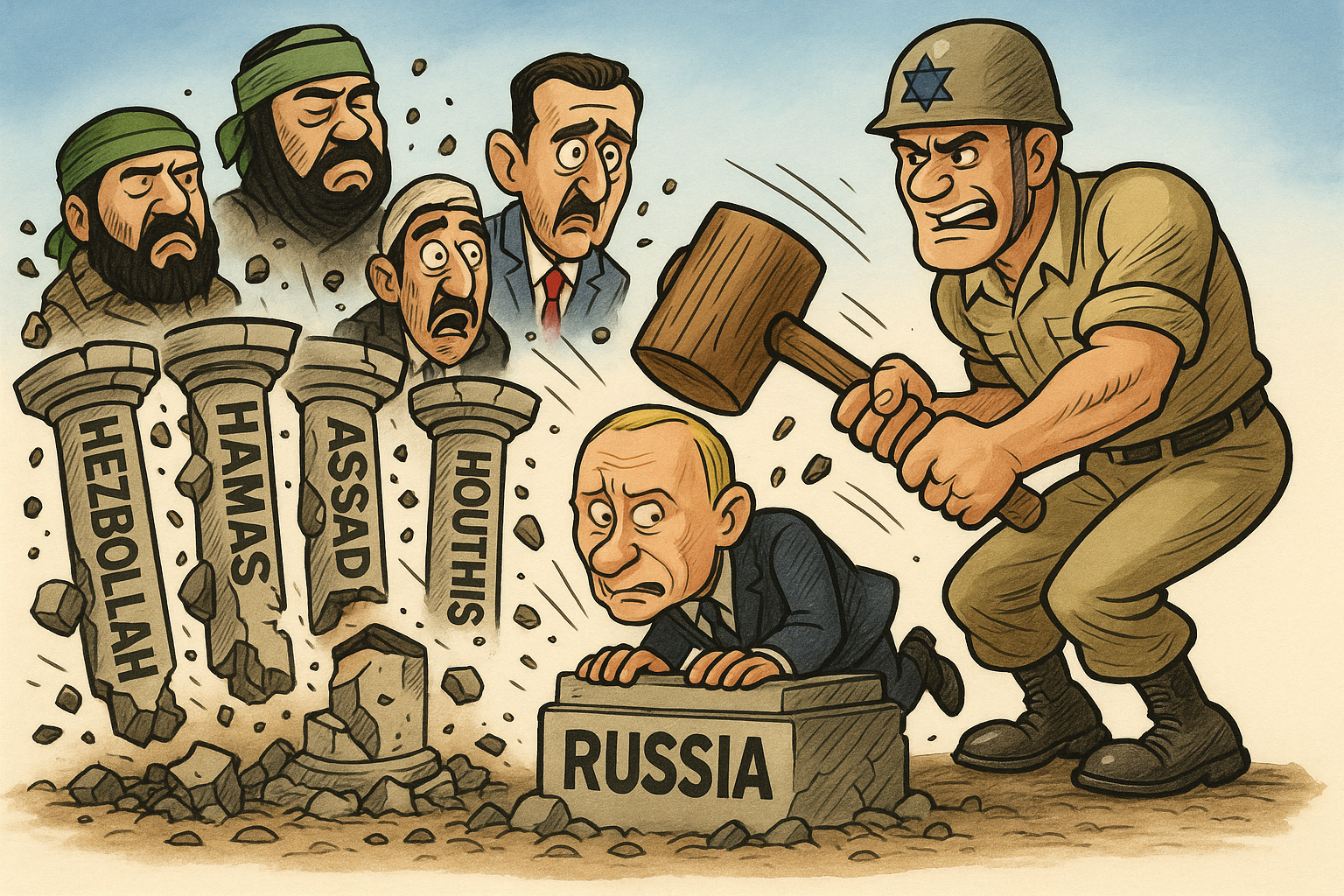
A caricature shows Israel smashing Russia’s crumbling Middle East pillars—Hezbollah, Hamas, Assad, and the Houthis—while a panicked Putin clings to the ruins. AI Generated Image.
October 7th, 2023 was meant to be Israel’s undoing.
Instead, it became the hammer blow that shattered Moscow’s fragile empire in the Middle East.
For years, Russia ruled the region through terror proxies and tyrants—Hezbollah, Hamas, Assad, the Houthis, Iran—each a cog in Moscow’s so-called “Islamic axis of resistance.”
Analysts from the Jamestown Foundation and the Carnegie Endowment have long warned that Russia’s regional reach relies on proxy warfare, energy leverage, and arms diplomacy—a modern empire held together not by belief, but by chaos and coercion.
Then Israel tore it apart.
In Lebanon, Hezbollah—once the crown jewel of Russian and Iranian power—has been gutted.
Since October 2023, 70,000 rockets—one-third of Hezbollah’s total arsenal—have been destroyed or intercepted, and Israeli strikes have killed more than 3,000 Hezbollah members (including senior commanders Ali Hussein Burji and Ibrahim Aqil).
Even Hassan Nasrallah, the terrorist organization’s military, political, and spiritual figurehead, was taken out in a precision strike that decapitated the organization.
What was meant to be a “second front” for Israel is now a graveyard of failed invasion units.
Hezbollah is no longer Tehran’s sword or Damascus’s shield—it is a bleeding relic of a dying empire.
In Syria, Bashar al-Assad’s fall sealed Moscow’s fate.
Once Russia’s indispensable client, Assad now hides in exile on Russian soil—poisoned twice, politically discarded, and replaced by Ahmad al-Sharaa, a former Al-Qaeda and ISIS jihadist commander turned new strongman.
Even Western governments went on to congratulate Al-Sharaa after his tightly controlled “elections,” in which only six women won seats and one-third of parliament was handpicked by the interim president—mostly Sunni loyalists.
Al-Sharaa’s recent visit to Moscow reportedly centered on one humiliating topic: Assad’s extradition to Damascus for trial—a desperate move by Russia to protect its bases in Latakia and Tartus.
Meanwhile, Israel’s relentless bombing campaign across Syria—striking Iranian convoys, drone factories, and weapons depots—forced Putin to pull his S-300 and S-400 air-defense systems back to Ukraine months ago.
The result: Russia no longer rules Syrian skies. Israel does.
Interestingly, academics long argued that Russia’s credibility in the Middle East depended on holding “the Syrian theater.”
That “scenario” has collapsed, along with the illusion of Moscow’s regional dominance.
In Gaza, Hamas—the supposed Palestinian “card” in Russia’s destabilization game—has been annihilated.
After praising Hamas on October 7th, 2023, and hinting their tactics would be studied at Russian military academies, Moscow now stands silent. The reality is unavoidable: Hamas can only survive through politics, not terror.
Under the current ceasefire with Israel, the Muslim Brotherhood terrorists will hold 47% of Gaza and will be able to have full control over its personnel -around 20,000- again.
But logistically and militarily, they are finished.
Twenty-three of their twenty-four battalions are gone.
Over 25,000 fighters—among them Marwan Issa, Ayman Nofal, Mohammed Deif, and Yahya Sinwar—are dead.
More than 500 tunnels (around one third of their London-like underground system), hundreds of leveled weapons factories, and intelligence command bunkers like the one under Shifa Hospital are gone.
Hamas, once Moscow’s favorite pressure point against Israel and Washington, is now dust.
Further south, the Houthis—the final spoke in the Russian-Chinese anti-Western wheel—have been reduced to background noise.
Israeli naval drones, with U.S. and U.K. support, now patrol the Red Sea, shooting down swarms of Houthi drones and anti-ship missiles.
In January 2025, Israel’s Arrow system intercepted a long-range missile aimed at Eilat, while precision strikes near Sana’a and Hodeidah shattered Houthi launch sites.
At the same time, Houthi leaders—Ahmed al-Rahawi, the regime’s prime minister, and Muhammad Abd al-Karim al-Ghamari, chief of staff—were killed in surgical airstrikes that sent a message: no one is safe.
Even Iran—the heart of this network—has paid a heavy price for hitching its ambitions to Moscow’s decaying empire.
During Israel’s summer campaign, strikes hit facilities directly tied to Russia’s nuclear cooperation program—projects Moscow had spent years building. The two regimes have since announced a $25 billion plan to rebuild them, but the message was clear again: Russia cannot even protect its own strategic assets inside Iran.
What the world is witnessing is not just a war, but the demolition of a geopolitical order.
Although Russia’s Middle Eastern empire was never colonial, it was criminal.
Moscow’s Middle Eastern geopolitical strategy thrived on militias, drug routes, and dictators who traded sovereignty for oil and weapons.
Scholars now agree that Moscow’s grip—from Damascus to Sana’a—was built on corruption, coercion, and the illusion of power.
Once Israel dismantled those pillars with surgical intelligence and superior force, the façade crumbled.
And the irony is brutal.
While Washington preaches “restraint” and Europe hides behind UN resolutions, Israel has redrawn the strategic map of the Middle East.
Moscow’s proxies lie in ruins, its tyrants dethroned, and its power projection reduced to ashes.
October 7th, 2023 was meant to break Israel.
Instead, in two years, the Jewish State achieved what America could not in two decades—ending Russia’s reign in the Middle East.
Related Topics
- Abraham Accords
- China
- Gaza
- Gaza Border
- Gaza Disengagement
- Gaza Rocket Attacks
- Gaza Strip
- Hamas
- Hezbollah
- Hostages in Gaza
- IDF
- Iran Nuclear Deal
- Islam
- Israel At War
- Israel-China Relations
- Israeli Foreign Policy
- Jerusalem
- Lebanon
- Middle East
- October 7 anniversary
- Palestinian Statehood
- Palestinians
- Russia
- Syria
- Terrorism
- Yemen
Related Posts