
How Israeli AI Is Redefining the Future of Sales
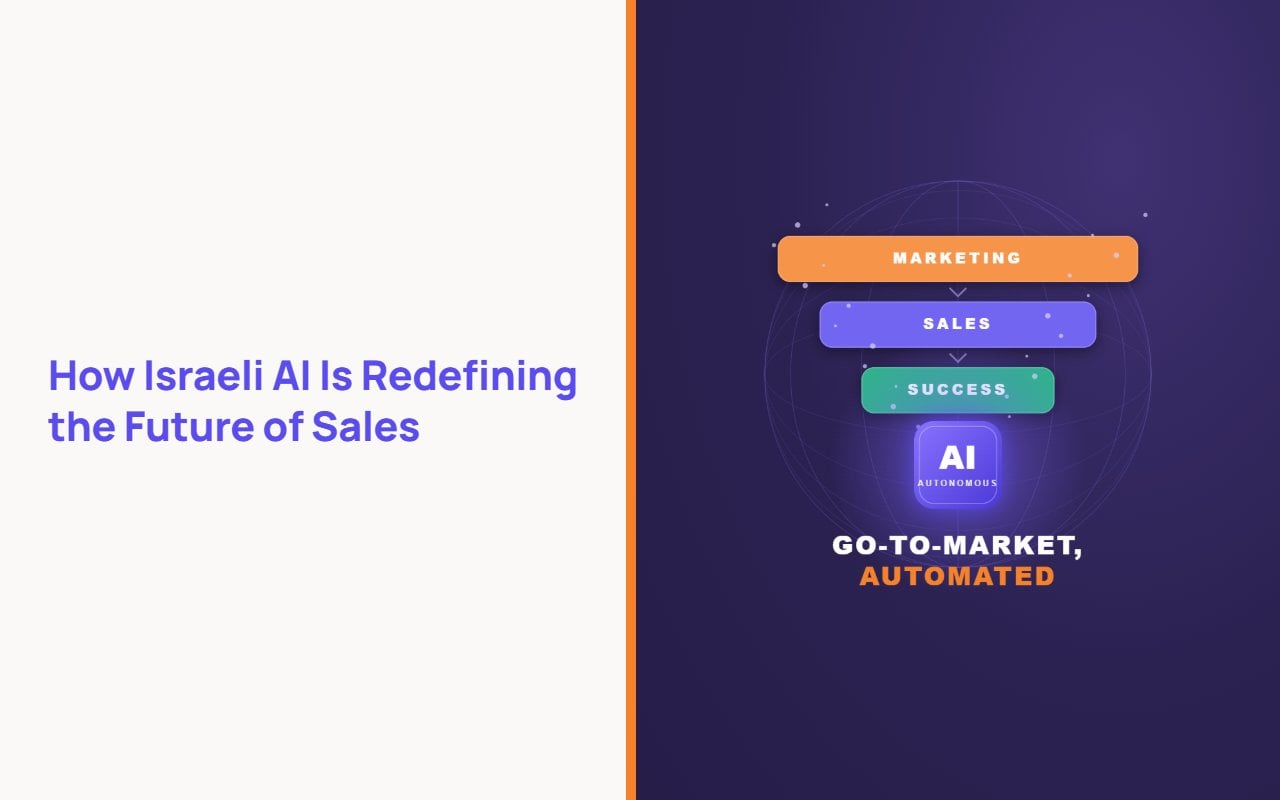
In recent pieces, I’ve explored how Israel has evolved from a cybersecurity and infrastructure powerhouse into a genuine AI leader across enterprise functions. This legacy of security dominance was recently highlighted by the remarkable exit of Wiz to Google.
However, there is a more specific phenomenon that I think deserves its own discussion. We are seeing a remarkable concentration of Israeli innovation across the technology that powers how companies find, convert, and keep customers, spanning sales, marketing, and customer success alike, and it tells us a lot about where our ecosystem is heading next.
This is not just a story about automation. It’s a fundamental rethinking of how revenue is generated at scale, and Israeli companies across several different categories are writing some of the most interesting chapters of it.
The Shift From Tool to System
For years, go-to-market technology meant software that helped people do their jobs faster. CRM platforms, email sequencers, and analytics dashboards are all useful, but incremental.
What I find genuinely exciting about the current wave of Israeli AI development is that it has moved well past that frame, and not just in one corner of the revenue function.
The pattern shows up more consistently, and the same shift that took code generation from basic autocomplete to tools writing and reviewing entire features with minimal supervision is now playing out across sales, marketing, and customer operations.
Alta, an Israeli startup out of Tel Aviv founded by one of the first employees of Monday, delivers AI-driven sales automation at the top of the funnel with the kind of consistency and geographic reach that human SDR teams simply cannot maintain across time zones, languages, and buying process variations.
A few miles away, Sett is applying the same logic to marketing, automating user acquisition campaigns for gaming companies well enough to raise a 30 million dollar round on the strength of it. And Notch is doing the same for customer experience in regulated industries like insurance and healthcare, areas where a trained human team was once the only option.
What strikes me across all three is the same product instinct. A prioritization of measurable commercial outcomes over feature sophistication that reflects something genuine about how our engineering culture approaches problems, whatever corner of the revenue function it happens to be solving for.
The most consequential products being built today, in sales, marketing, and customer success, are systems that execute commercial workflows autonomously, identifying prospects, interpreting intent signals, personalizing outreach at scale, managing follow-up sequences, and handing off to a human only at precisely the right moment.
That distinction between assistant and autonomous operator is not subtle. It represents a structural change in what a revenue function can look like, and the companies building toward it, across categories, are operating in a different league from those still iterating on the previous generation of technology.
That same logic does not stop at revenue technology either. BARY, a Tel Aviv startup that built an AI system for translating, subtitling, and dubbing film and television content, was acquired by the French media group Netgem this month. It is further evidence that the shift from assistive tool to autonomous system is showing up well outside the go-to-market stack too.
Why Israel Keeps Producing This
According to a report from Startup Nation Central, AI startups now make up 30% of Israeli tech companies and account for 47% of total investments.
The momentum has only built since. Israeli high-tech companies raised over $3 billion in early 2026 alone, a 34% jump over the same period the previous year, with artificial intelligence absorbing the bulk of it. That concentration did not happen by accident, and understanding why Israel keeps producing serious AI builders, across sales, marketing, customer success, and well beyond, requires some honest reflection on the environment that shapes them.
An innovation-first culture exposes engineering talent to high-pressure problem-solving early in their development. The habits that this environment plants are the act of building lean, testing against adversarial conditions, and optimizing relentlessly for outcome over elegance. This translates directly into how product teams approach AI development, whatever market they eventually build for.
Revenue data of every kind is noisy, whether it is a sales signal, a marketing campaign result, or a customer support ticket. The signals that indicate genuine intent are buried in noise regardless of which part of the revenue function generates them. Building AI that navigates those conditions reliably requires exactly the engineering disposition that our system, for all its particular pressures, tends to develop.
The Israeli founders building in this space, across sales, marketing, and customer operations alike, tend to have direct operational experience with the problem they are solving. Likewise, the founders behind Notch and Sett, built and ran commercial operations before they built tools to automate them. That grounding in revenue reality produces product thinking that purely technical teams sometimes lack.
The International Dimension
The pattern emerging across enterprise organizations is consistent. Companies integrating AI into their revenue function, whatever shape that function takes, are generating more qualified pipeline and stronger retention without proportional increases in headcount. For growth-stage companies trying to scale faster than they can hire, that leverage is significant. For Israeli companies specifically, it has additional strategic value.
Selling into enterprise markets in the United States and Europe from Israel means building go-to-market infrastructure that can operate effectively across time zones, cultural contexts, languages, and buying process differences that domestic US sellers simply do not face to the same degree.
AI-driven systems that can run consistent outreach, campaigns, and support across geographies without the coordination overhead of large distributed teams address a real operational constraint that Israeli companies encounter earlier in their growth than their US counterparts typically do.
It is no coincidence that a company like BARY, built to solve the language and localization side of that same constraint, found a buyer so quickly. It is the same problem Alta, Sett, and Notch are each solving from a different angle, just expressed through entertainment content rather than a sales pipeline.
In this sense, the international scaling challenge has produced a more sophisticated approach to AI-driven commercial infrastructure across the board than we might have developed if our primary market were domestic.
Israeli startups raised $8.6 billion in the first half of 2026 alone, much of it from international investors betting on exactly this kind of cross-border capability.
What the Next Phase Requires
The Israeli companies that will lead this space globally are those that can hold two things simultaneously. They must combine the product discipline and outcome orientation that have characterized their early development with the international scale required.
That is harder than it sounds. The engineering culture that produces excellent AI products does not automatically produce excellent sales and marketing capability. The transition from a technically superior product to a commercially dominant one requires organizational evolution that many of our most talented founders find genuinely challenging. The ones who navigate it successfully tend to be those who recognize the metamorphosis is coming and build for it deliberately, rather than assuming product quality will carry them across the line.
What the current generation of Israeli sales, marketing, and customer success AI companies demonstrates, more broadly, is that our ecosystem has continued its movement toward the commercial application layer of enterprise software.
Deep infrastructure mastery will always remain a foundational strength, as proven by the major exit of RunAI to Nvidia. We are no longer concentrated primarily in infrastructure and security. We are building the tools that touch revenue directly, in whatever form that takes, and the quality of what is being produced across categories is consistently high.
For anyone watching global AI, Israel remains one of the more reliable sources of new thinking. The revenue technology category, in all its forms, is the latest evidence of that. And as I’ve come to expect from our founders, it will not be the last.