
Israeli independent consultant and analyst exploring politics, security, and international affairs
How Mogador Became an Imaginary Israeli Plot
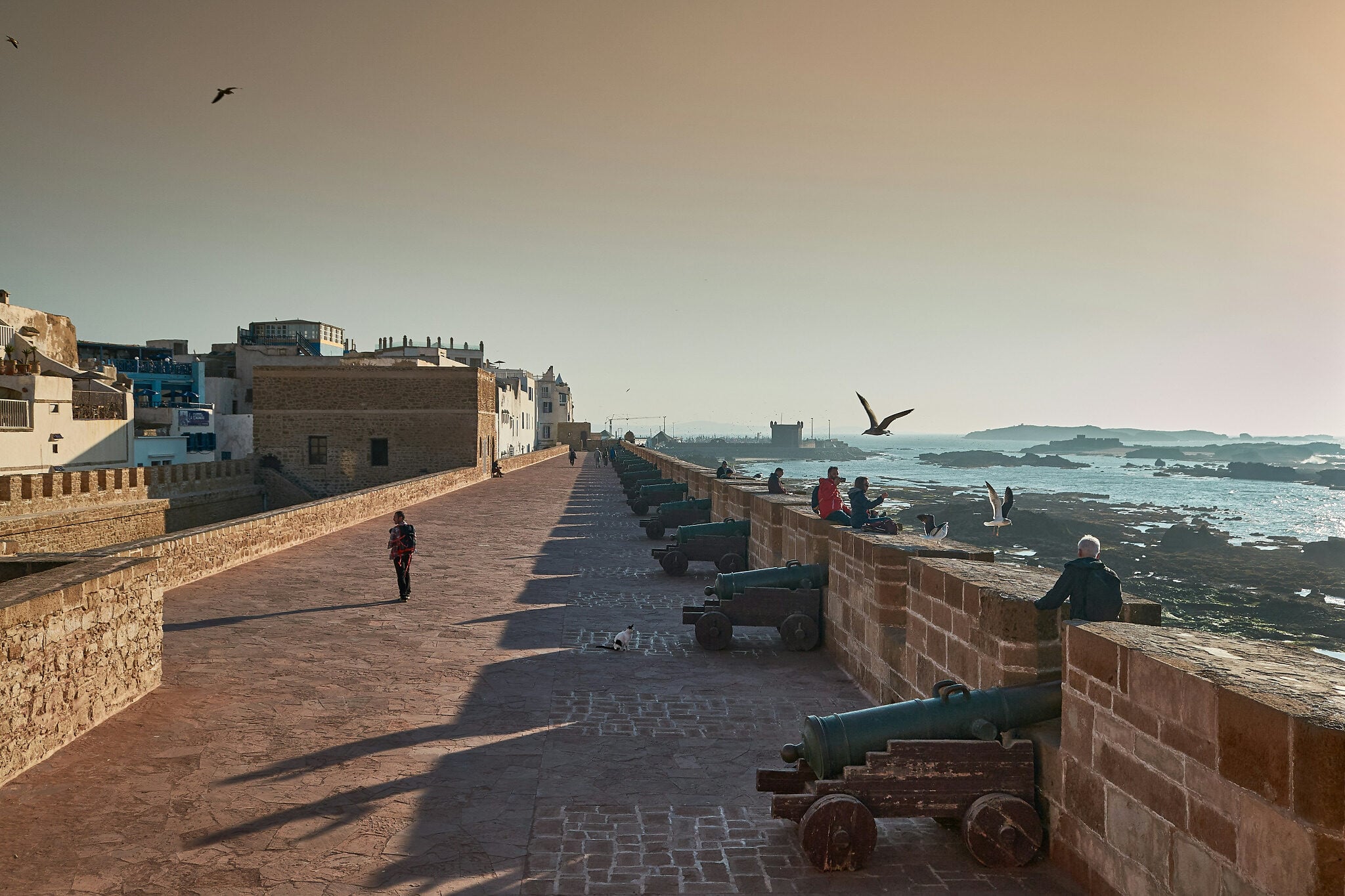
The historic ramparts of Essaouira, formerly Mogador, overlooking Morocco’s Atlantic coast. Photo: Dimitri Ana / Unsplash.
Adviser to Morocco’s King Mohammed VI and founding president of the Essaouira-Mogador Association, André Azoulay, has found himself at the center of a controversy following his call to recover the history of Mogador, the former name of Morocco’s Atlantic city of Essaouira.
Speaking on November 19 at the inaugural Mogador Essaouira Conversations, he referred to the city’s historical name and its presence in places such as Paris, where a street and a theatre bear the name Mogador. His argument was that Morocco should reclaim a fuller understanding of a history that originated on its own soil and subsequently traveled beyond its borders.
As Azoulay explained during the gathering, he was speaking about historical memory rather than changing the city’s official name. Yet some reactions turned his remarks into warnings about Morocco’s identity and sovereignty, with interpretations extending to the notion of a “Greater Mogador” or even a “new Israel in Morocco”.
What makes the controversy particularly revealing is that Israel was introduced as a supposed hidden actor in a discussion that contained no Israeli political claim or initiative. The resulting accusations are difficult to reconcile with Azoulay’s remarks and become even harder to sustain when examined against the city’s history.
When UNESCO inscribed the Medina of Essaouira on its World Heritage List in 2001, it used the designation Medina of Essaouira (formerly Mogador). The organization traces the historical name to the Phoenician word Migdol, meaning a small fortress, while studies of Amazigh place-names have examined related forms such as Amegdul and Megdul, associated with protection and fortification. Related names also appear in medieval geographical accounts, including the writings of the eleventh-century Andalusi geographer Al-Bakri.
Although the precise linguistic origin remains open to scholarly discussion, Mogador clearly belongs to a geographical tradition shaped by centuries of interaction between local populations and maritime civilizations. Its name cannot reasonably be reduced to the heritage of a single religious community, nor can its historical identity be detached from the Moroccan territory where it developed.
The decisive chapter in the city’s modern history began in the eighteenth century, when Sultan Sidi Mohammed Ben Abdallah undertook the development of Essaouira as a royal Atlantic port. His objective was to strengthen Morocco’s commercial relations with Europe, organize maritime trade and connect the kingdom’s interior with international markets.
The city that emerged from this policy became one of Morocco’s most important commercial centers, with its prosperity closely tied to the authority of the Sultan, the institutions of the Makhzen and trading networks extending from the Souss region toward Europe and beyond.
Moroccan Jews played a central role in this development. Some of the city’s most influential merchants belonged to the tujjar al-sultan, the merchants of the Sultan, whose activities operated through privileges and arrangements established by the Moroccan authorities. Their networks helped connect agricultural production, regional commerce and Atlantic trade with foreign markets, contributing to the city’s emergence as a major commercial center.
Historian Daniel J. Schroeter, in his study Merchants of Essaouira, documents how these merchants combined extensive international connections with close ties to the Moroccan state. Their economic influence was considerable, but their commercial position remained rooted in the institutions and interests of the kingdom rather than constituting a separate political authority.
Mogador’s Jewish merchants were part of the same Moroccan commercial world as the Muslim traders, craftsmen and other communities who contributed to the city’s prosperity. Their networks extended across borders, but their history was shaped by the Moroccan society and institutions in which they lived. The synagogues, cemeteries, trading houses and family histories they left behind belong to Mogador’s social history, alongside its fortifications, markets and maritime institutions.
As Mogador grew into an important Atlantic port, its name also traveled beyond Morocco. European maps and publications preserved it, while streets and institutions elsewhere adopted it. This international circulation reflected the reach of a Moroccan city whose economic and cultural relationships extended far beyond its geographical boundaries.
That is the essential meaning of Azoulay’s observation that Mogador’s history began in Morocco rather than Paris. As he reiterated on November 20, the name traveled from Morocco into the wider world, not the other way around. Its presence abroad reflects the city’s historical importance, rather than an identity originating elsewhere.
Morocco’s modern constitutional understanding of its national identity follows a similar historical logic. The 2011 Constitution recognizes the Hebraic tributary alongside the African, Andalusian and Mediterranean influences that have enriched the country’s Arab-Islamic, Amazigh and Saharo-Hassani foundations. It places that diversity within a national identity defined as one and indivisible, recognizing the different historical traditions that have contributed to the country’s development.
In Essaouira, that understanding also finds expression in the preservation of Jewish heritage, including Bayt Dakira, the House of Memory visited by King Mohammed VI in January 2020. As The Times of Israel reported, the institution preserves objects, documents and family histories reflecting the city’s Jewish past and the relations between its Jewish and Muslim communities. It is part of a broader effort to document a history that remains embedded in Morocco’s national heritage.
This historical and institutional background makes the political interpretations surrounding Azoulay’s remarks particularly difficult to understand. The controversy spread across social media, amplified by voices known for their strongly ideological opposition to Israel and normalization. Some critics focused on his use of the collective pronoun “we”, treating it as an indication that an unidentified group was claiming authority over the city, while others went further, constructing speculative claims about territorial ambitions and political agendas from a discussion about historical memory.
The deeper problem lies in the image of Morocco that emerges from this reasoning. A kingdom whose rulers shaped the development of Mogador, and whose Constitution explicitly incorporates its Jewish heritage into the national identity, is portrayed as though its sovereignty and historical character could be undermined by a cultural gathering or the use of a historical name.
Some of the voices invoking Moroccan sovereignty in response to these initiatives end up describing their own country as if its institutions had little control over its history or national identity. In this account, Morocco becomes an exposed territory where almost any expression of Jewish heritage can acquire extraordinary political implications, while its ability to define and manage its own historical narrative is largely overlooked.
The contradiction is particularly striking within parts of the anti-Israel and anti-normalization discourse. One critic who raised the specter of a “Greater Mogador” had previously invoked the image of Israel as “weaker than a spider’s web” when discussing regional confrontations. Yet the same reasoning portrays Morocco as almost defenseless before a historical name or a cultural initiative. The contrast raises a legitimate question about the confidence this rhetoric actually places in Morocco’s institutions and national resilience.
Such arguments attribute extraordinary influence to supposed external forces while diminishing the historical agency of the Moroccan state itself. They also turn one of Morocco’s longstanding characteristics, the incorporation of different religious and cultural traditions into a common national framework, into an alleged source of weakness.
There is another consequence of this reasoning that deserves attention, particularly in Israel. By treating almost every public expression of Moroccan Jewish heritage as politically suspect, these interpretations effectively associate that heritage with Israel, even when its origins and historical development are entirely Moroccan. A component of Morocco’s own history is thus presented as though it necessarily belonged to another country.
For Israelis of Moroccan descent, Mogador and other Moroccan cities remain part of family histories carried across generations. Those who emigrated brought with them languages, customs, religious traditions and memories of the places where their families had lived. The continued presence of that heritage in Israeli society reflects the historical ties between communities and their places of origin, without changing the identity of the cities themselves.
Jewish history has always extended across different societies and political settings, and the experience of Moroccan Jews is an important part of that wider history. Mogador illustrates how Jewish life developed within a particular Moroccan social, economic and political environment, while leaving a legacy that continues to be remembered beyond Morocco’s borders.
The controversy has therefore transformed a relatively straightforward historical question into an elaborate political narrative. A name documented in Morocco’s historical geography, a city developed by a Moroccan Sultan and generations of Moroccan Jews deeply involved in its commercial life have been brought together to support interpretations that bear little resemblance to the history they claim to explain.
More revealing still is the image of Morocco produced by these interpretations. In attempting to identify an Israeli role where the available facts establish none, they portray the kingdom as more vulnerable and less capable of defining its own identity than its historical record and institutions suggest.
Azoulay’s central observation was that Mogador’s history traveled from Morocco into the wider world, not the other way around. The city’s history supports that reading, from its development as a royal Atlantic port to the generations of Moroccan Jews whose commercial and cultural lives helped shape its place in the world.
The imaginary Israeli plot surrounding Mogador ultimately reveals little about Israel and much more about the political assumptions of those who constructed it. What began as a call to recover a Moroccan city’s history became a narrative that both assigned Israel a role it had not claimed and diminished the very Moroccan sovereignty its proponents said they were defending.
Related Topics
Related Posts