
Geopolitical & Defense Analyst
How Mossad and EYP Foiled Iran’s Athens Plot
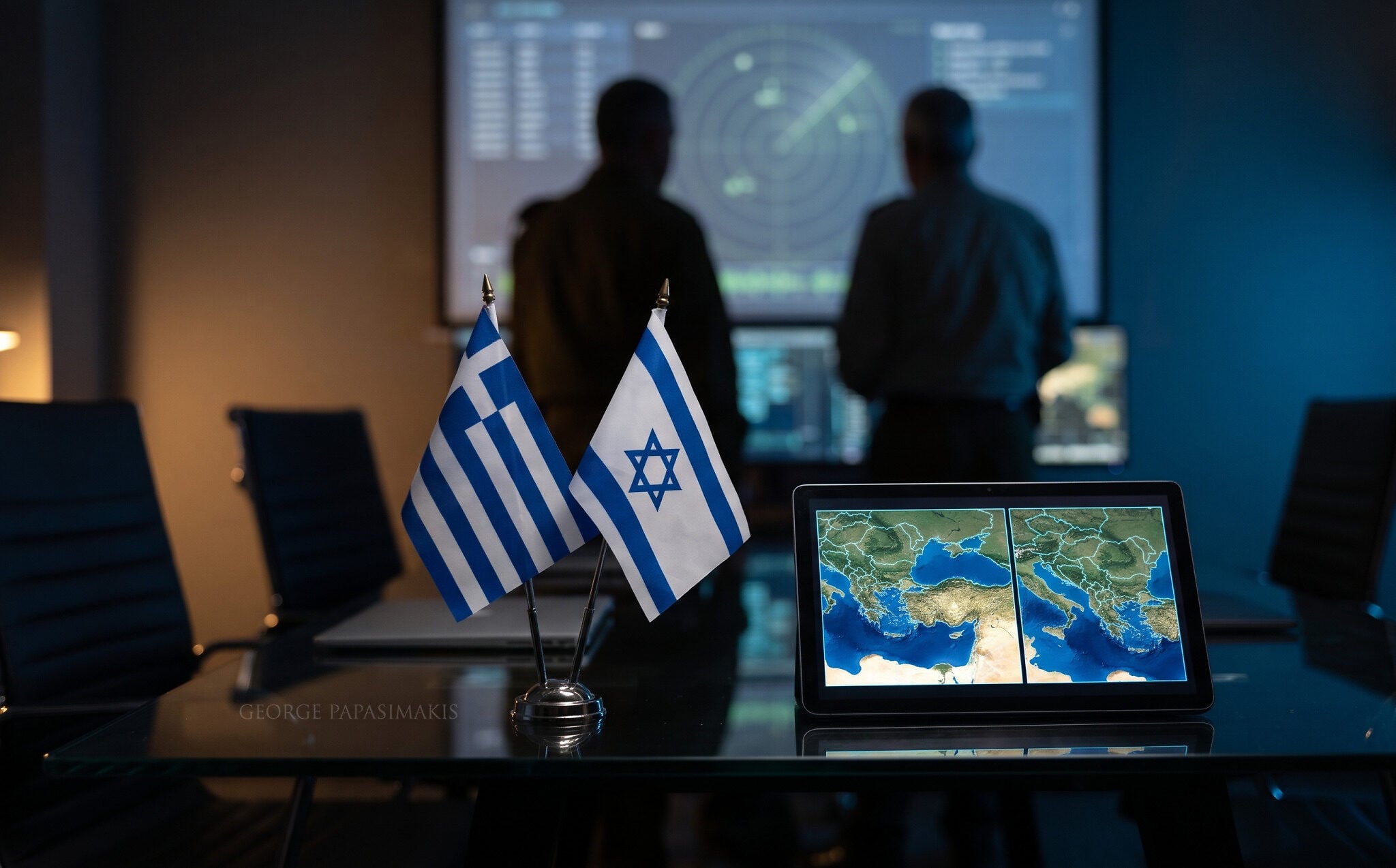
Illustrative: Intelligence and counterterrorism cooperation between Greece and Israel in the Eastern Mediterranean. (AI-generated illustration / Signature: George Papasimakis)
The dismantling of an Iran-linked terror cell operating between North Macedonia and Greece is far more than a routine counterterrorism success; it is a stark illustration of how Tehran has weaponized Balkan criminal syndicates to project lethal force onto European soil—and why the deepening intelligence architecture between Israel’s Mossad and Greece’s National Intelligence Service (EYP) has become indispensable to Eastern Mediterranean stability.
Earlier this week, North Macedonia’s National Security Agency (ANB), working in close coordination with Greek intelligence and law enforcement, announced the arrest of five suspects in Skopje, Kumanovo, and along Greece’s Evros border—where Greek border guards apprehended and deported a suspect flagged under a Schengen entry ban—while a sixth operative remains at large. According to official disclosures from Skopje, the cell was directed by an Iranian intelligence handler, Edris Jahangiri Mavaneh, and utilized the logistical network of Naji Sharifi Zindashti—a notorious Iranian narcotics trafficker sanctioned by the United States for orchestrating extraterritorial abductions and assassinations on behalf of Tehran.
While Greek police spokeswoman Constantia Dimoglidou confirmed Athens’s cooperation with Skopje—noting that police have not yet publicly determined whether the cell intended a targeted assassination or another form of terrorist attack, while confirming that protective measures have been heightened for specific individuals and facilities following intelligence handled by EYP—leading Greek dailies, including Ta Nea, alongside Albanian broadcaster Top Channel, have identified the alleged target as Avraam-Minos Moissis. A prominent figure in Greece’s financial sector and former president of the Jewish Community of Athens, Moissis also serves as a non-executive board member of Intracom Defense (IDE), a major Greek defense contractor acquired in 2023 by state-owned Israel Aerospace Industries (IAI).
Whether Tehran sought to strike a symbol of Greek Jewry, an executive tied to Israel’s premier defense conglomerate, or both, the operational blueprint is unmistakable. Facing severe degradation of its conventional deterrence across the Middle East, the Islamic Republic increasingly outsources its covert operations to transnational criminal networks in the Western Balkans, exploiting porous borders and illicit trafficking corridors to bypass traditional Western counterintelligence perimeters.
For Athens and Jerusalem, however, the foiled Athens plot underscores a strategic reality that transcends a single thwarted attack: the intelligence nexus between EYP and Mossad has evolved into one of the most consequential security partnerships in Southeastern Europe.
This is not the first time joint intelligence work has prevented bloodshed on Greek streets. In March 2023, EYP and Mossad disrupted an Islamic Revolutionary Guard Corps (IRGC) network that had recruited Pakistani operatives to attack an Israeli restaurant and synagogue in central Athens. That operation, like this week’s arrests, demonstrated that real-time intelligence fusion between Jerusalem’s external intelligence apparatus and Athens’s domestic security services can effectively neutralize asymmetric threats before they reach the execution phase.
Crucially, the strategic value of the Greece-Israel intelligence axis extends well beyond countering Iranian terror cells. In the broader geopolitical chessboard of the Eastern Mediterranean, Athens and Jerusalem confront overlapping challenges—most notably the assertive posture of Ankara and the expanding footprint of Turkey’s National Intelligence Organization (MIT).
Under the direction of Ibrahim Kalin, MIT has significantly ramped up its covert operations across the Balkans, the Aegean, and the Levant, frequently operating in permissive environments where Hamas infrastructure and Iranian-aligned financial networks intersect. For Greece, which faces persistent Turkish revisionism in the Aegean and Eastern Mediterranean, and for Israel, which views Ankara’s hosting of Hamas operatives and hostile rhetoric as a direct national security concern, intelligence sharing is a vital force multiplier.
The acquisition of Intracom Defense by Israel Aerospace Industries—the very link that appears to have placed its board member in Tehran’s crosshairs—symbolizes this convergence. What began over a decade ago as diplomatic warming and joint naval exercises has matured into deep defense-industrial integration and seamless counterintelligence coordination. By linking Israeli technological and human intelligence capabilities with Greece’s geographic vantage point as the southeastern gateway to Europe, EYP and Mossad have effectively erected a forward defense perimeter against both Iranian proxy terrorism and regional destabilization.
Tehran’s embassy in Athens has predictably dismissed the revelations as “baseless” Israeli “psychological warfare.” Yet the physical evidence seized in North Macedonia—unlicensed firearms, encrypted communications, and reconnaissance sketches of a target site in Greece—tells a far more concrete story.
As Iran’s shadow war increasingly spills into Europe’s soft underbelly, the lesson from Athens and Skopje is clear: asymmetric networks can only be defeated by equally agile intelligence alliances. For Greece and Israel, maintaining—and expanding—this silent partnership is no longer optional; it is the bedrock of regional deterrence.
Related Topics
Related Posts