
How Much Did the World Cup Influence Trump’s Iran Decisions?
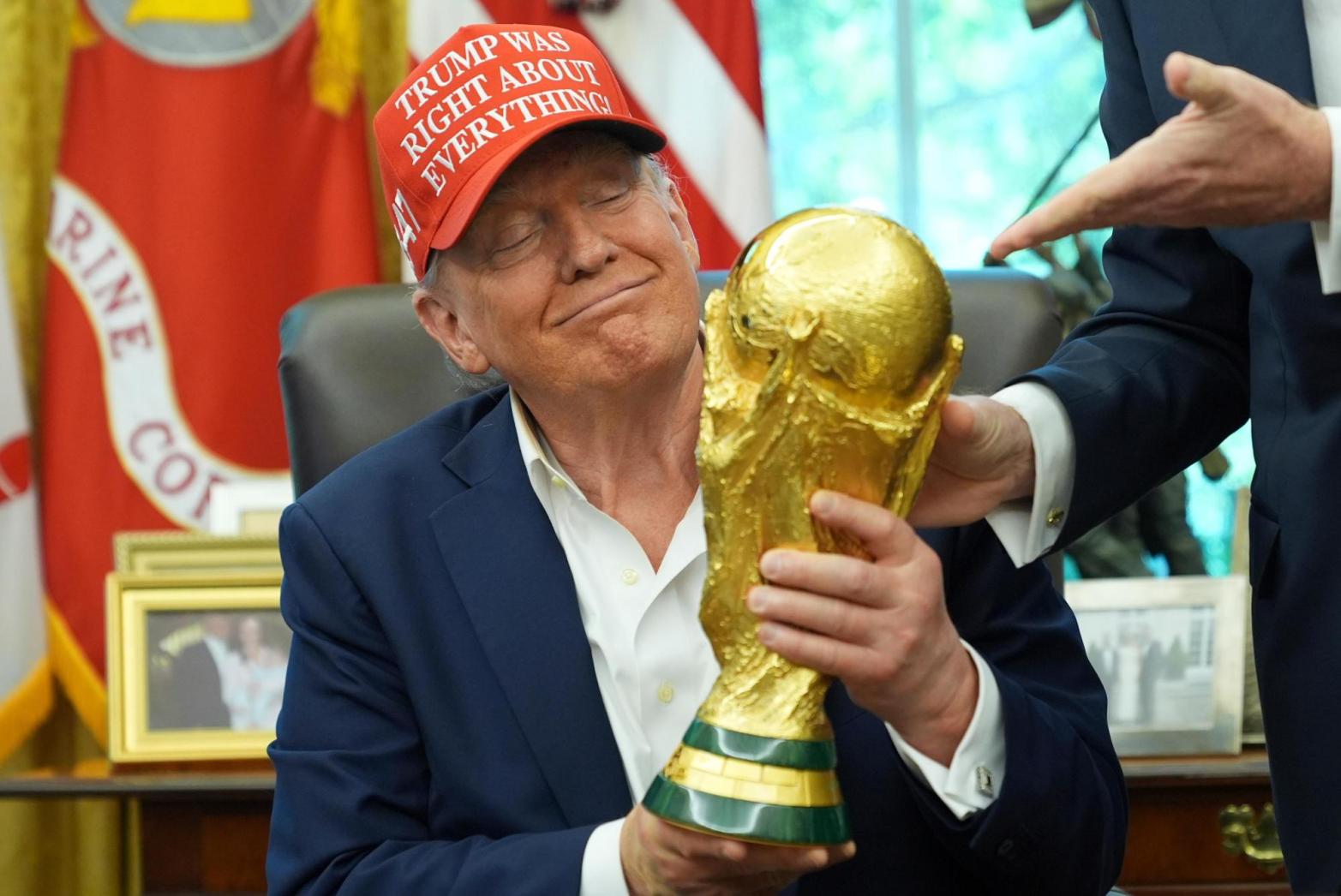
In August 2025, months before a single match kicked off on American soil, Donald Trump sat behind the Resolute Desk and pressed his cheek against the gold of the FIFA World Cup trophy. His eyes were closed. His red cap read “Trump Was Right About Everything.”
The occasion looked routine. Gianni Infantino had come to announce that Washington’s Kennedy Center would host the 2026 final draw, and that FIFA had opened an office inside Trump Tower. The cameras caught something the agenda did not list. A president reluctant to give the trophy back. When Infantino gently reminded him it had to return to the eventual champion, Trump kept insisting it was staying. “It fits very well on the wall right over there,” he said, picturing it “right below the angels.” He could not stop praising the metal either, insisting nothing else compared to the solid version.
The affection had a track record. Weeks earlier he had kept the original Club World Cup trophy in the Oval Office, and Chelsea, the side that actually won it, went home with a replica. He had also thrown himself into winning the hosting bid during his first term. For this president the tournament was a stage, and he will stand on the field in New Jersey on July 19 to co-present the trophy at the final.
Hold that image. Then ask the question this essay can raise without pretending to settle it. How much did the World Cup weigh on Trump’s decisions over Iran?
The blow that never landed
The war began on February 28, with joint American and Israeli strikes on Iran. Through the spring Trump escalated and pulled back in turns. In March he warned he would hit Iran’s infrastructure and put American troops on Kharg Island, then backed away and said a deal was close. He even told Iran’s national team to stay home from the tournament, for “their own life and safety.”
A larger blow always seemed one decision away. Israel, which had opened the war alongside Washington, wanted the finishing strike against the enemy it has named for decades. The expectation in those weeks was a campaign heavy enough to break Iran outright. Then the opposite happened. As the tournament approached, the fighting wound down, and on June 17 Trump signed a memorandum of understanding to end the war, putting his name to it during a dinner with Emmanuel Macron at the Palace of Versailles.
Washington insists the calendar was a coincidence. Andrew Giuliani, the White House official running the tournament, told The Jerusalem Post that the World Cup played no part. “It did not influence any decision from a national security perspective,” he said. The tell sits inside the denial. Nobody refuses a question that nobody is asking. The tournament never appeared in the official account of why the United States held its hand, and that silence is exactly what one would expect, since no government lists a soccer event among its reasons for war or peace.
A host cannot bomb in peace
Picture the strike Israel wanted, delivered days before kickoff. The costs arrive from every direction at once.
Start with oil. The war had already pushed crude higher and shaken the global economy, and Trump later conceded he signed the deal to head off “economic catastrophe.” A massive attack during the tournament would have driven prices higher still, straight to the gas pump, in front of every American voter and every visiting fan.
Then the optics. The United States would be bombing the home country of a team playing on its own soil. Iran had qualified, and despite denied visas and a base camp pushed down to Tijuana, Team Melli took the field in California, with Washington easing some travel rules mid-tournament so the squad could prepare. Two days after a devastating raid, the Iranian anthem would have sounded inside an American stadium, the bombed nation’s players on the grass, the cameras of the world fixed on them. Trump had urged that team to stay away. It came anyway.
Security was already a strain. Giuliani described a tournament guarded by more than 400 law enforcement bodies, intelligence tracked minute by minute, and said plainly that “with conflict in Iran right now,” even fan access carried a national security risk. A full-scale strike would have multiplied that exposure across eleven host cities and millions of arrivals.
It would also have sharpened a danger the host was already bracing for. Federal agencies had spent months preparing for retaliation on home soil, and the FBI had warned California police of a possible Iranian drone plot. The homeland security secretary called the threat level the highest the country had ever faced.
Soccer carries its own grim precedent, from the Stade de France attack in 2015 to the plots that shadowed the Paris Olympics, and sober threat assessments note that Iran could seek revenge for the war. A heavy blow would have handed any willing actor both a motive and a target list of arenas filled with civilians. Those victims would not have been only Americans. They would have been visitors from dozens of countries, killed at the event Trump built as his showcase, turning a security failure into a diplomatic catastrophe without borders.
And the politics were already raw. The war drew criticism from inside Trump’s own party, with Senator Bill Cassidy calling the offensive the “worst foreign policy blunder in decades.” For a president who had built this tournament into a personal coronation, finishing the war during it promised damage on every axis at once. Keeping things quiet with Iran, before and through the Cup, was the option that protected the trophy in his hands.
How the answer will arrive
Here the question turns testable, which is rare for an opinion piece. If the World Cup is a brake, the weeks of the tournament should look like the days behind us. Threats from both sides, contradictory statements, no movement on substance, Tehran running out the clock. The stillness itself would be the evidence. Read without the thesis, the deadlock looks like diplomatic failure. Read with it, the deadlock is what a deliberate freeze produces, because closing the hard file mid-spectacle would force either real concessions or a rupture, and both spoil the party.
Honesty demands the rival explanation. This is also simply how Trump negotiates, through delay and leverage, and he has told his own side not to rush because “time is on our side.” More of the same proves nothing by itself. The Cup only adds one more reason to prefer the freeze right now.
After the final, the branches separate. A signed comprehensive deal would strengthen the reading that Trump wanted the Iran front frozen until the cameras left. A return to threats, and then to strikes, would shrink the World Cup to a pause inside something that was coming anyway, influence measured as delay rather than as brake.
One condition could break the experiment before July 19. Lebanon. Neither Israel nor Hezbollah signed the memorandum, Netanyahu has vowed to keep troops in southern Lebanon, and the fighting there has already tested the deal. Trump has threatened to “hit Iran very hard again” over Hezbollah, while Pezeshkian insists Iran will never surrender its right to enrich uranium. If Israel drags Trump back into open war during the tournament, despite the cost to his showcase, then the Cup was never brake enough. The friction between those two men is the variable to watch.
So return to the man with his cheek against the gold. The honest verdict refuses certainty. No one can prove the tournament moved him, and the World Cup was never the only force in the room. Oil, a weary public, the Strait of Hormuz and the global economy all pulled the same way. Yet it is reasonable to think the Cup sat among the reasons Trump chose not to deliver the heaviest blow to Iran before or during his own party.
What comes after the final is the open part, and the answer may rest less with Washington than with Tehran. Iran has signaled there is no real agreement in force until the first clause is honored. The enrichment line is Pezeshkian’s to hold or to fold. Trump can host a flawless month. He cannot script the other side.
What is a president willing to freeze to protect the biggest sporting event on earth?