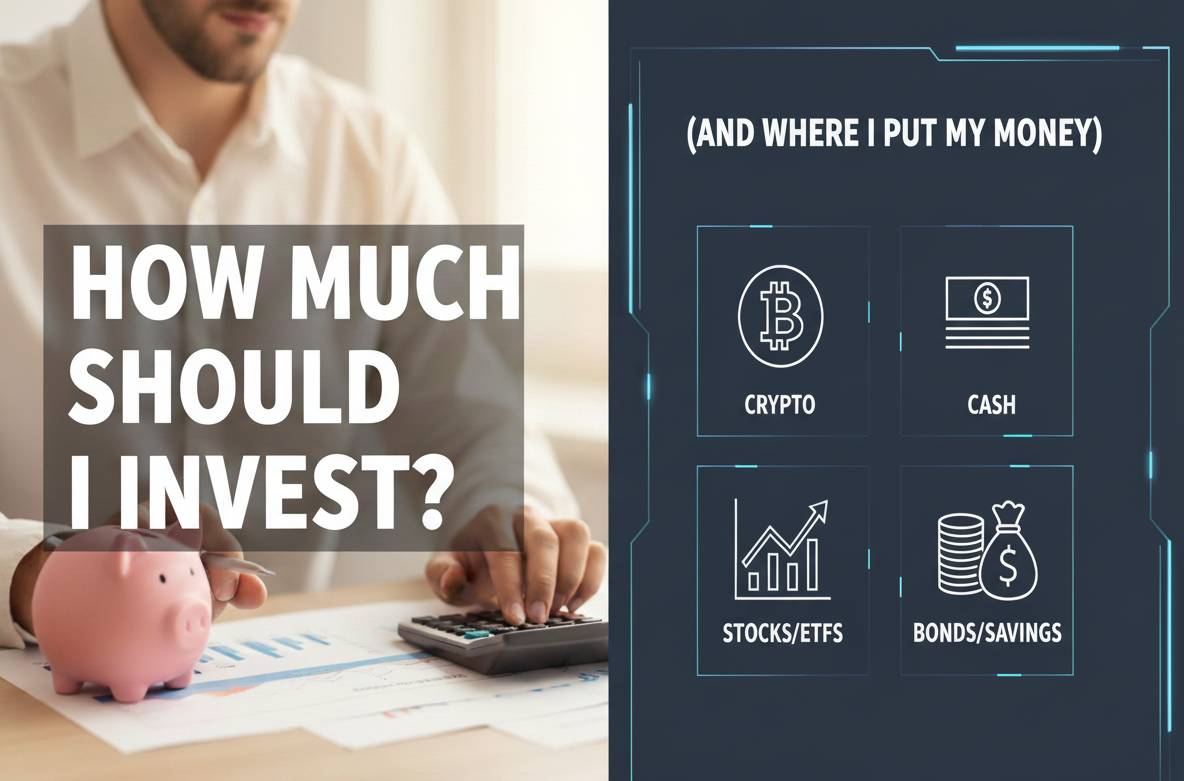
How Much Should I Invest? (And Where I Put My Money)
Hey, please read the financial disclaimer below before reading this.*
A question I get asked all the time is: “How much should I actually invest?”
The short answer is: As much as you can, while still being able to sleep well at night.
First Rule: Check Your Balance
Before we even talk about investing, look at your bank account. If you are in the minus (overdraft)—do not invest. You need to fix that first. Investing is for money you have, not money you owe.
Also, everyone’s situation and goals are unique. I’m speaking here in a very general way, and sharing what I personally do as a young professional. Do your own research and discuss this with finance professionals (I always recommend Blue & White Finance but I’m not affiliated with them at all).
Why “Cash is Trash”
IF YOU HAVE MORE THAN 50,000 ILS IN YOUR CHECKING ACCOUNT (OVER VE’SHAV), YOU ARE DOING THE WRONG THING.
There is an old saying in finance that “Cash is Trash.” That sounds harsh, but here’s why people say it: If your money is just sitting in your bank account, it is slowly losing value.
Every year, there is inflation. Inflation is what makes 100,000 Shekels today worth less next year. It’s as if each year a percentage of your cash (non-invested money) is eaten by mice. That 100,000 becomes worth 98,000 then the next year 96,000 then 94,000 the next and so on.
If you keep all your money in cash under the mattress (or in a checking account), your “buying power” decreases as time goes on. Investing is how you combat that.
The Magic of Compound Interest (Or: Why You Should Start Now)
It’s easy to look at 1,000 or 2,000 Shekels a month and think, “Is this really going to change my life?”
The answer is yes. It’s actually mind-blowing.
Thanks to compound interest, your money doesn’t just grow in a straight line—it snowballs. The money you earn earns money, and then that money earns money.
To give you some motivation, here is what happens if you invest these monthly amounts into the S&P 500 for 30 years (assuming an average return of ~8% per year):
-
1,000 ILS / month turns into ₪1.5 Million
(You only put in ₪360k, the rest is “free” money from interest) -
2,500 ILS / month turns into ₪3.5 Million (You put in ₪900k)
-
5,000 ILS / month turns into ₪7.5 Million (You put in ₪1.8 M over the 30 years)
-
8,000 ILS / month turns into ₪12 Million (You put in ₪2.9M over the 30 years)
The Takeaway:
You don’t need to be a millionaire to start. You just need to be consistent. Even 1,000 Shekels a month creates a multi-million Shekel safety net for your future self.
Important Note on these numbers:
This is based on an assumed 8% return. The market does not go up in a straight line every year—some years it’s up 20%, some years it’s down 15%. These numbers also don’t account for taxes. But the point remains: Invest early, and let time do the heavy lifting.
My “4 Bucket” Strategy
Personally, I feel uncomfortable seeing a huge pile of cash doing nothing, but I also feel uncomfortable seeing my bank account close to zero. So, I split my money into four “buckets.”
Here is exactly how I break it down:
Bucket 1: The “Sleep Well” Fund (Checking Account / Over ve’Shav)
I keep a certain amount of cash in my regular active checking account. I try to keep this relatively low because, again, inflation is eating it. But, I keep enough so that I don’t feel poor and I don’t have to stress about paying bills.
I don’t love having a balance of 232 ILS, but I know having tens of thousands costs me too. The exact number is up to you—it’s whatever lets you sleep at night.
Bucket 2: The Emergency Fund (Keren Kaspit)
This is my medium-term savings. It’s money I can access very quickly—usually within a day or a month. In Israel, a popular way to do this is a Keren Kaspit (Money Market Fund).
There’s a great video by Blue and White Finance that explains exactly what this is, but basically, it’s a very low-risk place to park cash that earns a good bit of interest. I keep about 6 to 12 months of living expenses here. Some people recommend 3 months, some say 6. I like closer to 12 months because it makes me feel secure that I can get this money at a moment’s notice.
Note that if you are saving for a big purchase soon (car/house/yacht) you may have most of your money sitting and growing in this.
Bucket 3: The Future Fund (S&P 500)
This is where most of my money goes (my net worth).
I put this into the S&P 500 (via VUAA as mentioned in previous articles). This is money I do not need today, tomorrow, or even in the next few years. This is for 10+ years down the road.
-
High Risk, High Reward: The S&P 500 is volatile. It will go up and down. Some years it may go down by up to 30%. But over a long timeline (7+ years), it has historically grown significantly.
-
The Goal: This is the engine that builds wealth for the future.
Bucket 4: The “Crazy” Fund (Crypto and individual stocks)
I have a small bucket for Crypto and individual stock picks, basically because I’m a little crazy like that. And I like a little bit of gambling. This is super high risk—you can win big or lose it all. It is definitely not for everyone.
-
If you are interested in Crypto, for non-US residents in Israel, I recommend using Kraken.
Summary
My personal ideal portfolio looks like this:
-
Enough cash to pay bills.
-
6–12 months of expenses in a safe, accessible place (Keren Kaspit).
-
Everything else into the S&P 500 for the long term.
-
A tiny bit of “play money” in high-risk stuff if that’s your thing.
Invest as much as you can, as early as you can.
*I am not a financial advisor or licensed professional. I am just a normal guy sharing my personal experience and opinions for entertainment and informational purposes. This should not be read as financial advice. If you want actual financial advice, please go to a licensed, registered service provider. I highly recommend speaking to Blue and White Finance (I’m not affiliated with them at all, they are just excellent and will be able to put you on the right track.)