
Middle East Analyst
How Netanyahu Backed Israel Into a Corner
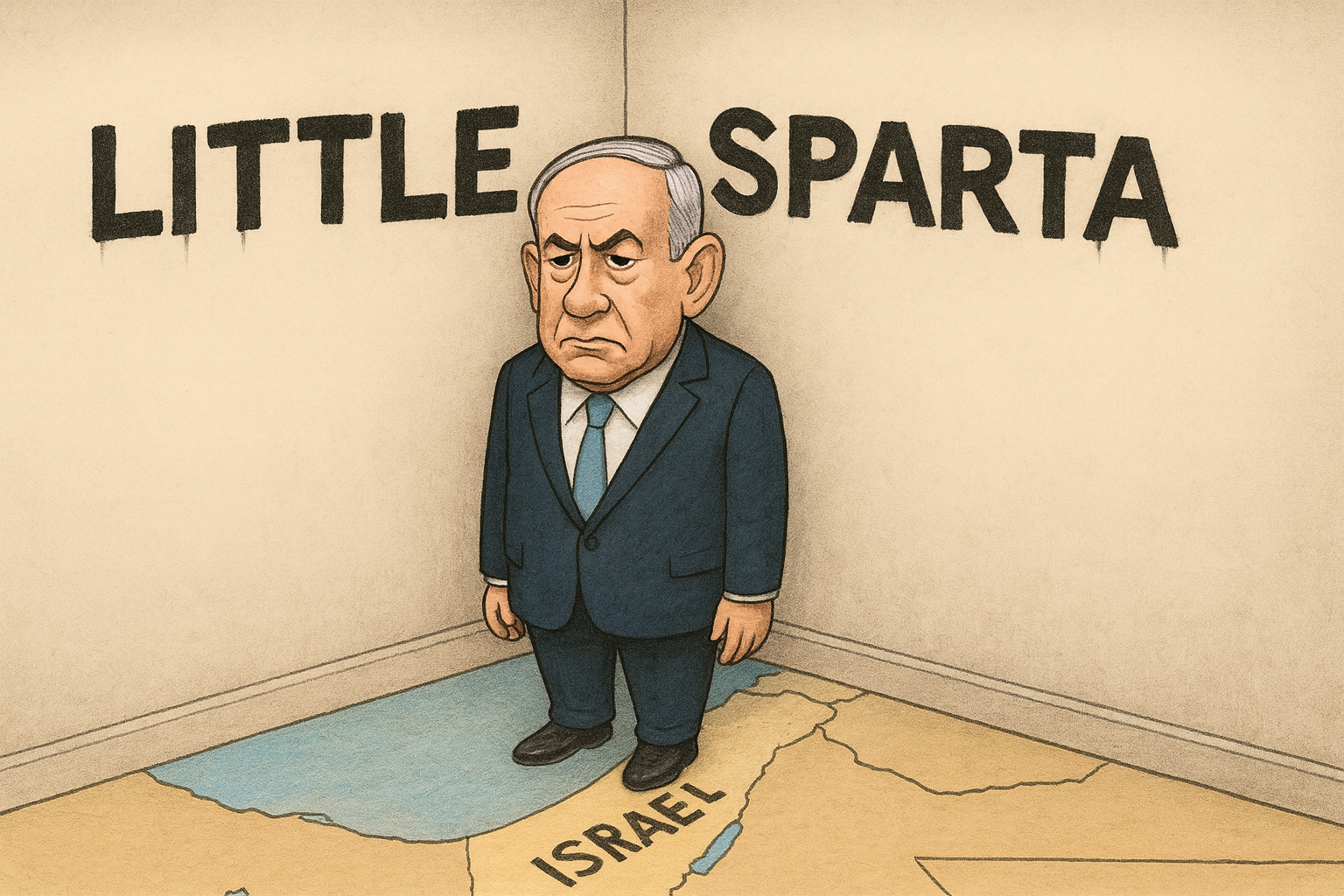
Cartoon by Author and ChatGPT
The United Nations Security Council passed Resolution 2803, establishing a two‑year International Stabilization Force (ISF) in Gaza and enshrining core elements of President Trump’s 20‑point peace plan into international law. The resolution also authorized a transitional governance body—the Board of Peace—to oversee humanitarian recovery and prepare the phased reintegration of the Palestinian Authority.
Crucially, the operative text itself now includes explicit references to Palestinian self‑determination and a pathway to statehood. This marked a doctrinal rupture: Gaza is no longer treated as a territory to be emptied, but as one to be stabilized. And Israel, long the chief architect of displacement and isolation, found itself boxed in by the very dynamics it had helped provoke.
The Original Doctrine: Displacement and Control
Between February and July 2025, Trump’s Middle East team promoted variations of a “voluntary relocation” framework for Gazans. The proposal, largely conceived as a U.S.-funded initiative, envisioned redevelopment under U.S.–Israeli oversight with minimal Palestinian agency.
Prime Minister Benjamin Netanyahu amplified this rhetoric, suggesting that “voluntary transfer” could be a “humane” solution—language widely interpreted across the region as coerced displacement. Arab states rejected the concept outright, and critics inside Israel called it a moral and legal dead end. By summer’s end, the “Gaza relocation” narrative had become politically toxic in nearly every capital.
The Pivot: From Rhetoric to Reversal
The break came at the 80th session of the United Nations General Assembly (UNGA) in September 2025, where the Trump Plan was formulated in collaboration with leaders of key Muslim‑majority countries. In a follow‑on private meeting at the White House, Trump demanded that Netanyahu end the war and accept the plan. Netanyahu had little choice but to verbally agree, yet he diluted the clarity of Palestinian statehood by adding an ambiguous reference to a “political horizon.” Statehood remained in the operative text, but its force was clouded, while Netanyahu publicly insisted there would never be a Palestinian state.
This maneuver sowed doubt among Muslim leaders about whether the plan they had endorsed was still intact. Trump himself equivocated, publicly speculating that the Saudis were not truly committed to Palestinian statehood. The backlash was immediate: Muslim countries insisted on a UN mandate before committing troops or funds to the ISF, transforming what began as a multilateral resolution into international law.
Netanyahu’s Overreach: Catalysts for Containment
This reversal did not emerge in a vacuum. It was catalyzed by a series of Israeli miscalculations that alienated nearly every stakeholder the Trump team needed:
- Doha Strike (Sept 9, 2025): An Israeli airstrike in Qatar targeting Hamas intermediaries killed several people, including a Qatari security officer. The incident collapsed hostage negotiations and triggered sharp condemnation from Gulf capitals and the UN. Saudi Arabia responded by announcing a mutual defense pact with Pakistan—an unmistakable signal that the situation had reached a breaking point.
- Humanitarian Obstruction: Even after the ceasefire, Israeli restrictions left aid deliveries at a fraction of agreed levels. UN and NGO officials accused Jerusalem of violating the truce framework and deepening Gaza’s humanitarian collapse.
- Regional Escalation: Israeli strikes in Syria and Lebanon, launched despite explicit U.S. warnings, undermined Trump’s effort to consolidate a fragile regional calm.
- Maximalist Rhetoric: Netanyahu’s August references to a “Greater Israel stretching beyond current borders”—including parts of Egypt, Jordan, Lebanon, and Saudi Arabia—ignited outrage and confirmed fears that post‑war Gaza policy was sliding toward annexationism.
Each episode reinforced the perception that Israel had become an unmanageable ally—strategically indispensable yet diplomatically reckless. For Trump, whose regional architecture depended on Arab cooperation, containment became the only viable path.
Trump’s Recalibration: Containment Over Chaos
Resolution 2803 represented less an ideological pivot than a tactical one: an attempt to re‑establish order after the failures of unilateralism. By internationalizing Gaza’s stabilization, the White House diluted Israeli operational control while preserving Western coordination.
The ISF was authorized to “use all necessary measures” to protect civilians, secure border zones, and disarm Hamas and other non‑state armed groups. It was projected to include approximately 20,000 troops, contributed by Muslim‑majority nations under a UN mandate. The U.S. did not deploy soldiers but coordinated the force’s composition and mandate language.
The Board of Peace, established alongside the ISF, now serves as the transitional governance body—tasked with coordinating humanitarian aid, rebuilding civil infrastructure, and preparing the ground for Palestinian political reintegration.
This recalibration was inseparable from Trump’s broader Middle East architecture, which seeks to expand the Abraham Accords to include Saudi–Israeli normalization. That framework depends on Arab cooperation and regional legitimacy. Netanyahu’s defiance threatened to unravel it, forcing Washington to act decisively to preserve the architecture.
Security Challenges: Hamas and the Limits of the ISF
Resolution 2803 may have reshaped the diplomatic landscape, but the security reality remains unresolved. Hamas has rejected the resolution, dismissing the ISF as a foreign imposition. The force’s mandate emphasizes stabilization and civilian protection, not offensive operations. That raises a critical question: who will disarm Hamas?
If the ISF avoids direct confrontation, Israel may be compelled to re‑engage militarily to enforce demilitarization benchmarks. Such a scenario would undermine the very purpose of internationalization, risking renewed escalation and further alienating Arab partners. The paradox is stark: the resolution enshrines a pathway to Palestinian statehood, yet the armed group most capable of obstructing that path remains intact.
The Israeli Backlash: Sovereignty vs. Strategic Reality
Reaction in Israel was furious. Opposition leader Avigdor Liberman lashed out after the UN vote, calling it “a fire sale of Israel’s security” and warning that the decision had led to “a Palestinian state, a Saudi nuclear program, and F‑35 planes for Turkey and Saudi Arabia.” Many commentators echoed his alarm, arguing that foreign forces in Gaza would endanger Israeli lives and sovereignty.
These concerns were understandable. Yet they overlooked a fundamental reality: Israel is not a member of the Security Council and could not veto the resolution. More importantly, it was Netanyahu’s own defiance—his disregard for Trump’s red lines and his pursuit of symbolic dominance—that narrowed Israel’s options to this point. What his government framed as strength abroad translated into strategic isolation at home.
Strategic Isolation: Little Sparta, Cornered
Netanyahu once embraced Israel’s image as “Little Sparta”—a small but indomitable fortress amid regional hostility. That posture once deterred adversaries; by autumn 2025, it deterred allies. Resolution 2803 was not an act of betrayal by Washington but an act of damage control after months of Israeli overreach.
The irony was sharp. By seeking absolute control, Israel invited external supervision. By rejecting limited concessions, it faced sweeping constraints. And by conflating short‑term dominance with long‑term security, Netanyahu maneuvered Israel into a position where even friendly powers saw internationalization as the only off‑ramp.
Western Endorsement: Diplomacy Reconsidered
While the internationalization of Trump’s plan may have been catalyzed by Arab states, Turkey, or Trump himself, its passage through the Security Council reflected something deeper: Western institutional endorsement. France and Britain—long dismissed by some as symbolic or illusionary actors—stood as permanent members backing the resolution. Their support signaled a reassessment of European diplomacy, and a convergence of regional urgency with Western legitimacy.
The Choice Ahead
With Resolution 2803 passed and the ISF mandate in motion, Gaza’s future is likely to be shaped more in multilateral forums than in the Prime Minister’s Office. The locus of decision‑making has shifted outward, and Israel now faces the challenge of adapting to a regional landscape it no longer fully controls.
Washington has not abandoned Israel; rather, it was forced to intervene to prevent Israel from doing further damage to its own long‑term strategic interests. The stabilization plan is less about sidelining Jerusalem than about preserving the broader architecture of regional cooperation and preventing collapse.
For a state built on strategic initiative, learning to operate within constraints may prove the hardest test yet.
Related Topics
Related Posts