
How Opposition to America Became a ‘Progressive’ Substitute for Moral Clarity
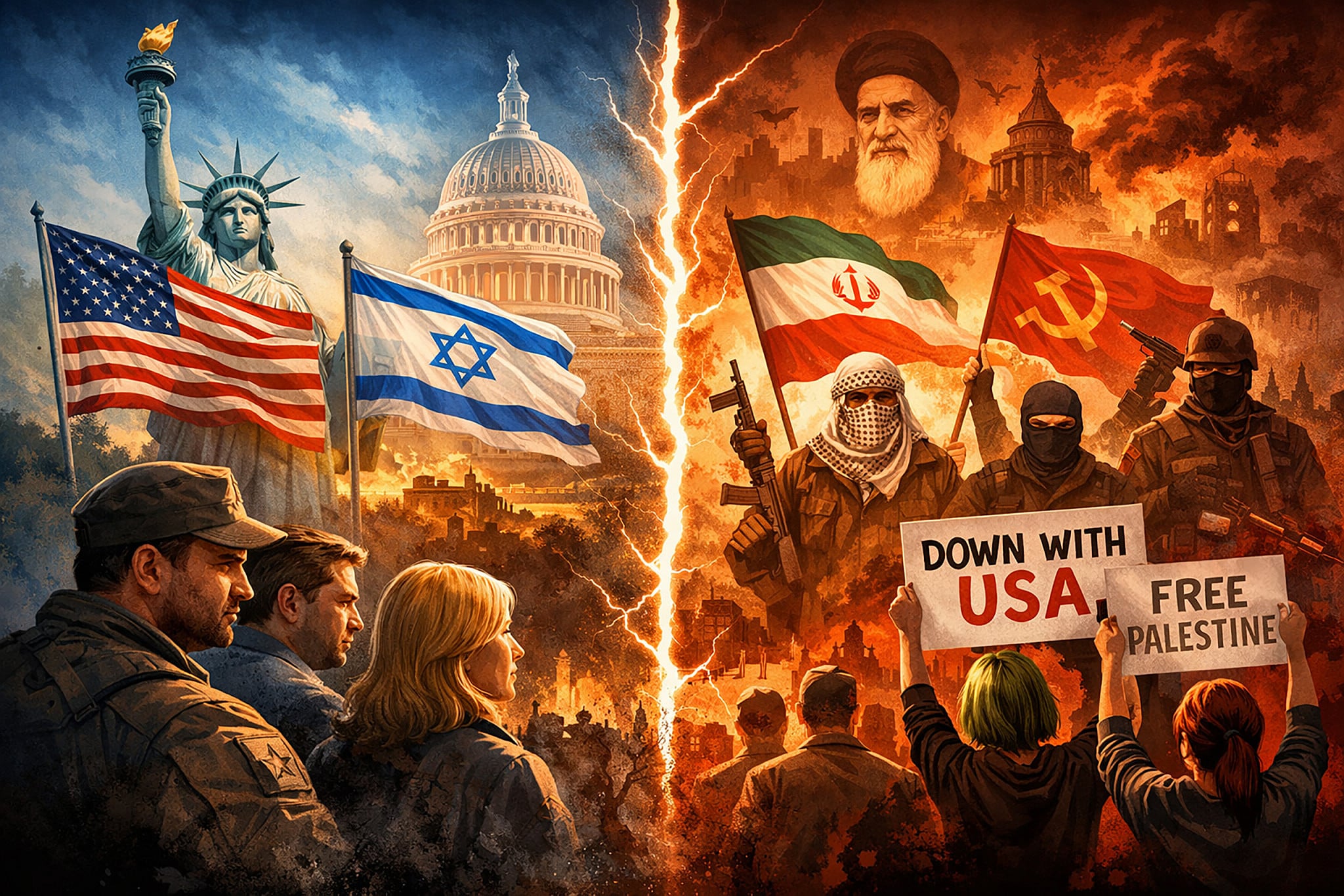
Why are there no major protests on elite American campuses against the Iranian regime, despite its brutal suppression of dissent and the killing of tens of thousands of its own citizens?
Why is there so little sustained outrage over the mass murder of Kurds, the slaughter of Druze in Syria, or the imprisonment and execution of LGBTQ people across large parts of the Middle East?
And why, at the same time, do we see enormous demonstrations against the American “invasion” of Venezuela, accusations of Israeli “starvation” in Gaza, or relentless campaigns against leaders aligned with the United States?
This is not a coincidence. It reflects a long-standing and deeply rooted pattern within a dominant strain of progressive activism in the West: a reflexive hostility toward America’s allies, paired with remarkable indulgence—or silence—toward America’s adversaries.
A Pattern With a History
This pattern did not emerge overnight. Its roots stretch back to the Cold War, when segments of the Western left defined themselves primarily in opposition to American power.
In the 1960s, it took shape on American campuses through protests against US efforts to contain communism in Vietnam. In the 1970s and 1980s, it continued as American students and activist organizations protested their own country for opposing communist movements in Central America—often while overlooking the repression carried out by those movements once in power.
The same dynamic appeared during the Iranian Revolution. France helped facilitate the return of Ayatollah Khomeini from exile, a move widely supported or excused by Western intellectuals. The result was not liberation, but the establishment of a theocratic regime that has terrorized its own population for more than four decades.
In the 1990s, a massive progressive and media mobilization targeted Serbia—an issue that can and should be debated on its merits. Yet even there, outrage was intense and sustained, while equally brutal regimes across Africa and Asia received far less attention or scrutiny.
Selective Outrage in the Present
In recent years, this selective moral lens has only sharpened.
Western media outlets and activist organizations, including many that champion LGBTQ rights, have devoted enormous energy to condemning Hungary’s democratically elected prime minister, Viktor Orbán—while showing far less sustained concern for countries where homosexuality is criminalized, punishable by imprisonment or death.
In South America, Brazil’s former president Jair Bolsonaro—controversial in many respects, but openly aligned with the United States and Israel—became the target of an intense and coordinated campaign of denunciation by progressive politicians and major media organizations in the US.
Argentina’s current president, Javier Milei, followed a similar path. His closeness to the United States, Israel, and figures associated with the American right was enough to trigger harsh criticism from prominent progressive leaders and editorial boards.
Israel, long regarded as a bipartisan ally of the United States, has now become one of the primary objects of progressive hostility—often described in language that goes far beyond legitimate criticism and into the realm of delegitimization.
Meanwhile, the mass killing of Christians by Boko Haram in Africa, the persecution of minorities by Islamist militias, and the systematic repression of women and LGBTQ individuals across much of the Middle East rarely inspire protests of comparable scale or intensity.
What Explains the Inversion?
The explanation is not ignorance. Nor is it simply hypocrisy.
For many activists, opposition to American power has become a core moral identity. In this worldview, America and its allies are assumed to be the primary sources of injustice, while those who oppose them—regardless of their actual behavior—are cast as victims or “resistance.”
This framework transforms geopolitics into a morality play: power equals guilt, opposition equals virtue.
Once this lens is adopted, facts become secondary. Atrocities committed by America’s enemies are minimized, contextualized, or ignored. Flaws—real or imagined—of America’s allies are magnified, absolutized, and moralized.
It also explains why the intensity of outrage often tracks not the severity of abuses, but proximity to American support. When the United States backs a government or a movement, condemnation follows. When America opposes a regime, that regime is more likely to receive indulgence—or silence.
The Cost of Moral Confusion
This inversion carries real consequences.
It weakens democratic allies, emboldens authoritarian regimes, and erodes the credibility of human-rights advocacy itself. When moral outrage is applied selectively, it ceases to be moral—and becomes merely political.
Israel, Argentina, and democratic forces inside Iran do not deserve criticism because they are imperfect; criticism is part of democratic discourse. But they do deserve something far rarer in today’s progressive ecosystem: moral consistency.
Human rights are not a weapon to be deployed against allies and holstered when confronting enemies. They are either universal—or they are nothing.
A Challenge, Not a Condemnation
This is not a call for silence, nor a defense of every policy pursued by America or its allies. It is a call for intellectual honesty.
If progressives wish to be taken seriously as champions of justice, they must ask themselves a hard question:
Do they oppose oppression—or do they oppose America?
Because when opposition to the United States becomes the primary organizing principle, the result is not progressivism. It is moral confusion, dressed up as virtue.