How Pharaoh resembles President Trump
This Week, as Pharaoh Reappears, It’s Worth Naming Trump’s Pathology
This week’s Torah reading reintroduces Pharaoh—not as a cartoon villain, but as a ruler who has become trapped inside his own compulsions. That framing, powerfully explored in Zohar Atkins’s recent essay “The God Not Found in the Archive: The Pathology of Antisemitism from the Nile to the Führerbunker” (Jan. 23), prompted a question that feels unavoidable in this political moment: what does it look like when a leader’s inner pathology becomes the organizing principle of public life?
I’m not interested in turning scripture into a partisan allegory. But the calendar can still serve as a moral prompt. And if there is a moment to speak plainly—without euphemism—about Donald Trump’s behavioral pattern and why it keeps producing the same damage, this is it.
Call it narcissism. Call it compulsive dominance. Call it greed elevated to worldview. The point is not diagnosis. The point is pattern recognition.
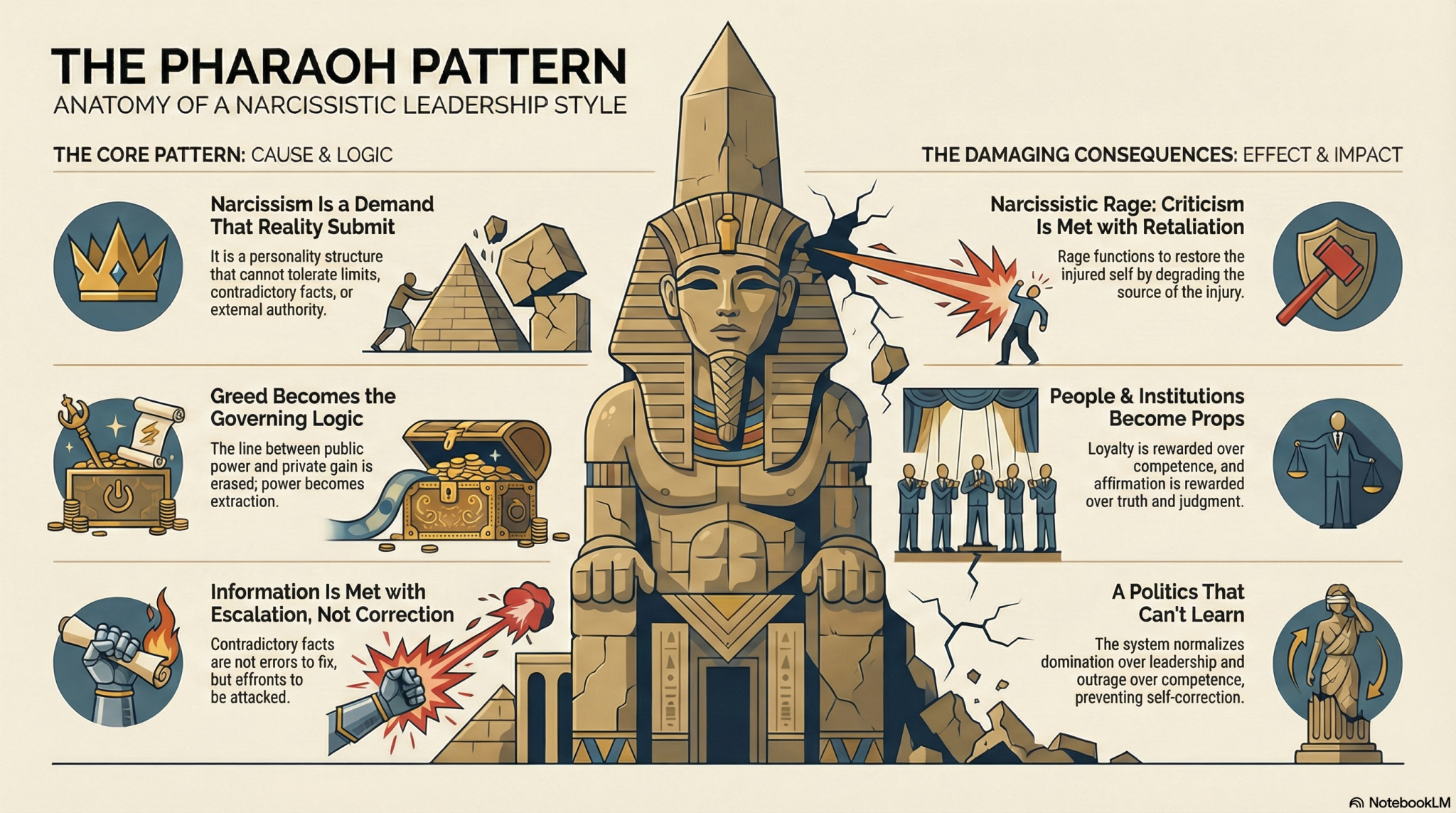
Narcissism isn’t vanity. It’s a demand that reality submit.
In everyday speech, a narcissist is someone who loves himself too much. In the classic psychological and cultural accounts, narcissism is more severe and more consequential: it is a personality structure that cannot tolerate limits.
Erich Fromm described “malignant narcissism” as a need to be right at all costs, an inability to accept external authority, and a willingness to destroy rather than relinquish control. Read this way, Trump’s behavior stops looking erratic and starts looking consistent.
Facts that contradict him are not errors to correct; they are affronts. Institutions that constrain him are not neutral frameworks; they are enemies. Elections he loses are not outcomes; they are humiliations that must be overwritten.
This is why correction so often fails. In a healthy political culture, new information can revise a claim. In a narcissistic one, new information is experienced as insubordination. The response is not adjustment, but escalation.
Rage as self-repair
Heinz Kohut’s concept of “narcissistic rage” helps explain the emotional intensity that accompanies this escalation. When the grandiose self is threatened—by criticism, loss, or mockery—the response is not reflection but retaliation. Humiliation is converted into attack.
This dynamic shows up repeatedly in Trump’s public life: judges, journalists, former allies, civil servants, even entire institutions become targets the moment they impose a limit. The counterattack often feels disproportionate because the trigger isn’t the issue itself; it’s the implied message that Trump is not dominant, not admired, not exempt.
Rage, in this sense, isn’t incidental. It’s functional. It restores the injured self by degrading the source of injury.
When people become props
Christopher Lasch, writing about narcissism as a cultural condition, adds another layer. In a narcissistic framework, other people are not experienced as independent subjects. They are mirrors, instruments, or obstacles.
This helps explain the revolving cast of characters in Trump’s orbit: the “best people” who become “total losers” the moment they stop reflecting him. Loyalty is prized over competence. Independence is treated as betrayal. Conscience is recoded as disloyalty.
This isn’t just a personal failing. It becomes institutional.
Organizations shaped around this style slowly relearn what is rewarded. Truth becomes loyalty-coded. Expertise becomes suspect. Process becomes “obstruction.” Accountability becomes persecution. Over time, institutions stop selecting for judgment and start selecting for affirmation.
A system like that can generate spectacle. It cannot generate good governance.
Greed as governing logic
Narcissism in Trump’s case is paired with something equally corrosive: greed—not simply as self-interest, but as a way of understanding the world.
In this worldview, everything is convertible. Fame becomes money. Office becomes brand. Politics becomes a revenue stream. Public anger becomes a monetizable asset.
Every politician fundraises. Every politician networks. But Trump’s signature move is the collapse of boundaries between public power and private gain. The distinction itself is treated as naïve, even laughable. Power is not stewardship; it is extraction.
Even when the legal questions are contested, the moral signal is unmistakable. The lesson absorbed by followers and imitators is not “serve the public,” but “take what you can.” That lesson scales.
Why this matters now
The danger of a narcissistic, greed-centered leader is not only what he does, but what he normalizes.
He teaches that admitting error is weakness.
He teaches that limits are illegitimate.
He teaches that domination is leadership and appetite is authenticity.
And because this style feeds on attention, it trains a media and political ecosystem to reward outrage over competence, loyalty over truth, performance over responsibility.
The result is a politics that can’t learn, can’t correct, and can’t stop escalating—because stopping would require acknowledging reality as something other than a mirror.
Seeing the pattern without mythologizing it
Atkins’s essay traces how antisemitism often functions within this pathology, as a rage response to the existence of limits, difference, and moral claims that cannot be absorbed into the ruler’s self-image. That insight matters. But it also points to something broader: narcissistic politics always needs an enemy, because enemies are easier than limits.
The task now is not to mythologize Trump—either as savior or as demon—but to describe the engine that keeps producing the same outcomes. Escalation instead of correction. Vengeance instead of governance. Appetite instead of responsibility.
This week’s reading reminds us what happens when a leader’s inner compulsions harden into public policy. We don’t need metaphysics to grasp the warning.
We just need the clarity to see the pattern—and the discipline to stop rewarding it.