
Middle East Analyst
How the AI Labor Displacement Tsunami Could Wipe Out the Entire Economy
graphic by author
Public debate about artificial intelligence still tends to focus on which jobs will be automated first, as if the sequence of displacement determines the scale of the disruption. It doesn’t. The distribution of job loss across sectors matters far less than the aggregate level of unemployment the system must absorb. Once that number approaches 30 percent, the question is no longer which industries are affected. The question becomes whether the system can survive.
The reason is simple: modern economies are tightly coupled systems. They are not a collection of independent labor markets but a dense web of income flows, consumption patterns, tax bases, credit structures, and institutional dependencies. When one major segment collapses, the shock does not remain contained. It propagates. And in the case of AI, the first segment to fall is also the one with the highest income density and the greatest leverage over the rest of the system.
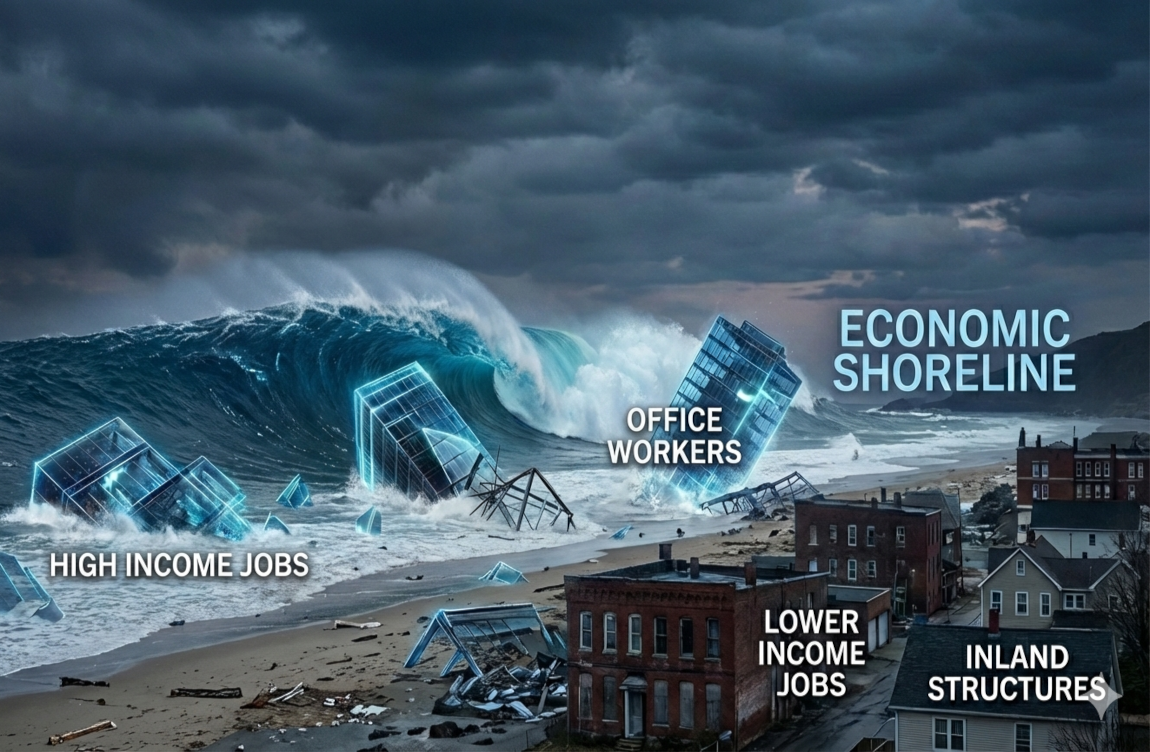
The earliest and deepest impacts will hit the symbolic workforce—urban office workers, managers, analysts, designers, coders, marketers, and administrative staff. These are the roles that exist entirely within a browser tab, and therefore the roles most exposed to generative models that can produce, summarize, categorize, and manipulate digital objects at machine speed. This is the shoreline of the economy, the place where the wave makes first contact.
But the metaphor of a wave understates the dynamic. A tsunami does not merely wash over the shoreline; it destroys the tallest structures first. High‑rise hotels and condos collapse not because they are weak, but because they are closest to the force. And when they fall, they generate debris—massive, fast‑moving, destructive debris—that sweeps inland and devastates communities that were never directly exposed to the ocean.
The same pattern applies to AI‑driven labor displacement. The urban symbolic workforce earns far more per capita than workers in most other sectors. Their incomes support restaurants, childcare centers, gyms, transit systems, retail corridors, healthcare providers, and entire municipal budgets. When these high‑income workers lose their jobs, the economic shock is not linear. It is multiplicative. A single displaced software engineer or financial analyst can remove as much consumption from the system as five or six displaced workers in lower‑income roles. That is the debris field.
Once that consumption disappears, the businesses that depend on it begin to fail. Service workers lose hours, then jobs. Small businesses lose customers, then credit, then solvency. Landlords lose tenants. Cities lose tax revenue. Public services contract. Layoffs spread to teachers, transit workers, sanitation crews, and municipal staff. What began as a symbolic‑sector shock becomes a full‑spectrum employment crisis.
At the same time, commercial real estate—already fragile in many cities—takes a direct hit. Empty offices become stranded assets. Property values fall. Pension funds and banks absorb losses. Credit tightens. Investment slows. The financial system, which relies on the stability of high‑income urban employment, begins to wobble. This is not a labor‑market problem anymore. It is a state‑capacity problem.
The inland communities—the ones far from the initial point of impact—are not spared. They are struck by the debris: collapsing demand, shrinking tax bases, tightening credit, and political instability radiating outward from urban centers. Even sectors that are not directly automatable, such as construction, logistics, and healthcare, feel the shock as their customers, funders, and coordinating institutions falter. The muscles of the economy cannot function when the nervous system has been severed.
This is why the fixation on “which jobs go first” misses the point. The first wave matters only because it determines the composition of the debris. And in this case, the debris consists of the highest‑income, highest‑leverage workers in the system. Their displacement is not just a labor event; it is a macroeconomic event. It is the collapse of the pillars that hold up the rest of the structure.
If aggregate unemployment approaches 30 percent, the system enters a zone where historical analogies become unreliable. Tax bases erode. Debt servicing becomes impossible. Political legitimacy fractures. Social order becomes brittle. Governments face impossible choices between austerity, emergency transfers, and institutional triage. The economy becomes a feedback loop of contraction, not a cycle of adjustment.
The challenge is not to predict which jobs will be automated. The challenge is to understand how the collapse of one layer destabilizes every layer beneath it. AI is not simply accelerating productivity; it is accelerating the divergence between symbolic work and physical work. And because symbolic work sits at the top of the income pyramid, its collapse sends shockwaves through the entire economic shoreline.
The tsunami metaphor is not hyperbole. It is a systems‑dynamics warning. The first wave takes down the high‑rise structures. The debris takes down everything else. Retraining coders to become plumbers will not save the day.
Related Topics