Middle East Analyst
How the UAE Became an Emerging Superpower in the Global AI Economy
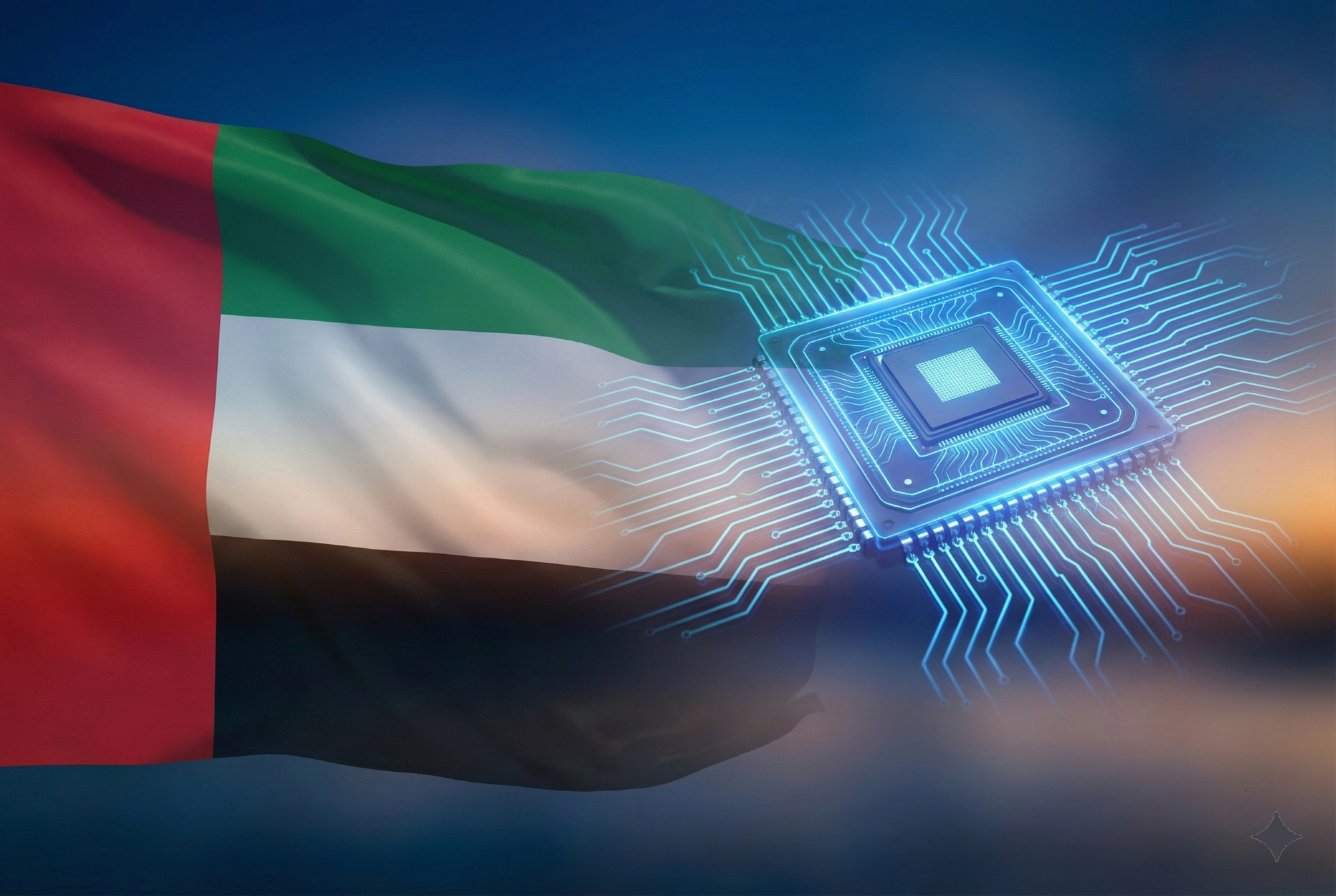
graphic by author/Nano Banana
For decades, the United Arab Emirates was caricatured as a glamorous consumer of technology—an economy that imported innovation the way it imported luxury brands. In the Western imagination, Abu Dhabi and Dubai built futuristic skylines and smart‑city systems on the back of foreign code written in Seattle, Shenzhen, or Tel Aviv. The Gulf, we were told, bought technology but did not shape it.
That view is now obsolete.
Over the past two years, the UAE has executed one of the most significant—and least understood—strategic pivots in the global technology landscape. It has moved from being a buyer of artificial intelligence to becoming a foundational node in the world’s AI infrastructure. And it has done so at the exact moment when the United States, Europe, and Asia are running into hard physical limits on land, electricity, and permitting.
A new map of global power—literal electrical power—is taking shape. And the center of gravity is shifting toward the desert.
The UAE is positioning itself not merely as a regional tech hub, but as a global AI utility provider: a jurisdiction capable of hosting, powering, and scaling the hyperscale compute infrastructure that the next generation of AI models will require. This is not a branding exercise. It is a structural transformation with implications for the entire global economy.
The End of Tech Neutrality
Until recently, the UAE tried to balance between Washington and Beijing. It deployed Huawei 5G towers while simultaneously exploring the purchase of American F‑35s. This hedging triggered alarm in Washington and led to restrictions on exporting advanced Nvidia chips to the Gulf in 2023.
What happened next changed the trajectory of the UAE’s technological evolution.
Instead of doubling down on neutrality, Abu Dhabi made a decisive choice. Through the Intergovernmental Assurance Agreement (IGAA), the UAE accepted U.S. security conditions on its high‑end compute ecosystem. This meant phasing out Chinese hardware, opening networks to U.S. auditing, and aligning its digital infrastructure with American export‑control standards.
Some observers misread this as a surrender of sovereignty. In reality, it was a calculation. In the AI economy, sovereignty depends on access to leading‑edge silicon—and the best silicon in the world is American. The UAE understood that a future built on second‑tier chips would be a strategic dead end.
This alignment with Washington unlocked something extraordinary: the ability to build the kind of hyperscale AI infrastructure that the U.S. and Europe increasingly struggle to approve at home.
Microsoft, G42, and the New Architecture of Trust
The realignment became concrete through the expanding partnership between Microsoft and G42, Abu Dhabi’s flagship AI company. What began as a $1.5 billion investment quickly scaled into a $15.2 billion strategic alliance extending through 2029.
This was not a commercial deal. It was an infrastructural compact.
By stripping out Chinese components and agreeing to U.S. oversight, G42 gained access to the frontier Nvidia chips—H100, H200, Blackwell—that define modern AI. In return, Microsoft gained a partner in a geography uniquely capable of building the type of hyperscale data centers that American utilities and planning commissions increasingly struggle to approve.
The U.S. provides the silicon. The UAE provides the power, the land, and the regulatory velocity. Both sides get what they need.
This partnership is the backbone of the UAE’s emerging role as a global compute host.
Stargate: The $500 Billion AI Archipelago
Nothing illustrates this shift more clearly than “Stargate,” the sprawling $500 billion compute initiative linking OpenAI, Microsoft, SoftBank, Oracle, and the UAE’s dedicated AI investment company, MGX.
Stargate is not a metaphor. It is a build plan.
It envisions an archipelago of colossal AI clusters across multiple continents—some in the United States, and some in the Gulf. The most strategically significant is “Stargate UAE,” a 1‑gigawatt supercomputing complex in Abu Dhabi scheduled to begin coming online in phases by 2026.
One gigawatt is roughly the power consumption of a small American city. Few countries can assemble that amount of energy for a single digital installation. Fewer still can deploy it at speed.
The UAE can because it has something the West increasingly lacks: energy abundance.
The Energy Moat
AI is an energy story before it is a software story. Training frontier models consumes staggering amounts of electricity. The U.S. grid is overstretched. Europe faces even harsher constraints. Environmental litigation and local opposition slow every major project.
The UAE faces none of these obstacles.
Its Barakah Nuclear Energy Plant—the first operational nuclear plant in the Arab world—provides stable, clean baseload power. Its vast solar parks add further generation without political resistance. Its regulatory system can approve in months what takes Western democracies years.
This energy moat is the critical input global AI firms now pursue.
And it is the foundation of the UAE’s ambition to become a global AI utility.
Beyond Consumption: Indigenous Capability Emerges
Skeptics often argue that the UAE lacks the human capital to be a serious AI power. It is true that the workforce is overwhelmingly expatriate, and that turnover remains a structural vulnerability.
But the evidence is shifting.
The Technology Innovation Institute’s Falcon series of open‑source models proved that the UAE can produce globally competitive AI research rather than merely host it. Falcon was trained locally, on Emirati infrastructure, by teams assembled in Abu Dhabi. It was not a white‑labeled Western model; it was an indigenous scientific product.
This matters because it signals that the UAE is not simply a checkbook partner. It is building real capability—and it is doing so in ways that complement its infrastructural strengths.
The UAE is not trying to replicate Silicon Valley. It is building something different: a hybrid model where indigenous research, sovereign capital, and global partnerships converge on a single strategic objective—compute dominance.
A Small Country with Outsized Ambition
It is important to remember that the UAE is small. Its landmass is a fraction of Saudi Arabia’s. Its coastline is shorter. Its citizen population is tiny.
Yet it is outpacing much larger states in:
- deployment speed
- regulatory agility
- international partnerships
- access to frontier chips
- operational readiness of AI infrastructure
This is not an accident. It is the product of a political system capable of making long‑horizon decisions and executing them quickly.
The UAE’s ambition is not to rival the U.S. or China in foundational model R&D. Its ambition is to become the global host, power provider, and infrastructure backbone for the AI century.
A New Center of Gravity
The global AI economy is restructuring around a brutal constraint: physical power. Nations with land, cheap electricity, and friendly regulation will host the next generation of AI infrastructure. Nations without those advantages will outsource more than they expect.
The UAE is emerging as one of those indispensable hosts.
Through its alignment with U.S. technology, its investment in nuclear‑backed compute, and its role in the Stargate consortium, the UAE has positioned itself as a structural pillar of the AI century—a kind of digital OPEC for compute capacity.
The message to the world is clear: engagement with the UAE is no longer optional. It is part of the backbone of the system the world is building.
The desert, improbably, has become the engine room.
Related Topics