
How to cook a lobster: The slow boil of judicial authority in Israel
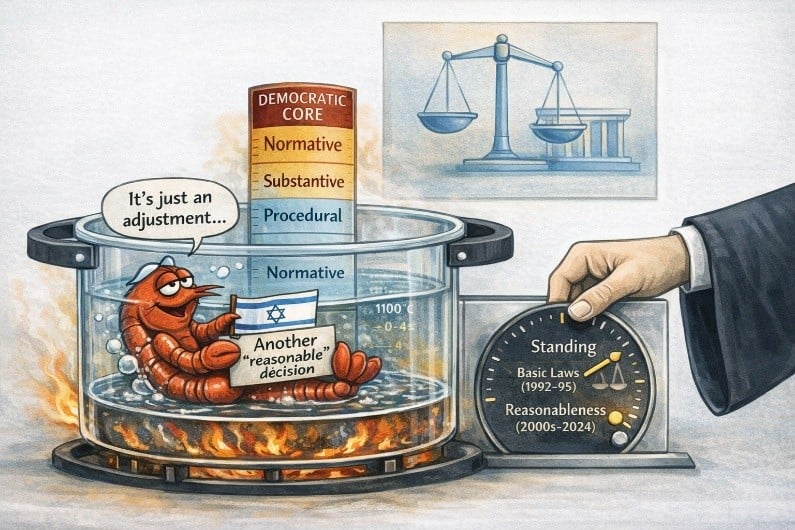
To cook a lobster without resistance, one simply places it in cold water and heats it very gradually, so that it does not perceive the danger until it is too late.
Michel Gurfinkiel chose this image¹ to describe the situation that emerged from the Oslo Accords, which he viewed as a mechanism that gradually dulled the vigilance of the Hebrew state. If Israel was not entirely “cooked,” it is because its adversaries raised the heat too quickly by launching the Second Intifada, thereby triggering a salutary shock.
A similar cumulative dynamic can be observed in the evolution of the jurisprudence of the Israeli Supreme Court: a series of decisions which, taken together, have progressively reshaped the balance of powers.
The first step, in 1988, was procedural. The Court broadened access to judicial review by expanding the concept of standing. The issue at stake concerned the enlistment of yeshiva students. The Court held that its role was to examine the legality of acts of public authorities whenever they raise a question of public importance, and that, as a result, any citizen may petition the Court.²
The next step was normative. The Court held that two laws adopted in 1992 relating to liberty, human dignity, privacy and freedom of occupation³ possessed constitutional value. It thereby authorized itself to review all other laws against these standards and to declare unconstitutional those laws and executive acts that contravened them.
This occurred when, in order to save the kibbutzim from bankruptcy, the Knesset adopted a law providing for the “rehabilitation” of agricultural debts, which impaired the rights of creditors. Seized by a bank claiming that its rights had been violated, the Court recognized its jurisdiction to rule on the constitutionality of the law.⁴
This revolutionary decision, however, was handed down five days after the assassination of Yitzhak Rabin and therefore passed largely unnoticed. In this way, the Court quietly constituted itself as a constitutional court.
The third shift was substantive: it concerned the gradual rise of judicial review based on the doctrine of reasonableness. Originally a simple safeguard against the absurd, reasonableness became a structuring criterion of judicial control.
It would be unfair not to acknowledge the positive aspects of this review. As a safeguard against arbitrariness or favoritism, it imposes a minimum of rationality, coherence and justification on public action and provides effective protection for fundamental rights.
The excess emerged, however, when reasonableness ceased to serve merely to exclude manifestly irrational decisions and instead allowed the Court to prefer a judicial solution over a political one that was nevertheless lawful—to assess ministerial and administrative appointments, budgetary decisions, and even choices relating to security policy.
In response, the Knesset adopted in July 2023 an amendment to a Basic Law on government, intended to remove the use of the reasonableness doctrine with respect to ministerial decisions.⁵ The Supreme Court annulled this amendment⁶ on the grounds that it constituted a substantial violation of the **“democratic core.”**⁷
Yet this democratic core is not defined by any superior constitutional text; it is defined by the Court itself. In doing so, the Court has become the ultimate source of constitutional sovereignty in Israel, without democratic validation.
This helps explain the decline in the Court’s standing, with only 41 percent of the population expressing confidence in it. It also explains why 71 percent of Israelis support the adoption of a formal constitution.⁸
A first step would be to require that constitutional laws be adopted by a qualified majority and, by virtue of that status, bind the Supreme Court itself. There exists within Israeli society a current of opinion working in this direction,⁹ conscious of the risk that polarization poses to society as a whole.
Notes
- Michel Gurfinkiel, La cuisson du homard, Éditions Michalon, 2001.
- Ressler v. Minister of Defence, HCJ 910/86 (1988).
- Basic Law: Human Dignity and Liberty (1992) and Basic Law: Freedom of Occupation (1992).
- United Mizrahi Bank v. Migdal Cooperative Village, HCJ 6821/93 (1995).
- “Reasonableness Amendment” to the Basic Law on Government, adopted July 24, 2023.
- Movement for Quality Government v. Knesset, HCJ 5658/23 (1 January 2024).
- Defined by the Court as including the separation of powers, the rule of law, and the existence of effective checks and balances.
- Israeli Democracy Index, Israel Democracy Institute (latest annual survey).
- The Rivon4 initiative, which calls on Israelis across the political spectrum to imagine and act for a future of unity.