
How to Get Kicked Out of Camp and Remain Religiously Intact – Part I
I’m proud to have recently completed my tenth year as the Rabbi of the Young Israel of Memphis (TN). During that time, it’s also been a privilege to teach Torah to high school students at Memphis’ Cooper Yeshiva of the South (CYOS). Before relocating to Memphis, I also spent a year teaching at a Jewish day school on Long Island, NY, as well as nine years of serving as a Shul Rabbi in Harrisburg, PA. Altogether, this amounts to twenty rewarding years spent in the Rabbinate and Jewish education.
Reaching this milestone caused me to reflect on my dual roles as a Shul Rabbi and Jewish educator. What do I hope I have accomplished in both of those capacities over the last two decades?
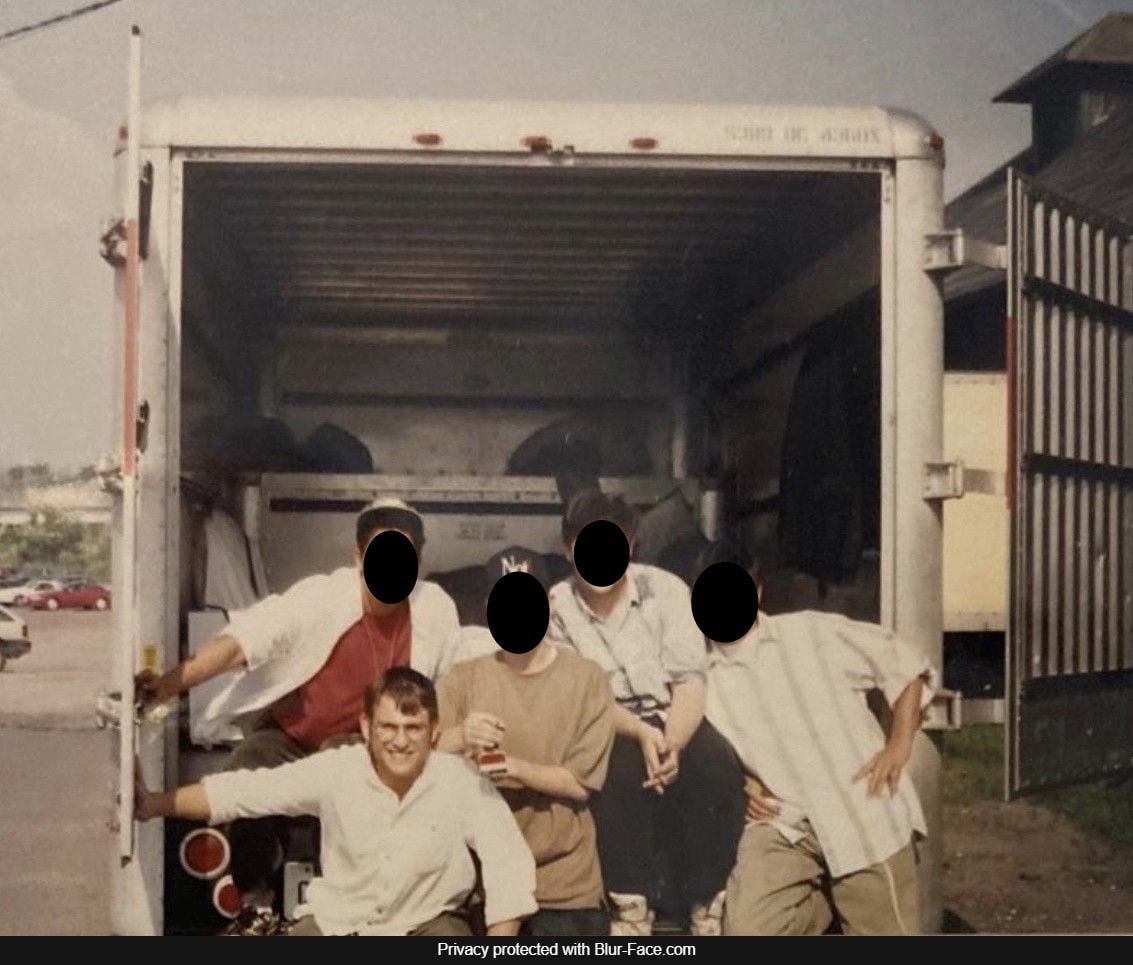
In discussing this with my wife Layala, I thought of a recently rediscovered picture from the summer of 1992. There’s a startling backstory to this picture of five smiling teenage boys posing at the open rear doors of a U-Haul truck. I’m the one at the bottom left. The faces of the other four in the picture have been obscured — as I did not track them down and ask for their consent in sharing the story that follows.
That picture was taken about a month after I graduated from Yeshiva high school in Milwaukee, WI. After four incredible years of learning and camaraderie, I left my friends and Rabbeim at WITS (the Wisconsin Institute for Torah Study) feeling a great sense of accomplishment and optimism about all that lay ahead. I was excited that I would soon fly to Israel for a challenging year of Torah study at Yeshivas Chofetz Chaim in Yerushalayim. Little did I know that I’d first end up in the back of a U-Haul truck after getting thrown out of summer camp.
Allow me to explain:
I spent the previous summer at home in Cleveland, OH working for a friend’s father who was remodeling houses. Concurrently, I took a lifeguarding course and passed a difficult certification exam. That same summer, a friend and classmate of mine at WITS named “Yosef” also became a lifeguard while he was back home in NY.
During our twelfth-grade year, Yosef and I often spoke about our plan to spend the coming summer working together as lifeguards at a sleep-away camp. We imagined having a fun time while earning some much-needed cash for the year of Yeshiva that would follow. I had no idea how to land such a job from out in Milwaukee, so I left that up to Yosef who had some ideas.
Shortly before we graduated, Yosef succeeded in securing positions for us as lifeguards somewhere in the northeast. However, it was at a camp that neither of us — or any of our friends — had ever attended. Nonetheless, we needed summer jobs, and we’d surely fit in, right?
To make a long story short, Yosef and I quickly realized the camp was not the right fit for us. Although we had spent the last four years attending a Yeshiva high school, there are so many nuances within the Jewish Orthodox community. Without going into detail, that camp’s leadership, clientele, and most of its staff came from significantly different backgrounds from within the frum community than we did.
Yosef and I immediately felt like outsiders in that camp and were pretty much left to do our own thing. We really missed the camaraderie of our friends and the connections with our Rabbeim that we had so enjoyed at WITS. Nonetheless, we had each other and figured that we could muscle through six weeks of that camp, collect our paychecks, and then head off to Yeshiva — and the like-minded friends and environment that we were used to.
That plan worked for two or three weeks — until one rainy day radically changed everything. Seeing that it was supposed to pour that entire day, the camp’s lifeguards (I think there were nearly ten of us) realized we wouldn’t have any work that day. As it turned out, many of the camp’s kitchen staff were also scheduled to be off that same day.
How would a group of about twenty summer camp staff spend their day off in bad weather? Someone (I don’t remember who) came up with an idea: Let’s borrow the camp’s two vans and head out for a day of fun. Our group’s representative was less than honest in explaining our plan to the camp’s assistant director. But the request was made, we somehow received keys to the camp’s vans, and we were off.
When we returned to camp several hours later, we learned that we were in trouble. The camp leadership had figured out what happened, and the director was furious that our group had not been honest with his assistant. We were summoned to a meeting with the camp’s director – whom I assumed would deliver us a tongue lashing.
However, I had no idea how angry the director was, or what punishment might be in store for our large group. Worst case scenario: I imagined we might be grounded from leaving the camp on future days off. Wow, was I mistaken!
Somehow, our group of nearly twenty offenders fit into what I think was the living room of the director’s bungalow. The director tore into us, furious that we had taken the camp’s vans after not having been honest with his assistant. I waited to hear what the consequences for us would be.
However, he wasn’t ready for that yet. The director told us that there clearly were bad apples in our group, and he was going to conduct a full investigation to discover who was responsible for our nefarious scheme. As director, he had a responsibility to ensure that his camp would not be corrupted by the rotten nucleus who had hatched that day’s plan. After taking down all our names, we were told to leave his bungalow, and that we would be summoned back in a few hours.
As we left, I remember thinking that the situation we were in was a bit more serious than my original assessment. However, I still had no idea just how greatly I had misjudged the storm that was surrounding us.
Our group returned at the assigned time, and it was immediately clear that our predicament had grown more serious. A tribunal comprised of senior camp staff now faced us – sitting alongside the camp’s director.
The director told us he had conducted a thorough inquiry into our group’s misconduct. He concluded that our misdeeds were the result of five ringleaders who had been a corrupting influence on the others and were responsible for that day’s misadventure. Reading from his notepad, we were shocked to hear the list of names he had assembled.
The first two were the fellows who had driven the vans. However, they were not troublemakers of any sort. They were just guys who had driven the camp’s vehicles in the past, so they were trusted to drive our group on that rainy day off.
The third name had us all scratching our heads. Why was he singled out?
However, it was names four and five which provided me with a figurative punch to the gut. I remember thinking: Did I just hear the director read off my name and that of my classmate Yosef? Did he really think we were criminal masterminds who had misled his assistant? In truth, Yosef and I were virtual loners in his camp. It seemed to us that few people there even knew we existed. How did any of this make sense?
As I sat there stunned, the pieces all started falling into place. Clearly, the camp director wanted to punish a small group of us, restore order, and ensure that for the duration of that summer, his staff would not step out of line again. But who could be placed on the chopping block? The five of us who had been singled out shared an obvious common denominator. Our family names and/or connections carried no weight in that camp’s circles. Each of us lacked the requisite “protektsia” that would have enabled us to avoid the proverbial hangman’s noose.
As I absorbed what was clearly taking place, I was overcome by the immense feelings of injustice occurring in that room. I panicked as I realized my face was beginning to flush, a lump had formed in my throat, and my eyes were starting to moisten. I remember mentally scolding myself: “Males! For G-d’s sake, in another few months you’ll be eighteen years old! You can’t cry — especially not in front of the other guys in this room. What will they think of you? You’ll also look like such a wimp to the director. Do you really want to give him that satisfaction? Man up — don’t cry!”
I swallowed, but as hard as I tried, I couldn’t control my emotions. Knowing that my tears were just moments away from bursting forth, in what must have looked like an act of defiance, I abruptly stood up, made a beeline for the door, and ran out in the nick of time. I remember hearing the director yelling at me to sit back down, or I’d be sorry. It was a no-brainer though; I had to escape that room — I couldn’t let anyone see my tears of frustration. After all, I was an eighteen-year-old man (almost).
I remember rushing to the room that Yosef and I shared where I retrieved a hatchet that I brought to camp (I grew up in the Boy Scouts, and I was taught to be prepared). With salty tears running down my cheeks, I ran into the woods and furiously chopped away at several downed trees. I burned off a lot of steam with that hatchet until I got all the crying out of my system.
By the time I was done making woodchips, the meeting in the director’s bungalow had ended. I was hungry and stopped by the camp’s canteen for something to eat. A few guys whom I left behind at the meeting were also there, and they filled me in on what I missed after I had left so abruptly.
One of them remarked, “Wow, Males you’ve got some real guts — storming out on the director like that! I wish I had a backbone like yours!” I just shrugged and nodded. What was I supposed to do, correct him, and tell him that I had to run out because I didn’t want everyone to see me cry?
Continued in Part II
___________________
Rabbi Akiva Males serves as the Rabbi of Young Israel of Memphis and also teaches at the Cooper Yeshiva of the South in Memphis, Tennessee.
I thank my father, Mr. U. Harold Males (Jerusalem, Israel) for his editorial assistance.