
How to Get Kicked Out of Camp and Remain Religiously Intact – Part II
Continued from Part I
Before packing our belongings, our group of five needed to let our parents know that we’d be coming home earlier than expected. While I don’t know how the other guys broke the news to their parents, I clearly remember using a payphone to call my father and tell him about the situation I was in. Without going into detail, I said that the camp was a really bad fit for me; they wanted me to leave, and so did I.
My father wasn’t upset at me, but he did inquire how I planned to return to Cleveland. I responded that I was working on getting a ride back to NY with four other guys who were also leaving the camp. I had already reached out to my brother Micha who had stayed in his Yeshiva in Queens, NY (Ohr HaChaim) that summer to continue his coursework at Touro College. He had invited me to stay with him in his apartment for the next two weeks. Following Tisha B’Av, Micha planned on driving back to Cleveland with some friends — and they had room in their car for me.
Now our group that had just been expelled from camp were a bit confused. How were we supposed to return to NY? Apparently, the director didn’t share that piece of the puzzle during the part of the meeting that I missed. One member of our group asked the director’s assistant about this minor detail. He was told that was our problem to figure out.
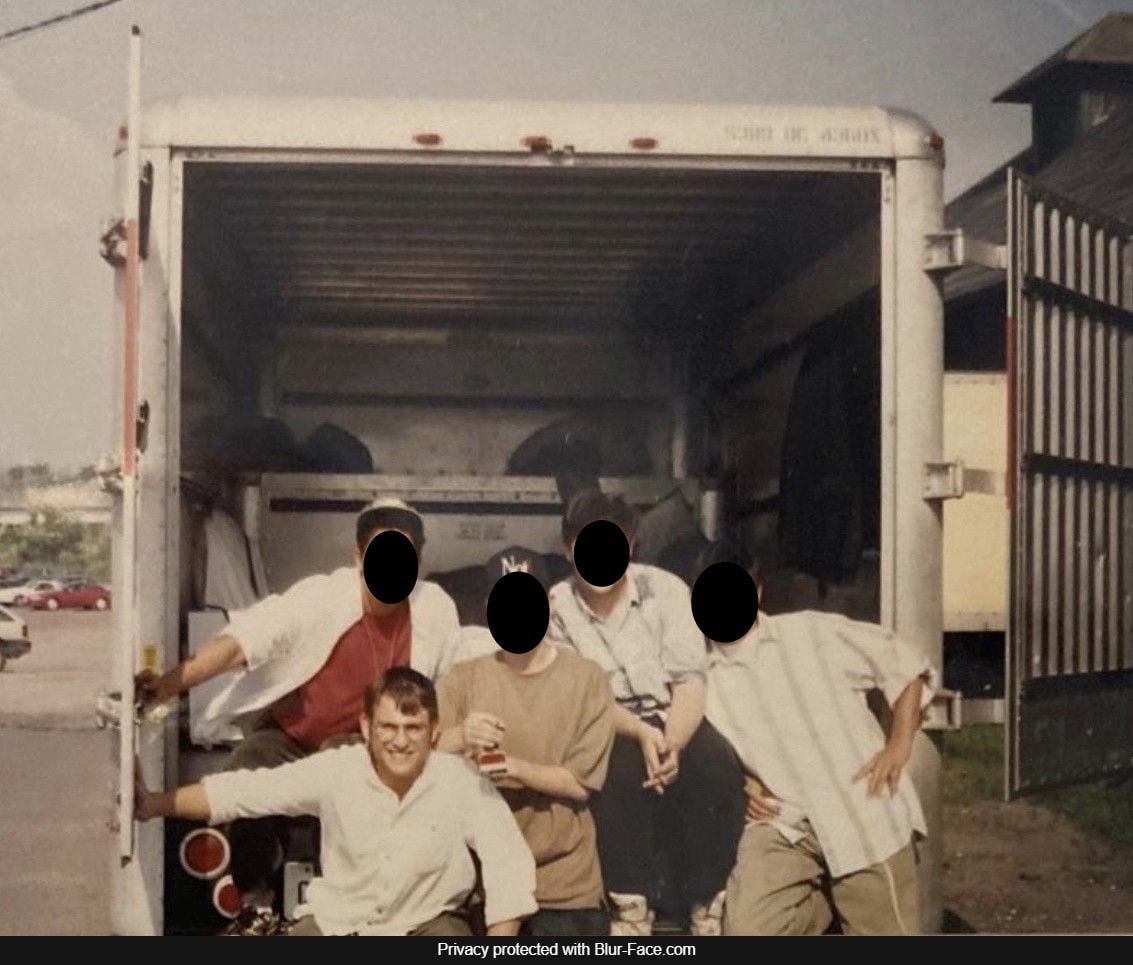
We talked it over and came up with the following plan: Both guys who had driven the camp’s vans were eighteen years old, the other three of us were only seventeen. None of us was old enough to rent a car. However, from previous experience, one of the guys knew that being eighteen was old enough to rent a U-Haul truck. Driving back to “the city” in a U-Haul truck would be such a fun experience!
It then hit us that we were a group of five, and only three could ride in the front of the truck. Where would the other two guys go? In our teenage minds, the answer was simple: Yosef and I excitedly volunteered to ride in the back with all the luggage. If the guys up front agreed to stop every hour to open the truck’s back doors for air, what could possibly go wrong with such a horribly irresponsible plan?
The next morning, a camp van drove the five of us to a nearby U-Haul rental location. The driver was somewhat surprised that we weren’t going to the local Greyhound station. However, we unloaded our duffle bags and suitcases, reassured him that everything was in order, and he drove off.
After filling out the requisite paperwork, our truck was rented. Yosef and I spread our sleeping bags over the floor in the back of the U-Haul, loaded in the luggage, plenty of drinks/snacks, a few newspapers, and we were off. The guys in front drove safely, and true to their word, they stopped every hour or so to let in some fresh air. Yosef and I thought traveling in the back of the truck was a real hoot, and we made the best of it. (We didn’t even need to use the flashlights we’d brought, as the truck’s roof was surprisingly translucent.)
Thankfully, G-d watched over us, and nothing went wrong with our terribly unsafe plan. Our U-Haul was not pulled over by the police during our drive back to NY, and we were each safely dropped off where we needed to go.
Shockingly, within days of throwing us out, someone from the camp’s office called each of us. Now that we had learned our lesson, we were welcome to return — albeit on probation. The other four guys took the camp up on the offer and went back. I, however, had no interest in returning to that place which had wronged me. I chose to walk away from my job as a lifeguard, forfeit my salary, and stay with my brother Micha before driving back home to Cleveland with him and his friends.
The rest of that summer went by smoothly for me, and about a month later, I was off for Yeshiva in Israel. There, I experienced an incredible year of Torah learning, developed strong friendships, enjoyed countless new (and safer) experiences, and I grew in so many ways.
Even though thirty-four years have passed since that turbulent summer of 1992, I’m still flabbergasted that after unjustly expelling us, neither the camp or its director thought to: A) call our parents, B) make arrangements for us to get back to NY in a safe/responsible manner, and C) even inquire how we planned to return home after being thrown out.
Like other sleep-away camps that have come and gone over the years, thank G-d, the summer camp of this story is no longer in operation. Additionally, its director has since passed away. As such, no other teenagers will be treated so unfairly by them — or end up in such a terribly unsafe situation because of them. (Close to seven years after this incident occurred, I had a providential final encounter with that camp’s director, but that’s another tale to be told.)
While discussing this episode (and picture) of thirty-four years ago with my wife, I was struck by the following observation:
Surprisingly, I believe I walked away from that incident completely unscarred. Even though I felt so mistreated by that Jewish camp’s leadership (the director even used the title of “Rabbi”), so far as I can tell, that experience left no negative impact on me.
This is rather surprising – as this episode could have ended very differently for me. After all, an untold number of Jews who have abandoned the Torah, Mitzvos, and their family traditions point to incidents in their lives where they felt let down, hurt, or betrayed by a religious leader.
In his seminal article entitled “When Leaders Fail: Healing From Rabbinic Scandal”[1], published in the Summer 2015 edition of the Orthodox Union’s Jewish Action magazine, Rabbi Yitzchak Breitowitz wrote:
. . . In all walks of life, people whom we admired have disappointed us with their failures and weaknesses. We have become disillusioned and cynical. Unfortunately, even within the Torah camp, leaders in whom we placed our trust have betrayed us . . . Many have lost faith not only in those who are supposed to transmit Torah but, to some degree, in the goodness and morality of the Torah itself. God’s name and His glory quite literally have been besmirched, the very definition of chillul Hashem . . .
However, unlike all those cases, the degree of my religious observance was unaffected by what I went through that summer. My relationship with Hashem remained firm, and my trust in Rabbis and Jewish leadership held strong. How could I explain why going through such a negative experience had left me religiously unscathed?
Here is my theory:
Rabbi Berel Wein, of blessed memory, used to quip, “Don’t confuse Jews with Judaism”. When we encounter a Jew behaving badly, we ought not see that individual as a representative of true Judaism. Instead, we should remember that while Judaism is perfect – unfortunately, individual Jews often are not. However, it becomes much easier to follow Rabbi Wein’s dictum if one was fortunate to know many good Jews who practice authentic Judaism.
Thank G-d, prior to being thrown out of that summer camp, I was fortunate to have known and have positive relationships with so many wonderful Rabbis whose conduct was exemplary. Between my family’s Shul Rabbi, the Rabbeim who taught me Torah as a child at the Hebrew Academy of Cleveland, and more recently, the Rabbis I was blessed to have at WITS during my ever-so-formative high school years – I knew many top-notch Rabbis. In their own way, each one of them helped connect me to Hashem, Har Sinai, Torah, and Mitzvos. (Of course, I also cannot thank my parents enough for nurturing me and my siblings in the loving, stable, and happy Jewish home which they worked so hard to create.)
As a result of all those positive relationships/experiences, being on the receiving end of some awful behavior of one Jewish “leader” did not at all shake my commitment to Judaism. My seventeen-year-old mind was certain that what I had experienced that summer was the exception and not the rule. After all, I knew that the “real” Rabbis and Jewish leaders in my life would never have mistreated me like that director did. (I sincerely hope the other four boys who were expelled by that camp were able to handle that mistreatment as well as I did.)
After twenty years in the Rabbinate and Jewish education, what is it that I hope to have accomplished? Of course, I hope I’ve succeeded in imparting some of the Torah’s timeless teachings to my congregants and students. Like the Rabbis who taught me, I also hope that I’ve played a role in connecting other Jews (of all ages) to Hashem and Har Sinai.
However, thinking of the outstanding Rabbis I’ve been fortunate to know, I hope I’ve accomplished something else. I hope that over the past two decades, I’ve made nothing but a positive impression on everyone I’ve encountered. Whether it was in the classroom, at Shul, in my home, or the public square, I hope I’ve consistently conducted myself in full accordance with the Torah’s values. I also pray that I have behaved like a Mentsch with everyone I’ve interacted with.
I sincerely hope that none of my congregants or students will ever end up on a highway in the back of a U-Haul truck after having been unjustly thrown out of a summer camp. However, if (and please not when) a Jewish “leader” or even a “Rabbi” in their lives fails them, I hope that I’ll be one of the “good guys” whom they’ll quickly be able to think of. I pray that I’ll be but one of the numerous Rabbis they have had a positive relationship with who can serve as a counterbalance to the negativity they’ve unfortunately had to experience.
If my efforts over the past twenty years help make it possible for a wronged student or congregant to not confuse Jews with Judaism, I’ll know that I have done something meaningful.
______________________
Rabbi Akiva Males serves as the Rabbi of Young Israel of Memphis and also teaches at the Cooper Yeshiva of the South in Memphis, Tennessee.
I thank my father, Mr. U. Harold Males (Jerusalem, Israel) for his editorial assistance.
[1] Available online at: https://jewishaction.com/religion/faith/when-leaders-fail-healing-from-rabbinic-scandal/