
Middle East Analyst
How to Read UAE’s Non-Denial of the Alleged Oct 7 Warning
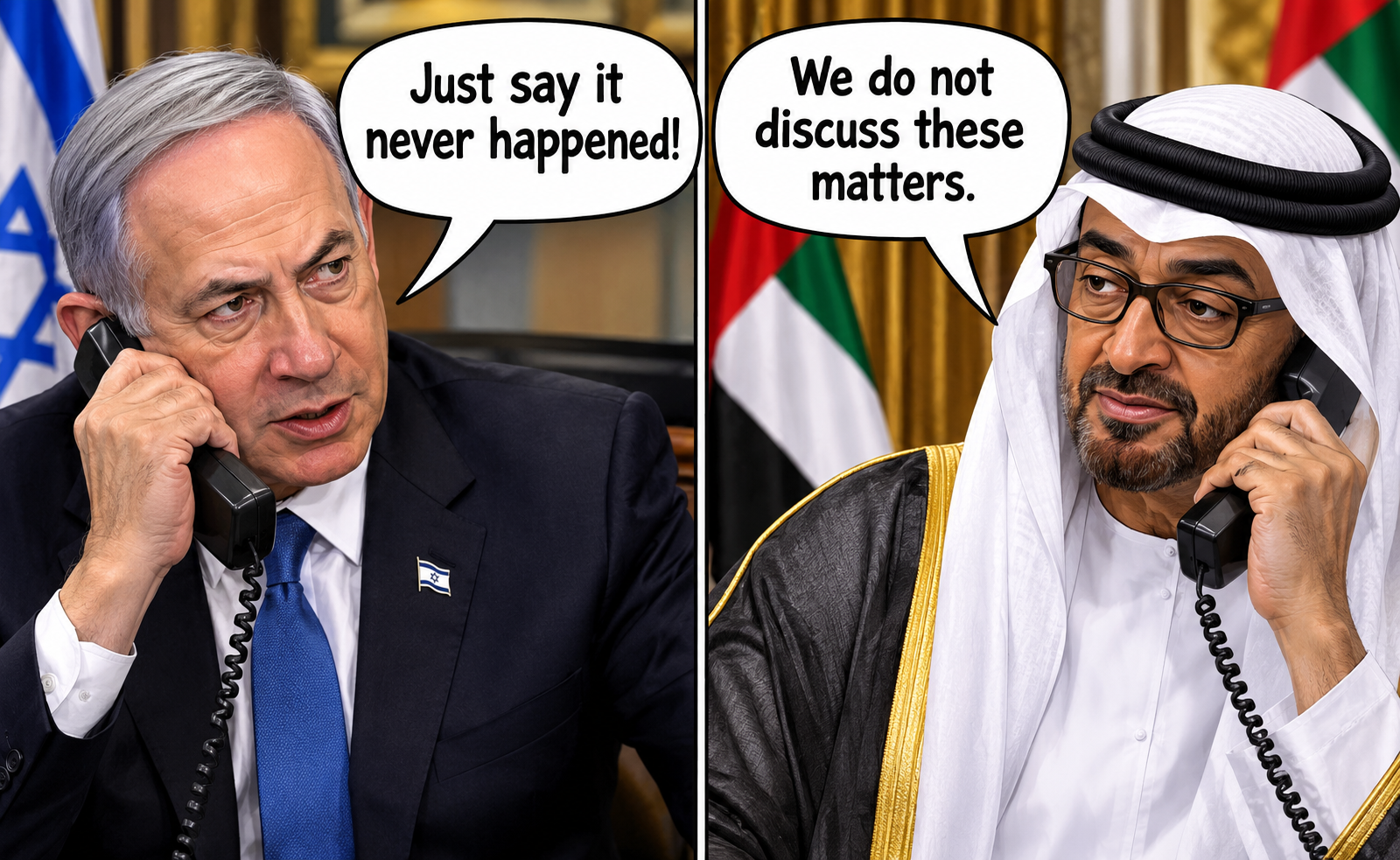
by author (AI)
The Statement Itself
On September 8, 2026, the United Arab Emirates’ Ministry of Foreign Affairs responded to a Haaretz investigation alleging that President Mohammed bin Zayed personally warned Prime Minister Benjamin Netanyahu of an imminent Hamas attack roughly ten days before October 7. The ministry’s statement read, in substance: the UAE does not comment on media reports or speculation regarding conversations between government leaders. Since the establishment of relations more than five years ago, governmental entities in both countries have maintained open and direct channels of communication, and when necessary, relevant intelligence information continues to be exchanged between the concerned parties.
That is the entire statement. It confirms nothing about the alleged call. It denies nothing about the alleged call. It affirms only that a functioning intelligence relationship exists and is used when the two governments judge it necessary.
The Standard Read
At first glance this is unremarkable. Governments routinely decline to discuss the substance of intelligence-sharing arrangements, regardless of whether a specific allegation is true. “We do not comment on conversations between leaders” is boilerplate deployed by virtually every state with an active security relationship, precisely because confirming or denying individual claims would compromise sources, expose the mechanics of a channel, or set a precedent obligating comment on the next leak. Read this way, the UAE said nothing at all. It reached for the standard formula and moved on.
The Question the Boilerplate Doesn’t Answer
The standard read cannot fully account for what happened next. An Israeli source familiar with the matter told CNN that Netanyahu’s office pressed the UAE to issue a flat denial of the Haaretz report, and that Abu Dhabi agreed only to put out the ambiguous statement about intelligence channels instead. That detail changes the analysis. This was not simply a government reaching automatically for a stock phrase. It was a government asked directly to kill a damaging story with an unequivocal denial, and declining to do so.
A state with no stake in the outcome, and nothing to hide, typically takes the free option. A flat denial costs the UAE nothing diplomatically if the underlying claim is false, and it would have ended a story that implicates Abu Dhabi in a foreign election. The UAE had that option available, was reportedly asked to exercise it, and chose the vaguer formula instead. That choice is the actual subject of this essay, and it opens onto several explanations that are not mutually exclusive.
Explanation One: Ambiguity as Asset
Whether or not Mohammed Bin Zayed actually made the call, the UAE benefits from the widespread perception that he did. A regional leader who reached out directly, twice-over through a Palestinian intermediary and then personally by phone, to warn Israel of a “zilzal” — an earthquake — being prepared by Yahya Sinwar, is a leader who looks like exactly what the UAE has spent five years since the Abraham Accords trying to appear as: a serious, plugged-in counterterrorism partner with intelligence reach into Gaza that Israel itself lacked. That reputational asset accrues to Abu Dhabi the moment the story is widely believed, independent of whether it can ever be proven. A categorical denial forecloses that benefit. Silence, or near-silence, preserves it. This is very likely the single largest driver of the UAE’s chosen language, and it requires no assumption about the underlying truth of the Haaretz report at all.
Explanation Two: If True, Neither Lying Nor Choosing Sides
If the call happened as described — and the reporting is detailed enough to take seriously, built on a forthcoming book by Shlomi Eldar and Ruti Yuval, sourced to multiple senior foreign officials and an adviser present for the exchange, with Netanyahu’s own former Shin Bet chief Ronen Bar and former IDF chief Herzi Halevi confirming to Haaretz that they were never briefed on this specific warning — then the UAE faces a straightforward constraint: it cannot deny something that occurred without lying outright, a risk few governments accept for a foreign election they profess no interest in. But it equally does not want to be seen as an active participant in an Israeli campaign, still less as an agent of Netanyahu’s removal, when Netanyahu may well remain prime minister past October 27. Confirming the call would read as an endorsement of the opposition’s central argument. The UAE’s answer to that bind is to say nothing that helps either side decisively while saying enough to avoid the appearance of covering for Netanyahu. That is a government trying to survive an election it has no vote in, not one trying to determine its outcome.
Explanation Three: Leverage, and a Quiet Preference
Even if the call did not happen as alleged, the UAE may still prefer to withhold a clean denial for reasons that have nothing to do with truth-telling. Ambiguity of this kind is a bargaining chip — a card the UAE can hold in reserve against a Netanyahu government it still has to negotiate with over Gaza, Lebanon, Syria, and its own position inside an increasingly strained Abraham Accords framework. A government that has just watched its non-denial dominate an Israeli news cycle for two days has demonstrated, to itself and to Jerusalem, that it can shape the domestic conversation without saying anything on the record. That is not a capability any state discards cheaply.
There is also a simpler possibility sitting underneath the tactical one: the UAE may privately prefer that Netanyahu’s tenure end, given the friction over Gaza policy that has produced two joint Arab-Muslim statements this year naming Israel as the obstructor of UNSC 2803’s implementation. A government holding that preference would still have every reason to avoid being seen as the one that tipped the scale, which is exactly what an aggressive denial or, worse, an aggressive confirmation would risk. Silence lets that preference operate, if it exists, without ever being stated.
What to Watch
None of these explanations are confirmable from the statement alone, and they are not mutually exclusive — the reputational benefit, the electoral caution, and the leverage motive can all be operating on Abu Dhabi at once. The tell will come from what the UAE does next rather than what it has already said: whether Emirati state media and government-adjacent commentary quietly sustain the story or let it die, and whether Abu Dhabi’s tone toward Israel shifts at all if the government in Jerusalem actually changes. Until then, the accurate description of the UAE’s position is not that it confirmed the warning, and not that it denied it, but that it calculated — correctly — that saying nothing decisive was more valuable than saying anything at all.
Related Topics
Related Posts