Hurting, Until We Heal
We await the return of 13 bodies held hostage in Gaza. If we said, until now, that we can only begin the healing process, once all the hostages are returned, I think it’s not too soon to further qualify that statement. As Hamas violates the agreement and may today still release two more bodies under US pressure, we know they have more bodies. We know they should have been released. The lingering feeling of war. The absence of feeling like a healing process is beginning. Not likely to just change with the return of the 13 deceased hostages. It was nice to have a target though, the delusion that reaching a particular goal would generate a new process.
I intended to write about other things this week, manifestations of post-trauma surrounding me, phenomena we just take in stride. But after dinner last night with a family friend, an elderly man visiting from the US, we suggested a Saturday excursion. We had a plan. Haim’s idea: take him to the Nova site, where the music party with over 3000 people took place on October 7. Our guest visited Israel in April 2024 but didn’t visit the Negev area bordering on Gaza then. He said then we took him to Hostages’ Square.
We drove to Re’im, the the Nova party site. Over an hour from Tel Aviv. Not the first time for me and Haim. Today I told him, I’ll never come again. I meant it in the moment. But I know I will visit again.
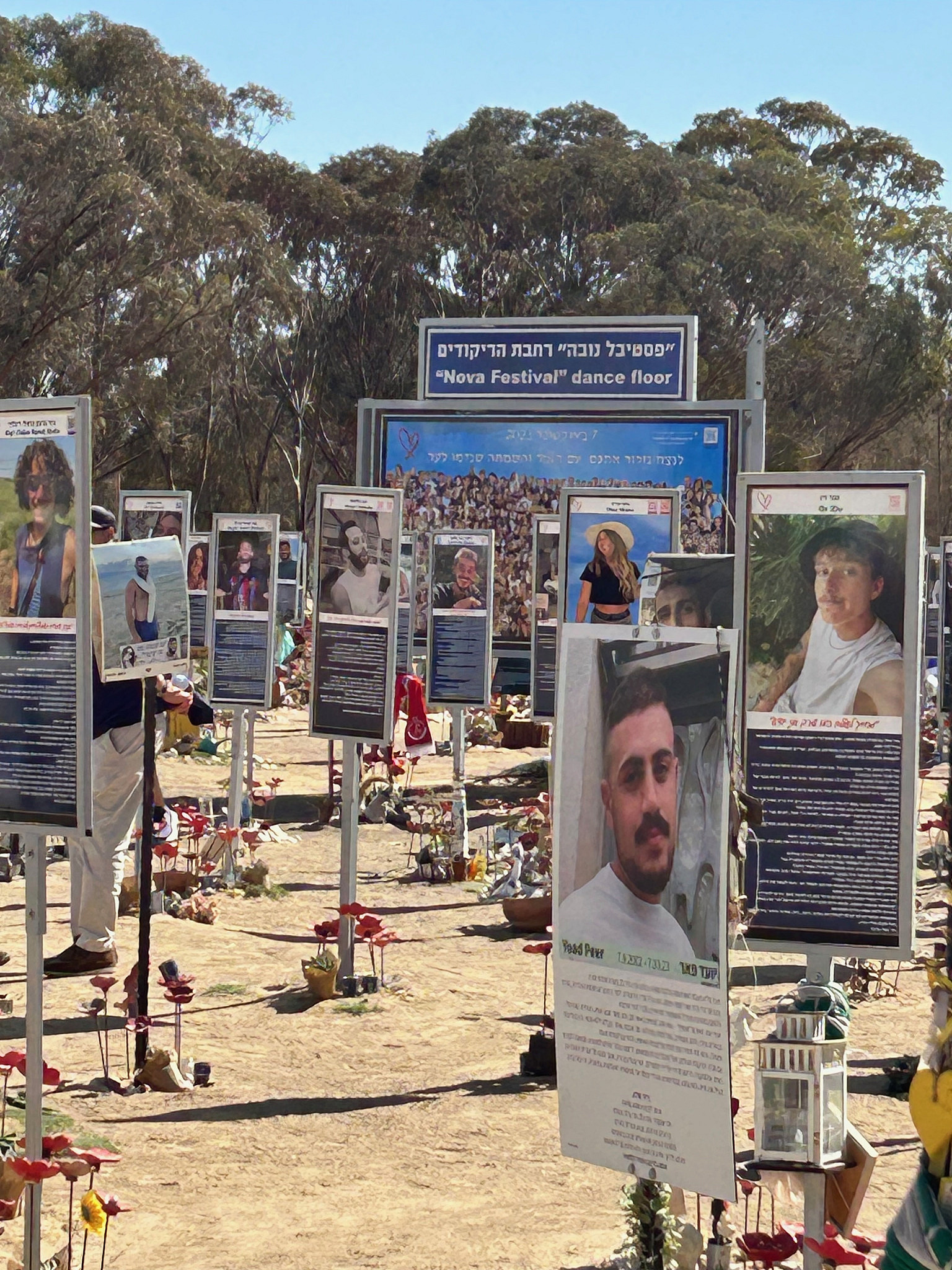
Installations from the party. Explanations. Reminders. Partyers sought shelter in trash dumpsters, at the police post, a bar stand, and a DJ station. Names and photos with stories about each of the victims of that day with the red ceramic poppy flowers memorializing them on posters propped on eye-level poles in this park.
At the edge of the site, people walking to their cars. Many Israeli families were visiting. We stopped for a moment. A teenager rested her head on her father’s shoulder, her arm around him, sadness enveloping her.
With the smile of helplessness, I’ve adopted since October 7, I looked at her walking away, and said, “I don’t know you, but I feel like I want to hug you too.” She said, “You can.” I did. We share the pain. She walked on and her mother and I exchanged a few more relevant words combined with exchanges of facial expressions, raised cheeks, raised eyelids, silent sighs.
We drove to the car cemetery. Ominous. Gate closed on Shabbat. You perceive the magnanimity from the road. Vehicles Hamas used. Israelis’ cars burned, shot. Driving through Jaffa to Tel Aviv with our guest we passed the Forensic Medicine facility where deceased hostages are sent for identity verification.
Before picking up our guest in the morning, while Haim drove, I read on my phone. An interview in Haaretz with Prof. Yossi Levi-Belz, psychology researcher from Haifa University entitled, and roughly translated as, “Only After the Soldiers Returned Home Did They Get What Happened and They Couldn’t Believe It.” It was long. I finished reading after our guest was back at his hotel. It ended with hope – not all hope is lost.
The data described from the work of his research team felt validating. It reminded me of why I support Breaking the Silence. It validated what I have said repeatedly to those who listen: Israeli society will confront the ethical horrors of this war – individuals will face it at different times, in different ways, tomorrow, two years from now, 20 years from now. The best way to support Israel is to demand it be accountable.
Our pain unites us, and we hug strangers. Our pain divides us, when we undermine pain selectively. “Together We Will Win” slogans and government refusal to establish a commission of inquiry, imposing its narrative – that invalidates pain. It’s volcanic. The interview argues that those who contain the complexity suffer more. It’s just that for me, not to contain the complexity, not to recognize the pain and suffering of Palestinians, of Gazans, is insufferable.
Harriet Gimpel, October 25, 2025
.