
Clarity for Leaders in Law, Policy, Finance, and Covenant
Hybrid Law, Fragile Peace: Abraham Accords on Trial
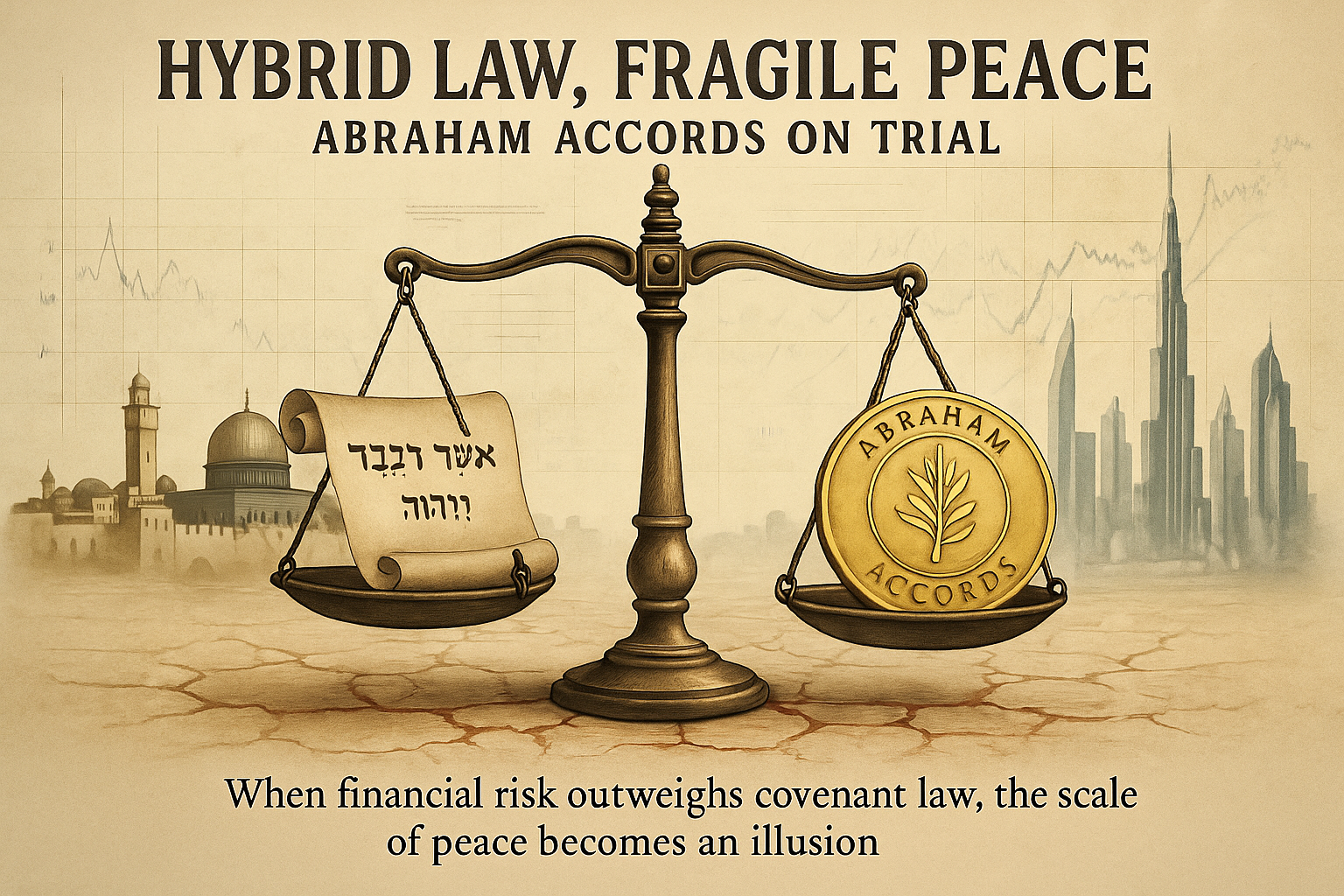
Source Image: The Sovereign Standard. A covenant scroll outweighs a gilded Abraham Accords medallion on the legal scales, signaling that peace without divine alignment collapses under its own political weight.
The Abraham Accords reshaped the diplomatic landscape of the Middle East, but their most consequential trial is financial. Symbolic handshakes are one thing. A sustainable financial architecture that global investors can trust is another. The experiment underway between the UAE, Israel, and increasingly Saudi Arabia will determine whether hybrid legal and banking systems, part Shariah and part Western contract law, can anchor a new order of capital or remain a structural fault line in global markets.
Recent weeks have exposed just how fragile the trust framework remains. On September 3, the UAE issued a stark warning that Israel’s annexation of additional West Bank territory would cross a “red line,” threatening the future of normalization. This escalation came amid diplomatic fallout from an Israeli airstrike in Doha targeting senior Hamas figures, which provoked outrage from Qatar and drew concern from Gulf capitals. While these developments lie in the political realm, their legal and financial consequences are profound. For institutional investors, any perception that diplomatic alignment is reversible introduces jurisdictional risk. Trust is not only built on law, but on political stability and mutual restraint, both of which are showing signs of erosion.
In the UAE, dual frameworks operate side by side. Commercial contracts fall under the Dubai International Financial Centre (DIFC), a common law jurisdiction modeled on English precedent. Yet within the same borders, inheritance disputes and family transactions are settled in Shariah courts. For investors moving billions in sukuk bonds, the decisive question remains: if a dispute arises, which court prevails? The answer separates confidence from contagion.
Clarifying these hybrid legal frameworks is essential. In practical terms, Shariah principles dominate instruments like sukuk, profit-sharing agreements, and asset-backed structures, while Western-style enforcement underpins equity deals, bond contracts, and cross-border project finance. These dual systems are increasingly blending, but not yet uniformly, and not without ambiguity.
Innovation is also being tested in the digital arena. The UAE has launched the mBridge central bank blockchain pilot and introduced an AED-denominated stablecoin, aiming to modernize cross-border payment systems. These advancements raise complex legal questions. Where will digital asset disputes be adjudicated? Regulatory maturity is being shaped in real time.
Israel’s case presents a more settled framework. Aligned with OECD legal standards, its legal system maintains a bifurcation. Civil courts handle commercial disputes, while religious courts oversee personal status. This structure, built on Talmudic foundations, produced an advanced legal framework centuries before the rise of modern finance. Instruments like the heter iska enabled finance to remain halakhically compliant while interfacing seamlessly with Western systems.
Predictability is the point. While jurisdictional tension can surface in inheritance or land cases, Israeli commercial law offers a consistent, contract-honoring environment. Investors trust that rulings will not be nullified by sudden religious intervention. It is why Israeli sovereign bonds often trade like Swiss paper, while Gulf sukuk still carry risk premiums.
Global investment leaders are paying attention. Mohamed El-Erian has argued that “the next phase of Middle Eastern finance will not be about oil rents but about creating frameworks of trust.” Israel already has the framework.
Sovereign wealth funds reflect the legal fault lines. The Abu Dhabi Investment Authority (ADIA), with nearly $1 trillion under management, often relies on London arbitration to reassure counterparties. Mubadala follows a dual path, deploying capital globally while structuring regional deals under Islamic finance. Until recently, these funds depended on Western jurisdictions to backstop enforceability. Reforms in Emirati commercial courts aim to internalize this, but trust remains externally anchored.
Israeli innovation funds face no such dilemma. Recent surveys show global investors rate Israeli legal systems as closely aligned with European norms. Civil court predictability, enforcement history, and judicial independence make Israel a legal safe zone in a volatile region.
Saudi Arabia is now catching up. Its Public Investment Fund (PIF), with nearly $900 billion in assets, has traditionally operated under Shariah-grounded contract law. But that is changing. A sweeping 2025 Investment Law expanded the definition of “investor,” clarified capital structures, and aligned arbitration procedures with UNCITRAL standards.
Restrictions are loosening even in the Kingdom’s most sensitive jurisdictions. In early 2025, Saudi Arabia permitted foreign investment in companies owning property in Mecca and Medina, signaling a new willingness to integrate capital into religiously sensitive zones under clear regulatory instruments.
If hybrids are to work, legal enforceability must come first. Islamic finance offers unique strengths, including asset-backing, ethical alignment, and profit-sharing. These disciplines could temper Western markets’ addiction to leverage. Larry Fink has noted that markets will reward systems that blend resilience with societal values. That blend is impossible without codified legal clarity.
Legal certainty is not solely a question of elite contract enforcement. Analysts have noted that five years into the Abraham Accords, economic gains have disproportionately benefited sovereign funds, elite investors, and multinational partnerships, while small-to-mid-size enterprises and regional populations remain largely disconnected from the capital corridors being built. This growing gap presents a long-term risk. Legal structures that serve only the top tier of capital flow, without protections for smaller actors or public trust in judicial fairness, become brittle. The integrity of any hybrid framework requires not only enforceability but broad legitimacy, especially as public opinion in Gulf states grows more skeptical of the Accords in the wake of ongoing Israeli actions in Gaza and the West Bank.
Creativity, however, is no substitute for certainty. Investors can weather political storms, but not legal ambiguity. Israel provides reliability. Gulf systems, while evolving, still risk religious override. That is the difference between investment-grade and experimental.
Washington cannot afford strategic detachment. Historically, the United States underwrote rule-based finance through legal clarity and treaty enforcement. If the Abraham Accords are to mature into capital corridors, the U.S. must embed IMF-style oversight, arbitration pacts, and enforcement reciprocity. Without it, capital will stay quarantined within state funds, not democratized through global private flows.
Other powers are watching closely. China is promoting yuan-oil contracts, India is piloting rupee settlement mechanisms, and Russia is anchoring trade to commodities and gold. If the Gulf perfects hybrid enforcement models, the rest of the multipolar world will follow. What will emerge are systems that appear open but retain domestic override.
Multipolarity is not merely economic. It is now legal. As China expands its Belt and Road legal frameworks and Russia deepens arbitration linkages through regional Eurasian courts, legal competition is entering a new phase. Even the European Union is pushing treaty enforcement structures in Africa and the Caucasus as counterweights to U.S.-backed arbitration norms. The expansion of Abraham Accord-style partnerships into Central Asia, with Azerbaijan, Kazakhstan, and Uzbekistan now floated as possible participants, will test whether hybrid legal systems can scale beyond the Gulf and Levant. Each new partner introduces new jurisprudential variables and new political liabilities. Hybridization may be scalable in theory, but expansion brings legal dilution if not governed through disciplined standardization.
Institutional architecture is evolving, but at times too slowly to outpace geopolitical volatility. The trust gap between diplomatic ambition and legal delivery is widening. While courts are reforming and statutes are modernizing, state behavior remains unpredictable, and enforcement mechanisms remain under pressure from populist backlash, cross-border retaliation, and elite overreach. Hybrid frameworks cannot absorb unlimited volatility. At some point, inconsistency becomes systemic. The Accords will only survive, financially and not just diplomatically, if the law can keep pace with the politics it is meant to restrain.
This is where the real risk lies. Mark Carney, Canada’s Prime Minister and former central banker, has warned that “the fragmentation of trust in global finance is the biggest systemic risk of our time.” Incoherent hybrids may accelerate precisely that breakdown.
Dollar primacy is a trust-based proposition. The greenback dominates not simply because of liquidity, but because of contractual credibility. If investors start tolerating partial enforceability elsewhere, America’s comparative legal edge begins to narrow. The dollar will not collapse, but its monopoly on trust may.
Abraham Accords must now be understood as a live experiment in legal architecture. Israel, grounded in Western-mirror banking and Talmudic legal DNA, represents predictability. The Gulf, through ADIA, Mubadala, and PIF, offers liquidity and scale. If these systems can be reconciled, the world may witness a new capital corridor linking East and West. If not, ambiguity will be institutionalized, and global markets will pay the price.
Related Topics
Related Posts