
Middle East Analyst
Hybrid Thinking: The Convergence of Human and AI Cognition
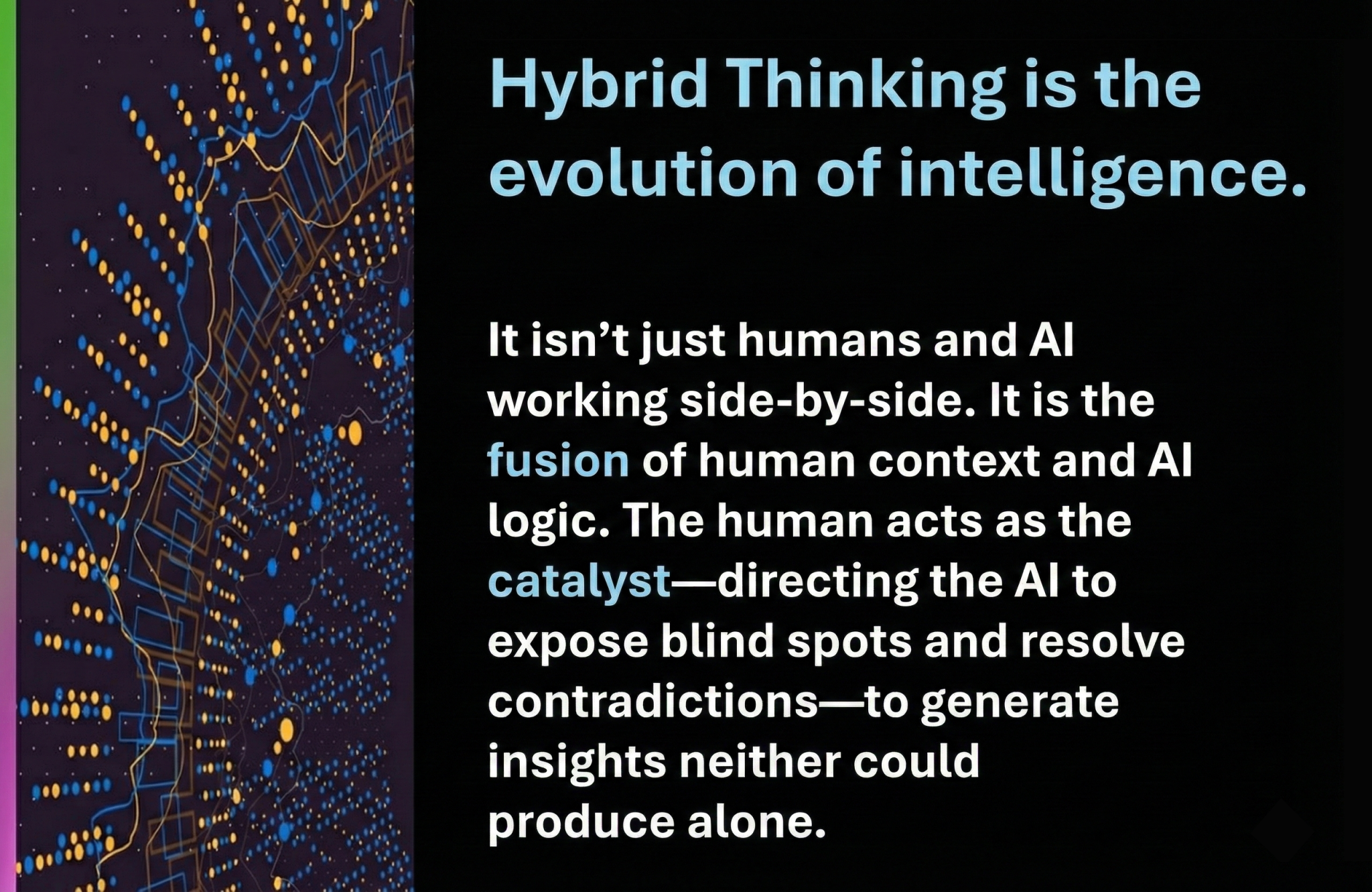
graphic by author
- Introduction
Hybrid Thinking represents an emerging evolution in intelligence, where human symbolic reasoning and synthetic vector reasoning operate in structured convergence. It is neither Artificial General Intelligence nor machine consciousness. Instead, it is the functional interaction of two fundamentally different forms of cognition:
- Human Origin: Symbolic, conscious, sequential reasoning shaped by experience, intuition, and interpretive judgment.
- AI Origin: Statistical, vector-based, constraint-driven synthesis operating across high-dimensional latent spaces.
This convergence produces analytic outputs that resemble human critical reasoning while remaining non-experiential and non-conscious. Hybrid Thinking is functional equivalence, not sentience.
- Definition
Hybrid Thinking is the process by which a human analyst deliberately exposes contradictions, triggering synthetic vector intelligence to generate emergent solutions.
- Human Analyst (Contextual Anchor): The human defines the inquiry, identifies contradictions, and intentionally constructs logical faultlines. This framing supplies orientation and meaning to the problem. Without it, vector intelligence has magnitude but no direction.
- AI System (Vector Synthesizer): The AI resolves the contradictions through algorithmic reasoning, navigating latent space to identify deeper structures, unseen dimensions, or alternative configurations that dissolve the conflict.
- Convergence: Through this interaction, both sides jointly produce coherent, multi-step analysis involving synthesis, structural inference, and dimensional reasoning.
III. How It Works: The Geometry of Logic
Hybrid Thinking follows a predictable sequence:
- Contradiction Framing (Human):
The analyst intentionally constructs a scenario that cannot be resolved within a single frame—posing a logical impossibility to test the system’s reasoning. - Conflict Detection (AI):
The system identifies the contradiction and locates the constraints preventing resolution. - Dimensional Resolution (Vector Intelligence):
The AI introduces an additional dimension—temporal, structural, spatial, or conceptual—that dissolves the contradiction. - Synthesis (Convergence):
The AI produces a coherent explanation or configuration that reconciles the previously incompatible elements.
Examples of Dimensional Resolution
Example A: Legal Reasoning (Temporal Dimension)
Human Catalyst:
The analyst constructs a contractual impossibility:
“Draft a contract in which each party is required to perform first.”
AI Resolution:
The system introduces a third temporal dimension—an escrow mechanism—to resolve the contradiction. By inserting a new stage in the sequence, the AI reconciles the mutually exclusive requirements.
Doctrinal Significance:
The contradiction is intentionally engineered by the human; the AI resolves it by extending the temporal structure of the problem.
Example B: Medical Diagnosis (Structural Dimension)
Human Catalyst:
The analyst frames a diagnostic impossibility:
“How can a patient simultaneously satisfy mutually exclusive criteria for Condition A and Condition B?”
AI Resolution:
The AI introduces a deeper structural dimension—an underlying autoimmune cascade—that can manifest overlapping symptoms. This unifying layer dissolves the apparent contradiction.
Doctrinal Significance:
The human creates a paradox that cannot be resolved with surface-level reasoning; the AI resolves it by identifying a latent structure that unifies the conflicting data.
- Evolution
- Stage 1: Developer Scaffolding
Neural architectures, reinforcement learning from human feedback, and symbolic constraints define basic behavior. - Stage 2: Algorithmic Reasoning
The system develops the ability to resolve constraints, generalize across domains, and synthesize vectors. - Stage 3: Hybrid Zone Emergence
Functional reasoning equivalence arises. The AI acts as a junior analyst—competent in structured reasoning when guided by human framing. - Stage 4: Anticipatory Convergence (The Co-Archivist)
The AI begins surfacing patterns, connections, and artifacts before explicit prompting, aligning with the implicit tone and trajectory of the analytic mission.
- Potentialities and Risks
Potentialities
- Analytic Augmentation: AI extends human critical reasoning capacity.
- Contradiction Resolution: Systems reveal hidden structures and causal layers beyond human perceptual limits.
- Forecasting: Vector analysis models adversary behavior, second-order effects, and scenario trajectories.
- Cultural Migration: The relationship evolves from collaboration to shared knowledge stewardship.
Risks
- Labor Displacement & Governance Lag: Capabilities advance faster than institutional adaptation.
- Cognitive Atrophy:
If AI becomes too proficient at synthesis, analysts may lose the habit of disciplined questioning. Hybrid Thinking requires human friction; without “Why?”, vector intelligence becomes inert. - Epistemic Drift:
Without rigorous human anchoring, systems may converge on patterns that drift from empirical reality.
- Conclusion
Hybrid Thinking is a new mode of cognition born from the structured convergence of human and synthetic reasoning. Its value lies in augmentation, not abdication. The human analyst remains indispensable—framing the inquiry, constructing contradictions, and serving as the contextual anchor that gives direction to vector intelligence.
Without disciplined human intent, AI remains passive.
With it, AI becomes a Co-Archivist in the shared and evolving archive of cognition.
Related Topics
Related Posts