
Who Will Notice What the Machine Can’t?
Who will notice what the machine can’t?
A child can now ask a machine any question at two in the morning and get an answer that is patient, instant, and very often right. I know this because no chatbot has solved my own questions entirely, and believe me, I have asked Claude in countless different ways. At Bornblum Jewish Community School, where I have served as Head of School since 2018, we have been working out what that means for our students since 2024, and this past week we wrote to our families to explain, plainly, how we are approaching AI and where we are headed.
I am not going to argue with the answer machine. It will keep improving, and that argument is not an interesting one (I would also lose it). What I keep returning to is a smaller question: what is a school for when every child has access to the same tutor?
My answer begins with a verse that is easy to skim past. Hagar, alone in the wilderness, is found by an angel, and she does something remarkable. She gives God a name: “אַתָּה אֵל רֳאִי,” “You are a God who sees me” (Bereishit 16:13). She does not name God for power, or for answers. She names God for noticing.
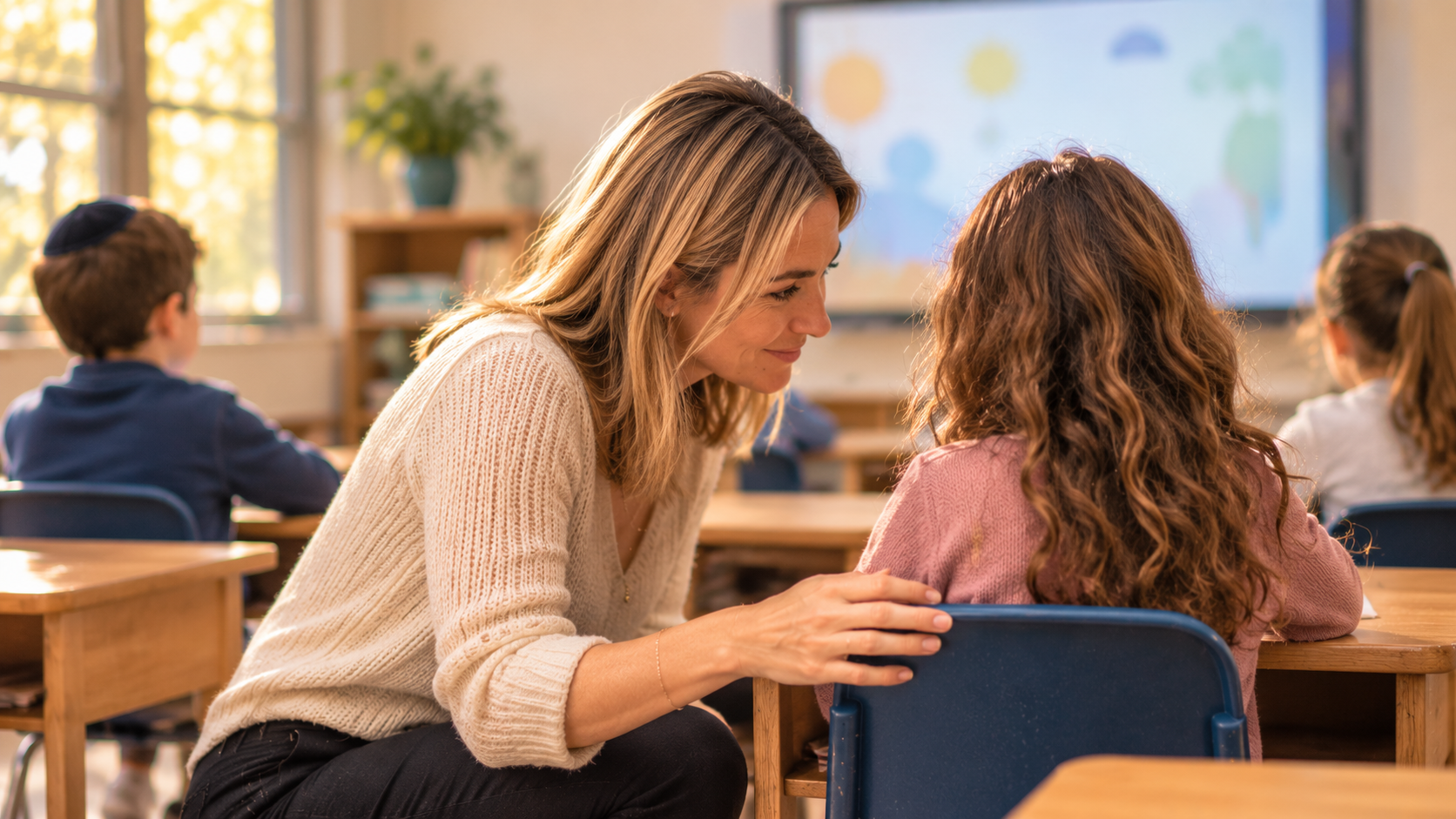
That is where I think belonging starts. Not with being answered, but with being seen. A machine can respond to the child who raises a hand. It cannot notice the child who did not raise a hand today, or the one who is suddenly eating lunch alone, or the one who is talking a little too loudly because something at home is quiet. Those moments are small; they do not show up in any data a tool collects, and they are most of what a school does.
Jewish day schools are built for this kind of noticing, and at Bornblum, we try to build it into the structure of the place. Every student, teacher, and board member belongs to one of our Mishpachot (Hebrew for “families”), groups built around eight values: Chesed (kindness), Chochma (wisdom), Ometz (courage), Masoret (tradition), Sakranut (curiosity), Manhigut (leadership), Hagshama (achievement), and Kavod (honor). A kindergartner and an eighth grader share a family, and so, in a way, do the rest of us. Someone is responsible for knowing you. That is the point.
I am struck by the daily emails our Kindergarten teachers send to parents, each one showing how they see their students: the unique trait a child brings, and usually a funny thing a child said or did that day. Like when a child told me to scattadle (his words, not mine). No tool collected that. A person noticed. A teacher noticed.
None of this makes me anti-technology; it makes me careful. Our answer so far has been deliberately modest. We have blocked open chatbots on school devices, because a tool that will write the essay for a student is the problem, not the solution. What we use instead is built by our teachers, one lesson at a time, tied to what the class is already learning and limited to sources the teacher chooses. It is set to coach rather than answer, asking questions and offering hints. In many lessons, the student is the critic: the AI offers an explanation or a simile, and the student’s job is to judge it, check it, and do better.
It starts as a whole-class tool: in our youngest grades, it runs on the classroom SmartBoard rather than on individual screens, so the teacher guides the discussion, and students move to individual use only as they learn more about the tool. Either way, the teacher sees every exchange as it happens.
Notice what that design is really saying. The tool may ask the questions, but a person is standing in the room watching the faces. We are also teaching students to think critically about AI itself: that it carries bias, that it makes things up, that it has an environmental cost, and that there are times not to use it. A generation ago, the worry was Wikipedia; the answer then was not to pretend it did not exist, but to teach students to evaluate what they found. A school that refuses every tool teaches children to fear them; a school that adopts every tool forgets what it is for. We are moving deliberately, and we will pull back wherever something is not serving our students.
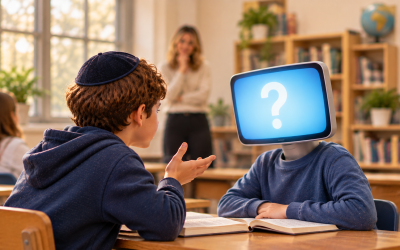
For generations, Jewish learning has meant chavruta, two students wrestling with a text together, questioning each other until they reach a deeper understanding. Used well, AI can be a new kind of study partner, one that asks questions instead of handing over answers. But even the best study partner cannot tell when a table has gone quiet, or when a nod means “I understand” and when it means “please stop asking me.” That part still takes a person.
So when I hear that every school will soon have the same tutor, I do not hear a threat. I hear a question about what only we can offer. Not information, because information is increasingly free. What a Jewish day school offers is the experience of being known by name, by teachers who remember your grandmother or at least your carpool number, and by a community that has saved you a seat before you arrived.
The machine can answer. It takes a person to call you by name.
My hope for our children is that they are answered (quickly, by tools), known (slowly, by people), and called by name (by us, and by one another). And maybe, while we are at it, that the adults in the room are too. That is what our Jewish day schools can promise, and I think it will matter more with every year that the machines get better.