Israeli-American Jewish medical anthropologist, and peace advocate
I Dreamed an Oasis in Gaza
I Dreamed an Oasis: A Vision Born from Despair
Like many Israelis, October 7, 2023, was my worst nightmare realized. The loss of 1,200 lives, the shattered kibbutzim, and the renewed cycle of violence broke me, as it did millions.
The recent release of 20 hostages from Gaza offered a fleeting breath of hope, yet I couldn’t forget those who died or would return in body bags. In the aftermath, comfort was scarce.
Returning to Israel in late December 2023, I found a nation on edge; its people were barely holding on, and they had little emotional capacity to support one another. Amid this breakdown, I turned to action. I wrote a series of letters to the Knesset, the IDF, and influential figures, sketching the design for Oasis 1—a New Vision of Gaza in a post-Hamas world. An oasis, to me, is a safe zone where inhabitants and visitors agree to live without violence.
My initial sketch, dated December 23, 2023, drew from Avraham’s four-cornered tent—a symbol of tolerance and kindness—joining that oasis with four roads.
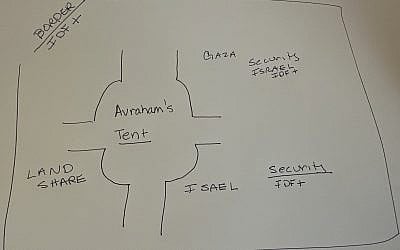
Using geo-mapping and research into Gaza’s terrain, I envisioned six oasis zones. I sent a rough draft to the IDF and Knesset in late December 2023. Remarkably, a 5,000-year-old oasis with six walled zones and a shared road was recently discovered in Saudi Arabia’s Rub’ al-Khali (Popular Mechanics, October 2025), echoing my design.
My early sketch included a MAX subway system linking these zones, a vision now mirrored in Phase 1’s Gaza Ring highway.
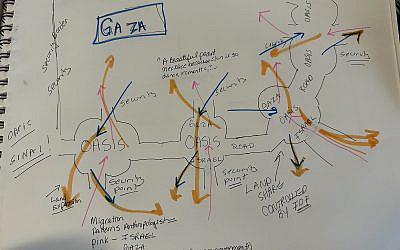 For Oasis 1’s geo-mapping, I prioritized avoiding displacement backlash. Zone B, currently a security buffer unused for farming, could become a hub for integration, agriculture, and industry once Hamas is gone, expanding Gaza’s land and cushioning Israel. The six zones are strategically placed: Zone 1 in North Sinai (450 km²) is a temporary housing area that could potentially evolve into a Bedouin market, local government, and studies department. I sent numerous letters to President el-Sisi requesting land rental.
 Zone 2 at Kerem Shalom Crossing focuses on environmental studies, aquifer protection, and education. This area is vital to the health of Gaza’s oasis zones, as it is the location of their own water supply and can be used as a base for environmental education and cooperative farming.
Zone 3, the Nir area, supports families with small farms, a high school, sports facilities, and clinics. Zone 4, Sderot, is the central transportation hub, ideal for technical and trade schools. Zone 5 at Erez Crossing 1 hosts a university, nightclubs, and tourism, with an Oasis nightclub as a safe social space accessible via subway or shuttles from Zone 4. Zone 6, Gaza’s pier (Erez 2), is a tourism and day-cruise hub, linking to Ashdod boats. The economic devastation in Gaza underscores the urgency of this vision.
The conflict has contracted Gaza’s GDP by 83% in 2024, dropping its contribution to the Palestinian economy to just 3% despite housing 40% of the population (World Bank, February 2025) worldbank.org. Reconstruction needs a total $53 billion, with $30 billion in physical damages alone—housing is hardest hit at 53%, followed by commerce and industry at 20% (World Bank, European Union, and United Nations, February 2025). Prices have soared 300% overall, with food up 450%, exacerbating 40% unemployment and 97% undrinkable water (UN OCHA, 2024)
thedocs.worldbank.org. Without bold action, Gaza’s GDP per capita could take until 2092 to recover to 2022 levels, even under optimistic growth (UNCTAD, January 2024), reliefweb.int.
Oasis 1 offers a pathway to reversal: a $2.5 billion initial investment yielding $1–2 billion in annual conflict savings and a 20–40% reduction in terrorism risks (RAND, 2023), thedocs.worldbank.org. It projects 50,000–100,000 new jobs through hydroponics, trade schools, and tourism, leveraging Gaza’s 300 sunny days and 35-km coastline for solar farms and facilities (PENRA, 2019), thedocs.worldbank.org.
The MAX Caravan Line could generate $200–$500 million in annual revenue, unlocking $120–$165 billion in regional trade by 2030, integrating Gaza into Abraham Accords networks that have already spurred $2.8 billion in Israel-Arab trade in 2022 alone (Observer Research Foundation, May 2025), mises.org.
With UN, private, and Abraham Accords partners ($10 billion cushion from 2020 agreements, State Department, 2023), thedocs.worldbank.org, profits could multiply, especially for Egypt via North Sinai rentals ($25–$45 billion in trade benefits). This isn’t charity—it’s a green economy with 4 million jobs and $1 trillion in activity over a decade (Abraham Accords Peace Institute, 2025), aapeaceinstitute.org, turning Gaza into a Mediterranean hub. I pray that someone is listening with hundreds of letters sent to the IDF, Knesset, world leaders, and two U.S. administrations. This vision, born from despair, offers peace and prosperity—will you help it bloom?
Related Topics