
I made a film about hostage posters. I was accused of centering ‘whiteness’
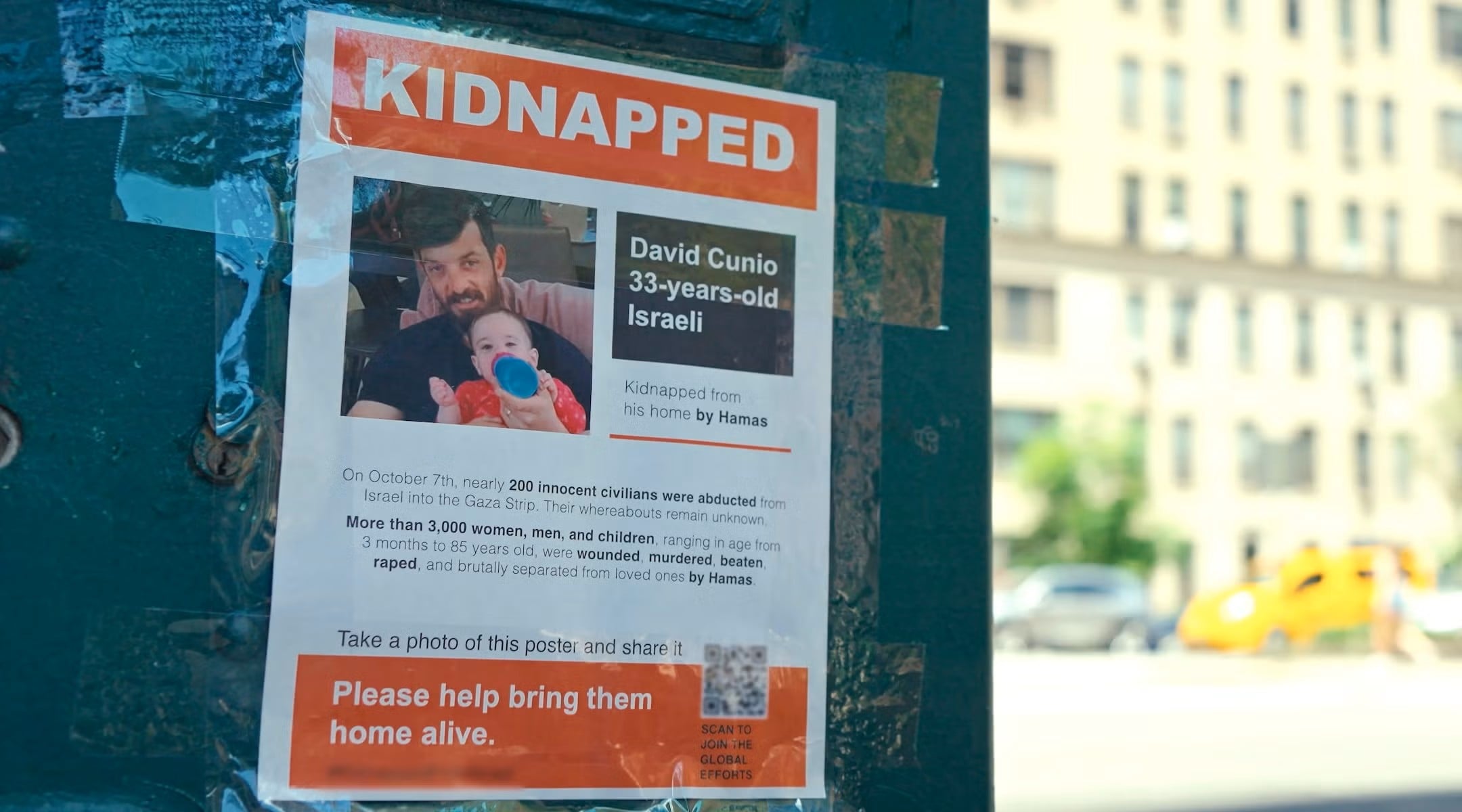
JTA — A year ago, after a screening at Baruch College of my documentary “TORN: The Israel-Palestine Poster War on NYC Streets,” four different students asked me the same question: What about the whiteness of the posters?
“TORN” follows the fight that broke out on New York’s streets over the “Kidnapped” posters of those taken hostage by Hamas-led terrorists on October 7, 2023. Many pro-Palestinian activists tore down the posters of those abducted from Israel as soon as they were put up.
The students’ question stunned me and has stayed with me ever since. Look at who was actually on the posters. Among the 251 hostages taken on October 7 were more than two dozen Thai farmworkers, a Nepalese agricultural student, a Filipino caregiver, a Tanzanian agricultural student, Bedouin Arab citizens of Israel, and many dozens of Ashkenazi, Mizrahi and Sephardi Jews whose families came from places as far apart as Germany, Russia, Ukraine, Argentina, Mexico, Morocco, Iraq, Yemen and Iran.
And yet these students only understood the poster project as a plea for sympathy for “white” people. Afterward, their professor told me that many of them had never heard of Mizrahi or Sephardi Jews.
“TORN” shows what that lens does on the street. In the film, Alana and Liam Zeitchik, whose family is Yemenite, describe confronting people who were tearing down the posters of six of their relatives, all kidnapped to Gaza. A passerby called their cousin’s 3-year-old daughter a “white colonizer.” In another scene, in Williamsburg, a white, middle-aged man in a keffiyeh calls a pro-Israel gathering a “white supremacist” rally. An Israeli woman in the crowd asks him: “Did you see the color of my skin?” Her skin is darker than his.
Marking three years since October 7, the hostages’ faces are being held up again at vigils and rallies. Others may again look at the faces of these men, women and children and see “whiteness.” After all, it has become a way of seeing Israelis, and increasingly Jews more broadly. It has traveled from social media to campuses to peer-reviewed journals, and it rests on a mistake.
America’s racial categories are the wrong lens for the hostage posters, and a dangerously distorting one for the Israeli-Palestinian conflict. When they turn a kidnapped toddler into a “white colonizer,” they are no longer describing a child. They are deciding she does not deserve to be mourned.
None of this asks anyone to look away from what is happening in the Middle East. Innocent lives have been lost in Israel and in Gaza, and many on both sides are still living with the consequences of that day and the war that followed. My argument is that empathy is not a zero-sum game, and race should not decide who receives it.
My objection is not to the word “white.” I am a Jew of Polish, Ukrainian and Lithuanian descent, and in America and in Israel I am seen as white, with the privileges that come with it. My concern is what the word does when it is applied to Israelis. It creates a chain of conclusions: White means Western; Western means settler; settler means colonizer; colonizer means oppressor; and oppression becomes collective guilt.
Nor does the chain stop at Israel’s borders. Once “Israeli” is made synonymous with “white colonizer,” a Jew in New York, London or Sydney can be made to answer for a government thousands of miles away, and Jewish grief itself becomes politically suspect.
This is not a fringe misunderstanding. In a 2024 article in the Journal of Palestine Studies, Raz Segal, a professor of Holocaust and genocide studies at Stockton University, described Israel as a project to create a “White Jewish settler society,” placing the treatment of Jews with roots in Middle Eastern and North African lands within that racial frame. Ta-Nehisi Coates’s 2024 book “The Message” compares what he saw in the West Bank to the segregation of the Jim Crow South. In Baltimore, the advocacy group Leaders of a Beautiful Struggle published an essay titled “Zionism Is White Supremacy.”
The latest version arrived last month in Theory & Event, a political theory journal published by Johns Hopkins, in an article by Alyson Cole, a professor of political science and women’s and gender studies at Queens College and the CUNY Graduate Center. Drawing partly on my film, she argues that the posters’ ordinary photographs – drawn from birthday parties, family dinners, selfies – coded the hostages as “middle-class, Western, and white,” whoever they actually were. She suggests the designers chose familiar, unmarked snapshots to “capitalize on perceptual habits,” inviting viewers to see themselves in the hostages.
That imposes a strategy onto what began as a small, independent effort. The artists who started the poster project, whom I interviewed for “TORN,” printed the first 2,000 copies and walked across Manhattan putting them up themselves. They had no idea the campaign would spread around the world.
Cole herself places these posters in the tradition of missing-person flyers, like those that covered Manhattan’s walls after 9/11, all built on ordinary photographs meant to move strangers. When she turns to the Kidnapped campaign, that familiar visual language becomes evidence in an argument about whiteness. In her essay she calls for more listening, not less. But her framework draws on the same vocabulary I encountered on the street – and her words are now in an academic paper available for any professor to assign. The category error I heard from undergraduates at one CUNY campus has become academic theory at another.
The photos were family snapshots because family snapshots were what existed, not a calculated play on anyone’s perceptual habits. It takes a particular habit of mind to look at a grainy photo of a kidnapped person and start by asking what color they are. It also takes a particular habit to note, as Cole did, that the competing posters for Palestinian victims copied the Kidnapped template with the same kind of ordinary photos of children — but to not accuse them of coding Palestinian children as white. Of course, neither group should they be. If the same visual language signifies ordinary life in one case and “whiteness” in another, the whiteness is coming from the framework, not from the photograph.
America’s racial categories are products of America’s particular history, including slavery and segregation. But exported wholesale to a conflict between two Middle Eastern peoples, they can obscure more than they clarify. The US government’s statistical standards now place Israelis, alongside Lebanese, Egyptians, Syrians, Iraqis and Iranians, in a “Middle Eastern or North African” category, after decades in which federal standards classified MENA populations under White. Israel itself does not fit the binary: More than one in five Israeli citizens is Arab, and about half of Israeli Jews identify as Mizrahi or Sephardi.
The question is not whether Israelis are white. It is why we need to decide what race a kidnapped person belongs to before deciding whether we can mourn them.
And even if every hostage had been white, would that be a reason to feel less for a human being taken hostage? After all, white people are no less deserving of empathy.
Ninety-one years ago, the Nazis’ Nuremberg Laws classified Jews as a separate and inferior race. On both my father’s and my mother’s side, my grandparents’ families were murdered in the Holocaust because they were Jews; my grandparents survived only because they had escaped to Tel Aviv before the war.
The vocabulary is different today, and I am not equating these eras. But as a character in Joshua Harmon’s play “Prayer for the French Republic” puts it, “They hate us for being capitalists, they hate us for being communists.” To that list I would now add: They hate us for being white, and for not being white enough.
Jews are older than these categories: a people with a faith, many ethnicities, cultures and languages that has never fit neatly into anyone’s boxes. The danger begins when the category matters more than the person standing in front of us.
Cole’s own footnote makes the point better than I can: She found no evidence that any posters other than those for the October 7 hostages were consistently defaced and destroyed. That held true for the Palestinian posters using much the same visual language. The people on the destroyed Kidnapped posters included a 9-month-old baby, an 86-year-old Iraqi Jew who had survived the 1941 Farhud pogrom in Baghdad and a 17-year-old girl kidnapped from Kfar Aza with her mother and little brothers after her father and sister were murdered. What those posters shared was neither skin tone nor ancestry. What was being torn down was a claim: that Israelis, too, could be victims.
For many of us, those posters were a way to mourn, in public, people we knew and people we didn’t. Whatever their individual motives, tearing them down told many of us that our grief had no right to be there.
Now, with those posters of murdered hostages back up, look the faces on them in the eyes. You will see a child, a grandfather, a daughter. You will not see a color.
The views and opinions expressed in this article are those of the author and do not necessarily reflect the views of JTA or its parent company, 70 Faces Media.