
Lawyer & Law Professor
I pray for the day I can take off the diskit
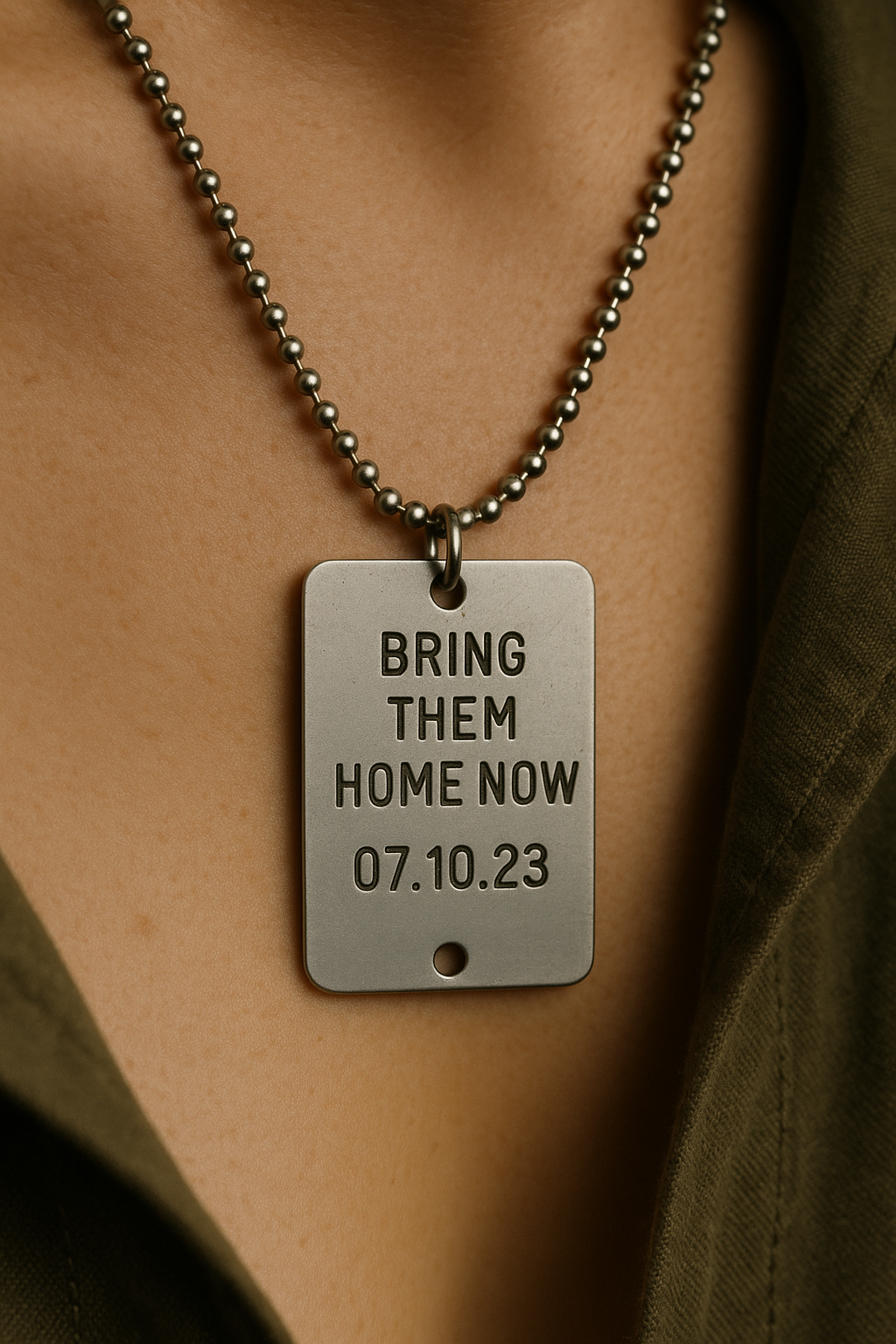
Image Created by ChatGPT with DALL-E, 2025.
Second anniversary of October 7.
Since that dark day, some songs now trigger a knot in the throat. For me, one is Kol HaChayalim Chozrim Habaita, “All the soldiers return home.” Elkana Marziano’s voice breaks me, perhaps because we know not everyone returns, and because I know a mother’s love deeply. Each note feels like a prayer amidst the noise. In Hebrew, it says:
tishmor al atzmecha, yaldi, tamid tizkor et ima, “Take care of yourself, my son, always remember your mother.”
They are simple, direct words, yet every time I hear them I wonder how many mothers are still waiting for that call that never comes, and how many sons are still out there, uniforms covered in dust and silence, exchanging glances with their brothers in arms, dreaming of returning home, to their mothers’ embrace.
October 7 was the day Israel shifted from peace to mourning. That dawn of Simchat Torah, as families opened homes to joy, hatred and terror arrived. It was not a battle. It was a massacre. Hundreds of terrorists crossed the border and invaded, murdering, burning, and kidnapping in kibbutzim, at concerts, on roads, in kitchens, and bedrooms. For hours, nothing made sense; for hours, Israel seemed to vanish.
Since that day, the world has been divided into two: those who saw the horror and named it for what it was, and those who reduced it to another headline on a screen. Meanwhile, Israel began the most painful war in its recent history, confronting three main enemies: radical Islamic terrorism, antisemitism, which never disappeared but was hiding in a corner, and above all, indifference.
The main front was never on the maps. It is in the hearts of the families that are still waiting. The faces of the hostages have become part of our daily prayers, and our silences call their names. Each captive became the symbol of a wound that would not heal, but also of a hope that would not die, as long as someone waited for them, they had not been forgotten.
In some cases, we have had to cross out the age on the “Bring Them Home” posters and correct it more than once. Two years have passed, and time has erased nothing. The images remain alive, the names are spoken with the same tremor, and the empty chairs still stand at the Shabbat tables. Every hostage still held is an open wound in the heart of Am Israel, a pain that beats through tfilot, protests, marches, and letters that cross oceans. Alongside that pain, a different kind of strength has grown, a silent determination that cannot be negotiated. The enemy managed to wound us, but not to break us. Every day that passes without surrender is a moral victory. Every family that continues to wait with dignity teaches a lesson in faith.
Since the beginning of the war, I have worn a diskit (a military dog tag) around my neck, like the ones our soldiers wear and that we have distributed in solidarity with the hostages. I wear it every day directly on my skin, as a reminder of the duty to remember, as if by doing so I could accompany them somehow in their darkness. How I long for the day I can take it off, not out of abandonment but out of redemption. I yearn for the day when every hostage returns home and we can finally breathe with them, or let them go with dignity to eternal rest.
During this festival of Sukkot, I lift a prayer for the blessing of the Sukkah of Peace, the Sukat Shalom, to cover each of them wherever they may be, to embrace them with the Divine Presence, and to return them to the arms of their families. We are waiting for them, anxiously, with our souls trembling, never having stopped thinking of them for even a single second.
These two years have also been a test for the world. Instead of learning from horror, many repeated it disguised as ideology. In universities, in media outlets, in streets that claim to defend justice, antisemitism returned with new colors and old arguments. Suddenly, it became acceptable to doubt the pain of our People, to relativize the massacre, to justify the abduction of children or the rape of women. They dared to call us genocidal, an insult that cuts especially deep. It is a double wound, to the body and to the conscience, yet we are not surprised. We have seen it before. History has taught us that hatred never dies; it only changes its face.
What the world forgets is that the Jewish People have never been defeated by hatred. We have survived empires, inquisitions, exiles, and wars. We have mourned our dead and built cities upon ashes. Israel stands as living proof that life is stronger than destruction. Today, more than ever, we remain determined to defend our existence with love, with purpose, with hope. Our unity, our identity, and our memory are stronger than any enemy.
October 7 broke Israel, but it did not defeat it. In the midst of mourning, volunteers rushed to help, reservists ran to their bases, and young men and women who had never held a weapon stepped forward to serve. In every grieving home, a candle was lit and a vow was made that no murderer will decide when our story ends. Israel does not fight for revenge; it fights for the most elemental right of all, the right to live.
This war is not over. We know it. There are still hostages. There are still mothers writing letters without reply. There are still soldiers marching in the rain with the names of their friends engraved on their souls. Yet one truth remains untouched: our lives are worth more than their hatred. The Jewish People stand tall, united in pain and in faith. Israel is more determined than ever to go on living, to keep defending truth, and to continue bringing light to a world that too often chooses darkness.
At the end of the day, when the noise fades and silence takes its place, my mind returns to that song.
Kol HaChayalim chozrim habaita, hakrav od lo tam, “All the soldiers return home, but the battle is not yet over.”
It is a song that passes through war and turns it into prayer. It speaks of a child in uniform and boots who protects his soul by remembering his mother. Of a mother who, with no news of her son, writes a blessing that rides the wind until it reaches him:
ulechol asher telech, bracha shlucha me’ima, “Wherever you go, a blessing follows you, sent by your mother.”
That blessing travels today as well, to every hostage, to every soldier, to every heart that beats with the name of Israel. It reminds us that even when the battle is not yet over, the Jewish soul keeps returning home to Eretz Israel, again and again. What the enemy does not understand is that Israel endures not by power but by love. Our secret lies not in our weapons but in our promise. As long as someone sings Kol HaChayalim chozrim habaita, as long as someone believes in HaTikva, the People of Israel will keep coming home. Always.
Am Israel Chai Ve’Kayam.
Related Topics
Related Posts