I thought it would be over soon
On October 7, 2023, I was in Jerusalem.
A cousin of mine and his wife had just arrived from Argentina. It was their first visit to Israel, a trip they had waited almost their entire lives to make.
He saw the news on his phone before I did.
“There has been an attack at a party in the south,” he told me.
I had already lived in Israel for more than two decades. I had experienced wars, rockets, terrorist attacks and the familiar cycles of violence that periodically interrupt life here.
And perhaps, after so many years, I had acquired a certain Israeli arrogance. A feeling that we knew how these things worked. That we were somehow invulnerable.
“It will be over soon,” I told him.
I believed it.
That morning I took him to see the Tower of David. I wanted to show him Jerusalem, the city he had traveled thousands of kilometers to finally see.
At the entrance, we were told that the museum was closed.
Because of the war.
The word surprised me.
War?
Something inside me shifted.
Perhaps this was not going to be another short round after all.
Around noon, Lily and I returned home to Netanya.
The following day, rockets were being fired across Israel, and they were reaching
Jerusalem too.
My cousin and his wife were still there.\
I got into my car and drove to Jerusalem to bring them back with me.
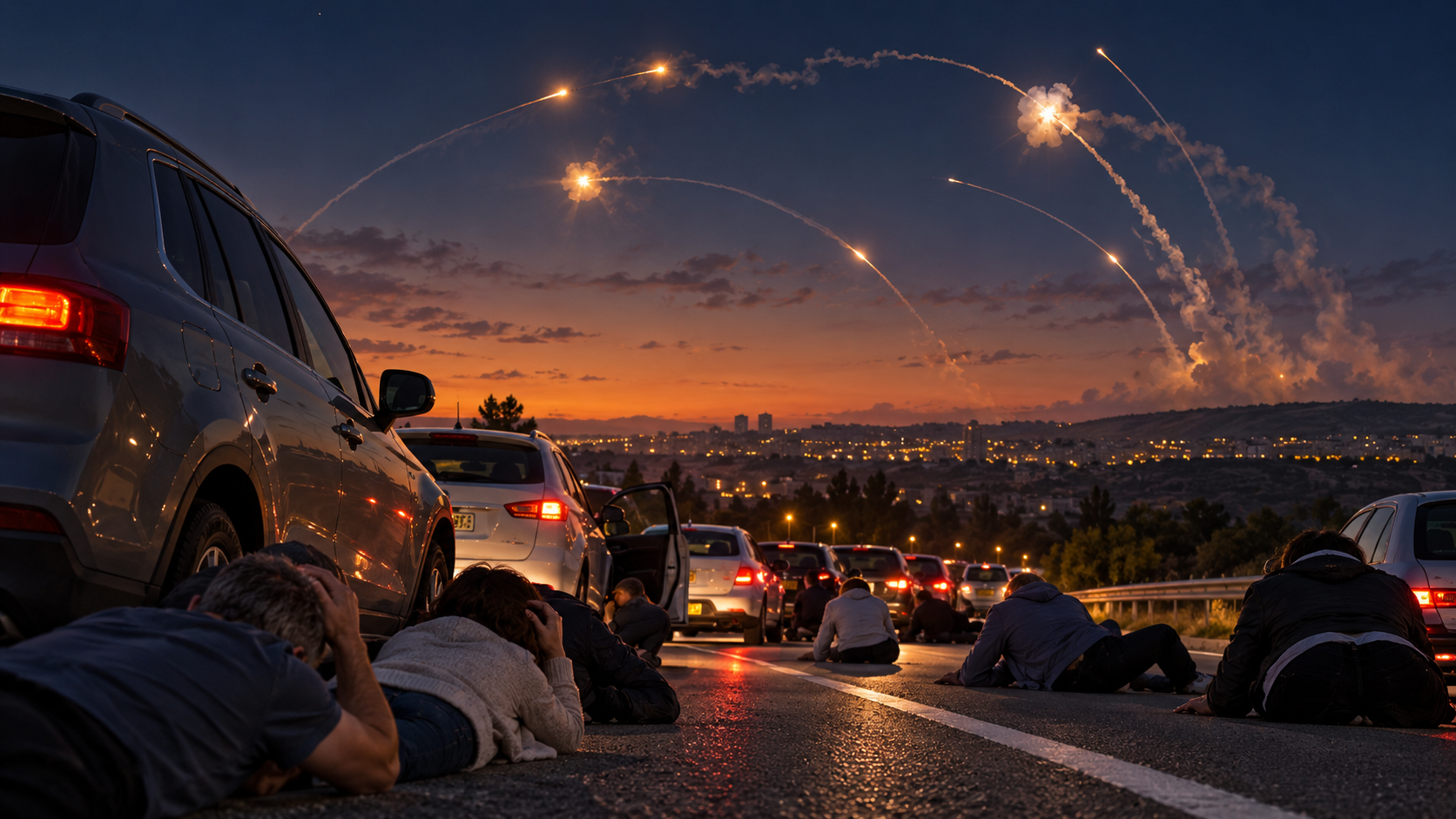
On our way to Netanya, the sirens caught us on the road.
Cars stopped.
Drivers and passengers got out and lay down beside their vehicles. We did the same.
And there we were, lying beside the road, looking up as Iron Dome intercepted rockets in the sky above our heads.
It is an image I will never forget.
What I remember just as clearly is the people around us.
Most remained remarkably calm. Some helped those who were crying. Others tried to comfort people having panic attacks.
Then the sirens stopped.
People stood up, returned to their cars, and continued driving.
So did we.
My cousin and his wife stayed with us in Netanya for several days.
The telephone kept ringing.
Their family in Argentina called. Our family in Argentina called. Everyone was telling them the same thing:
Come home.
But there were almost no flights.
And, more importantly, they did not want to leave.
Their first trip to Israel, the journey they had dreamed about for so many years, had become something none of us could possibly have imagined.
And I kept repeating my prediction.
This will not last long.
Even today, when we speak on WhatsApp, we remember it.
We remember my confidence.
My acquired Israeli arrogance.
I thought I understood the country in which I had lived for more than twenty years. I thought I understood its wars. I thought I knew the script.
I was wrong.
Slowly, the information began to arrive.
The music festival.
The kibbutzim.
The murdered families.
The hostages.
The scale of what had happened became clearer hour by hour, and that first sentence I had said to my cousin began to sound increasingly absurd.
“It will be over soon.”
Three years have passed.
For millions of Israelis, what began that Saturday morning has never entirely ended.
Everyone here has his own October 7.
Mine began with a cousin from Argentina looking at his phone and telling me that something had happened at a party in the south.
And with me, an Israeli by then for more than twenty years, confidently telling him not to worry.
Today, October 7, I remember many things.
But I also remember that sentence.
Because perhaps one of the things October 7 took from me was the certainty that I knew what tomorrow in Israel would look like.
I no longer say, “It will be over soon.”
I have learned to say something else.
We will be here tomorrow.