Torah Brain, Talmud Mouth
I Won’t Unlink Them
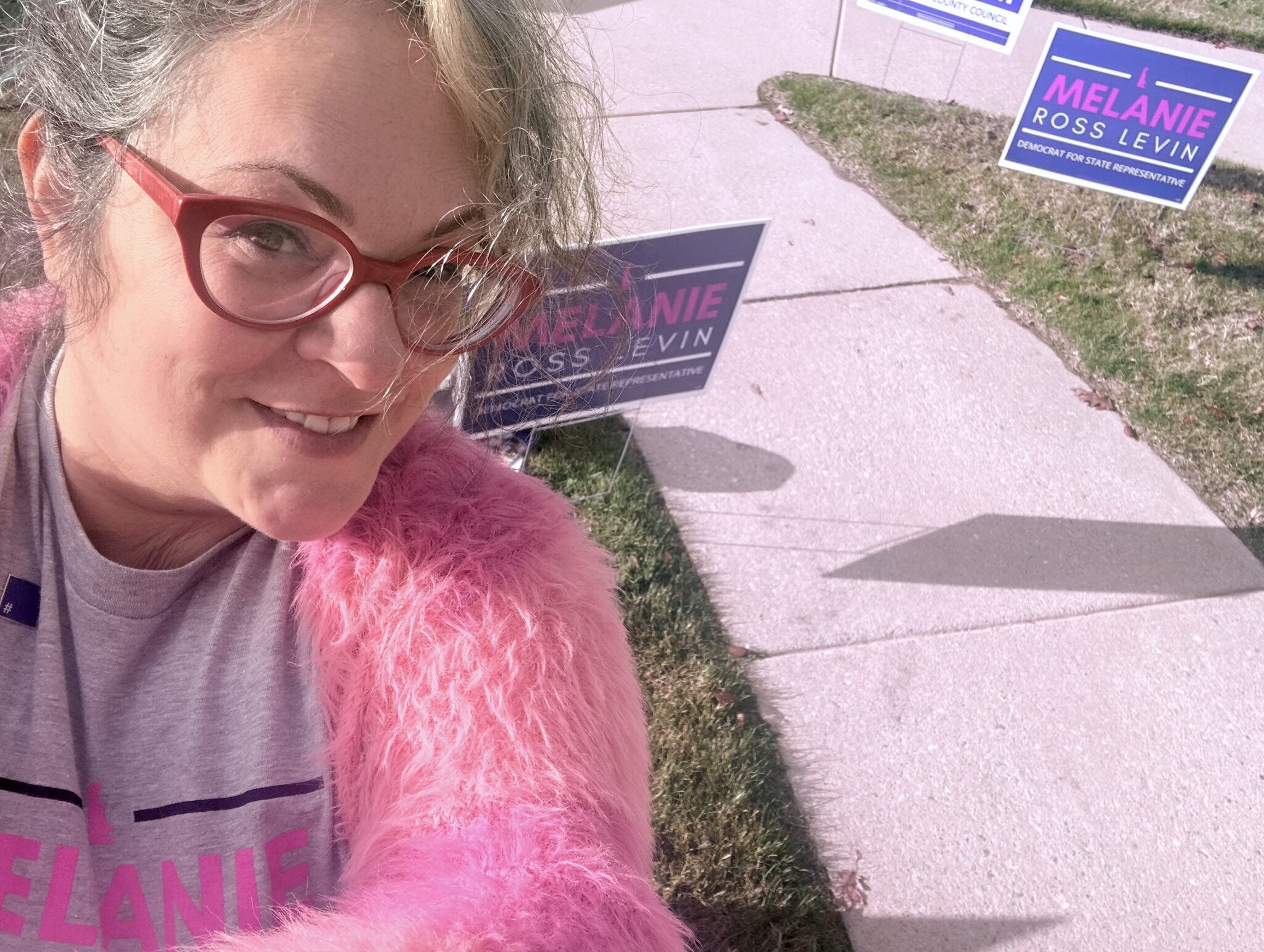
I’m sitting outside a polling place in Delaware’s 10th Representative District, in a beach chair that may still have sand or mud from the endless hours I’ve spent watching my daughter play softball. I have a stack of hot-pink campaign cards beside me, all with my friend Melanie Ross Levin’s face on them. It’s a little chilly. The sky is that impossible Election Day blue, the leaves are starting to fall, and I’m wearing a furry pink sweater to match the pink on Melanie’s sign.
I don’t vote here. I’m here anyway.
This morning, before I left the house, my friend Jordana Horn Gordon’s Substack landed in my inbox. She wrote about the Lorax. Her sister Ariel once nicknamed their sister Dara (yes, that Dara) “the antisemitism Lorax,” the one who speaks for the trees. Jordana’s point was that Jews are not trees. We have tongues. (Anyone who has ever eaten a meal with us knows this.) We can’t outsource our voices to the very few Daras of the world. Each of us has to speak.
I read it twice. Then I put on my pink sweater, picked up the campaign cards, and came here to do my part.
Melanie and I have been doing this sort of thing, in one form or another, since we were fifteen.
We met at Kutz, the URJ leadership camp for Reform teenagers, which no longer exists and which I will mourn until I die. We were the kind of kids who thought tikkun olam was a career plan. We went to the University of Delaware together and strummed guitars at Hillel. (I have photographs. I will use them if necessary.) Now we sit in the same synagogue, arrange coffee without really arranging it, and have perfected the art of me making Melanie late.
When my family had nowhere to be on Thanksgiving, Melanie’s family made room for us. Her husband is one of those people who makes you want to stay another hour. Her daughters are full of spirit and talent and, yes, beauty. Look at the card. One of them is working with Melanie to build Delaware’s first educational Holocaust memorial.
Melanie is Jewish to her core. When Abraham Joshua Heschel came home from marching with Dr. King at Selma, he said his legs were praying. Melanie prays with her feet.
Before she was elected, Melanie ran Delaware’s Office of Women’s Advancement and Advocacy. She helped pass paid family leave and paid parental leave for state workers. I had the opportunity to write for her during that time, and I wish I could have devoted more of my own life to the work she was doing for women across this state.
Now she does that work in Dover, and she still does it at home, one constituent phone call at a time. Someone’s unemployment check hasn’t arrived. Someone’s tax refund is missing. There’s a pothole that has been eating a tire for three months. These things don’t make the news. They’re also the reason people need someone to represent them.
I know that kind of work matters because I’ve spent a good part of my own life trying to do it, too.
Years ago, I helped Ivan Thomas start DETV, a Black media company. I learned pretty quickly that building something for a community doesn’t mean you automatically get to speak for that community. We fought City Council over whether DETV should have the television station, but there was another fight happening, too. Some of the older members of Wilmington’s Black community were afraid that giving DETV the station would mean losing the voices and presence of the people who had been there before us. They had built something, and they didn’t want to be pushed aside or erased. It wasn’t simply a fight to get a television station. It was a fight about who gets to tell the stories and how a community makes room for something new without abandoning the people who came before it. I was part of that fight, and I never forgot it.
I’ve carried that belief into my classrooms. I’ve taught single mothers from Wilmington’s inner city who were trying to build better lives for themselves, men on work release figuring out what came next, and now young Latino freshmen whose parents have been taken by ICE. They come to class carrying things no nineteen-year-old should have to carry, and somehow they’re still expected to write an essay, meet a deadline, and figure out their future.
I have fought for these students. Sometimes that means making sure someone sees the person sitting in front of them instead of the circumstances that brought that person into my classroom. Sometimes it means reminding a student that the life they’re living right now does not have to be the limit of the life they can have.
I don’t tell you this because I think I’m some kind of saint. I’m not. I tell you because when I talk about education, dignity, opportunity, and showing up for people, I’m not reciting a political platform. I’m talking about people I know. People whose stories have become part of mine.
And that’s why the person representing my district matters to me.
I live in District 1, in Wilmington. My state representative is Nnamdi Chukwuocha, an Army veteran, longtime social worker, former city councilman, one half of the Twin Poets, and one of Delaware’s poets laureate. He’s also been deeply involved in the Redding Consortium’s work on educational equity for Wilmington’s children.
I believe in the things he has spent his life working toward: giving kids a real chance, investing in neighborhoods, taking poverty, housing, and education seriously, and understanding that public safety cannot be separated from opportunity. I believe people deserve dignity, including people who have been failed by the criminal justice system. I believe government ought to be useful. Imagine that.
In my last post, I wrote about Abdul El-Sayed and said I was lucky I didn’t have to make that choice. That wasn’t quite true. I made my own version of it in September, in my own primary. And it was harder than I let on.
Nnamdi’s challenger was Councilwoman Shané Darby. On paper and in person, she’s someone I should be cheering for. She was born and raised in Wilmington’s 2nd District, became a mother in high school, went on to Temple, and earned a master’s degree in Africana Studies. She’s a doula. She founded Black Mothers in Power to fight for Black maternal health. She organizes tenants. Housing, criminal justice reform, mothers and babies: nearly everything she works for is something I believe in.
And I believe something else, as a Jew. I have an obligation to show up for the Black community. Not as charity. Not as a well-meaning white lady with a yard sign. I don’t think of myself as white. I’m a Jew, and that’s the whole story.
It’s Heschel and King. It’s the Jewish lawyers and Black organizers who worked together in Mississippi. It’s the history of Wilmington, where the National Guard occupied the city for nine months after King was murdered in 1968. I’ve spent years researching that history, and most of my Jewish neighbors have never heard it. Our histories in this city are tangled together. I won’t untangle them.
But I had a problem with Shané Darby.
Weeks after October 7, she sponsored a Wilmington City Council resolution calling for a ceasefire in Gaza. Wilmington was one of the few cities in the country to pass one. She later moderated a panel on Black and Palestinian resistance to oppression. The debate over Israel at City Council became so contentious that, afterward, police escorted a member of Wilmington’s Jewish community to his car for his safety. I haven’t forgotten that.
Wilmington has real problems: housing, schools, crime, families trying to make ends meet. I felt the city needed every ounce of Darby’s experience and commitment on its own streets. I didn’t understand why so much of her political energy was going toward a war she could never vote on. I voted for Nnamdi. He won, 56.6% to 43.4%.
Today’s ballot is easy. September’s wasn’t. I wasn’t choosing between someone I liked and someone I didn’t. I was choosing between two people whose work touched things I care about deeply.
And then there’s the part I have to be honest about, because I know someone is going to ask.
Melanie went to Israel with other Delaware legislators on a trip paid for by Israel’s Foreign Ministry. A colleague in the House called it a propaganda tour. She sits on the board of Hillel at the University of Delaware, and she’s helping build a Holocaust memorial in Dover. So how can I be uncomfortable with Shané Darby’s engagement with Israel and Gaza and not have the same discomfort about Melanie?
I have thought about this. I don’t have an answer that makes the tension disappear.
Part of the difference, for me, is that Melanie represents a district with a substantial Jewish community. Israel is part of her constituents’ lives. They bring it to her. And Hillel isn’t some abstract political affiliation. It’s a place where Jewish college students find one another, celebrate Shabbat and holidays, argue about Jewish things, and build a community of their own at a time in their lives when having that connection can matter enormously. The Holocaust memorial is about teaching Delaware children what happens when people stop seeing one another as human beings. These things matter to me, too.
Melanie also went to Israel to learn. She pressed Israeli officials about aid, food, and medical access in Gaza. She has said publicly that Israelis and Palestinians are both suffering, and that loving Israel doesn’t mean endorsing Netanyahu. I can disagree with parts of a trip sponsored by a foreign government and still understand why a Jewish legislator would want to go, especially when Israel is so deeply connected to the lives of people she represents.
But I live in Delaware’s District 1. My district isn’t Jewish. It has needs that are immediate and enormous: housing, education, public safety, poverty, families struggling to get by. I want my representative focused on those things. I don’t want our local government becoming a forum for statements about foreign policy, no matter how strongly I might feel about the issue being discussed.
I understand that Gaza mattered to Darby and to people in Wilmington. I understand that she saw connections between Black and Palestinian experiences. I’m not saying people in Wilmington shouldn’t care about Gaza or that a city council member has no right to speak about it. I questioned whether sponsoring that resolution and moderating that panel were the best uses of her position and political energy, particularly when the debate became so divisive here at home.
Maybe some of my distinction comes down to the people each woman represents. Maybe some of it comes down to the way they engaged. And maybe some of it comes down to the fact that Melanie is my friend, someone whose Jewish commitments and public work I’ve known for decades. I would be dishonest if I pretended that didn’t matter.
I don’t think friendship should exempt someone from scrutiny. But I also don’t think pretending I have no personal loyalties makes me a more honest observer.
I can see why someone would draw the line differently. I can understand why Darby believed she was responding to something her constituents cared about. I can understand why a Jewish legislator would travel to Israel, particularly at this moment. I don’t think those actions are automatically equivalent, and I don’t think the distinction is as simple as one person talking about foreign policy and another not talking about it.
I made a decision based on what I believed the people in my district needed from their representative. I voted for Nnamdi. That’s the decision I made. But I don’t need to pretend it was uncomplicated, or that I have resolved every contradiction in my own thinking.
I think about this a lot because Jewish voters in America are being told, from every direction, that we have to choose. Our people or our politics. Israel or our allies. The Jewish community or the Muslim community. Jordana wrote about Michigan Jews facing a Sophie’s Choice this year. Some people really are facing choices that have no easy answer.
But I don’t want to live as though every commitment I have cancels out another one. I don’t want to be told that because I care about Jewish safety, I can’t care about Black maternal health. That because I stand with Israel, I can’t stand with Palestinians who deserve to live in safety and dignity. That because I believe in the Jewish community, I have to look away from the students in my classroom whose families are being torn apart.
Maybe that’s what I’m trying to explain. I don’t experience these commitments as separate parts of my life. They’re all tangled up together: the people I’ve loved, the students I’ve taught, the fights I’ve joined, the history I carry as a Jew, and the responsibility I feel to the people who share this city with me. I don’t always get it right. I don’t always know where to draw the line. But I’m not willing to make my world smaller just to make those contradictions easier to live with.
Jordana reminded me that Jews have tongues. She’s right. We have to use them. We also have feet. Heschel knew that. Sometimes they take us to Selma. Sometimes they take us to City Council. And sometimes they take us to a polling place in a district where we don’t vote, wearing a ridiculous furry pink sweater.
Jordana passed along the old line that a vote isn’t a love note; it’s a bus ticket. I like that. But today, sitting outside this polling place, I keep thinking about the people who make me want to get on the bus in the first place.
I’m here for Melanie. I’m here because I believe in the work she’s doing. I’m here because we’ve been friends since we were kids who thought we could make the world a little better, and apparently neither of us has entirely grown out of that.
And I’m here because I won’t unlink the things that make me who I am.
My Judaism is here. My friendships are here. My students are here. My city is here.
I’m here, too.
Related Topics
Related Posts