
The airstrikes we canceled: What NAZA leaves out
Three years ago today, I put on my uniform.
Since then, I have served hundreds of days of reserve duty, including in the Israeli Air Force’s planning and operations directorate. Part of my job involved supporting IDF ground troops and requesting strikes. On every front of this war.
Now a film named after one of the procedures we used to minimize civilian harm and exercise self-restraint, often at the expense of military goals and while endangering our own troops, is playing in theaters around the world. It is called NAZA, the Hebrew acronym for “nezek agavi.” Collateral damage.
The film gets that procedure backwards.
I want to tell you what NAZA is. From the inside.
A brake, not a license
Here is how it works.
A unit on the ground asks for a strike. Before anything flies, someone has to answer a question: how many civilians are near this target and is the military need worth the risk to them?
That answer is the NAZA.
It is not a quota. It is not a kill count. It is a brake. It’s a constraint.
When the number is high, the munition gets smaller. The angle changes. The timing moves. A warning goes out. Or – in many cases – the strike is called off entirely.
We also estimate what the blast will do to the buildings around the target. That’s called NAZAS or “nezek svivati,” surrounding damage. We work to shrink that too.
None of this is unique to Israel. The US military calls it collateral damage estimation. When the expected civilian toll passes a set cut-off value, approval moves up the chain, in some campaigns as far as the secretary of defense or the President.
The IDF’s October 1 response to the film describes the same principle: above set thresholds of estimated harm, approval must come from higher up. In some cases, approval is requested from the IDF chief of staff or the defense minister.
Can you imagine the alternative? No NAZA. No estimate at all. Every target a green light, because no one thought to check what the surrounding, unintended damage would be?
That is the war this film implies. It is not the war I fought.
How we count
Intelligence teams track, constantly, how many people are in each neighborhood, street and block of Gaza, measured against how many lived there before October 7. They use several streams of information: cellular signals, aerial imagery, evacuation calls and whether people heeded them, and more.
It is never exact. Nobody stands on a street corner counting heads in a war. But it is not a guess either.
A neighborhood on the frontlines might be under five percent of its pre-war population. In al-Mawasi, the designated humanitarian zone in Gaza’s south, the population at times reached around 300 percent. The film itself cites that figure.
The higher the population, the higher the NAZA. The higher the NAZA, the harder it is to get anything approved.
Harder is not impossible. On July 13, 2024, a strike in al-Mawasi aimed at Mohammed Deif killed at least 90 people, according to the Hamas-run Gaza Health Ministry. I wasn’t in that room, and I don’t know the number commanders weighed. I know the test they apply: expected harm against military advantage. Deif commanded Hamas’s military wing and was one of the chief architects of October 7.
Some areas are closed to fire altogether. We call them fire-coordination zones. Firing into them requires a sign-off that rarely comes. Some of them exist to protect civilians in humanitarian zones. Others keep our own units from hitting each other.
The funnel
A strike is not one decision by one person. It is a funnel.
First comes the request. Then initial planning. Then collateral-damage clearance. Munitions planning. Approval by a senior commander, with military legal advisers and international law experts in the process. Then the aircrew, who make the final call.
At every stage, a strike can get nixed. Many do.
Intelligence targets – such as a commander or a weapons depot – require intel corroborated by two independent sources and are planned well in advance, under surveillance. Even then, they are sometimes called off.
Operational targets, such as a suspected lookout post, sit mostly in contingency fire plans: “red button” plans, activated on condition that troops come under heavy fire and have to be extricated quickly. Even then, the decision to activate a red-button plan is made high in the chain of command, not by a soldier in the field.
Hamas makes all of this harder by design. A senior fighter pilot, Col. (res.) A., who until about a year ago commanded Ramat David airbase, put it plainly to Ynet: “The missile is in the bedroom, the weapons depot is in the children’s room.” (His quotes are translated from Hebrew.)
He once watched a strike crew hold back: “I’m not executing under these conditions, let’s wait another two minutes.” In those two minutes, a salvo was fired at Israel from the very launcher they had been sent to destroy.
That is what restraint costs. It is paid in real time, by people on our side.
Rejected targets
When providing fire support for ground maneuvers, the chief concerns are keeping our own troops safe and enemy civilians out of harm’s way.
Critics will point out that deep intelligence targeting high-ranking enemy commanders operates under different proportionality calculations – and that is true under international law. But whether a target is a tactical mortar position or a senior brigade commander, the governing mechanism remains identical: expected harm is calculated, weighed against military advantage, and used to decide whether, how and by whom a strike is approved.
I have had target requests declined. More than once. Not out of malice on anyone’s part. They were stopped somewhere along the approval process, because the military need did not justify the risk.
After enough rejections, you start filtering yourself, requesting targets you know would pass: an empty field. An empty intersection. A road that needed to be blocked before enemy forces reached it.
For the targets I requested, the NAZA was usually zero. In some rare cases, NAZA estimates reached single digits. That was not luck. It was the funnel and the feedback loop in action.
The criticism I heard from inside, again and again, was not that the Air Force was too eager. It was that it was too cautious. Troops under fire asked for help and waited, because the expected NAZA was too high and so the request was under deliberation or rebuffed altogether.
We sent ground forces into Gaza and southern Lebanon instead of fighting a “safer” war from afar. Then we tied our own hands further with a number that measures the lives of people on the other side, people the enemy deliberately puts in harm’s way.
What the film gets wrong
The film’s very title exposes a fundamental contradiction. Collateral damage is an operational concept rooted in international humanitarian law – specifically the principles of distinction, necessity, and proportionality. You cannot build an architecture designed to measure, limit, and record unintended civilian harm while simultaneously operating under a strategy of intentional mass destruction. One cancels out the other.
You can criticize where specific thresholds were set or debate individual command decisions – as democracies should – but the existence of NAZA demonstrates an ongoing, systematic effort to enforce constraints in an urban battlespace where the enemy deliberately uses civilians as human shields.
Collateral damage is, by definition, harm to people who were not the target. Genocide requires the opposite: the specific intent to destroy a people. The film cannot have it both ways.
Its sourcing is thin. The Times of Israel, which screened the film, found that it rests on 24 anonymous interviewees. Their testimony ranges across unrelated subjects, rarely establishes each speaker’s role, and gives no date, place or target for the most explosive incidents. Nor did the filmmakers seek the IDF’s response before release.
Had the filmmakers wanted to see the rest of the funnel, they could have asked someone like me. I would have appeared on camera, under my own name. We have nothing to hide.
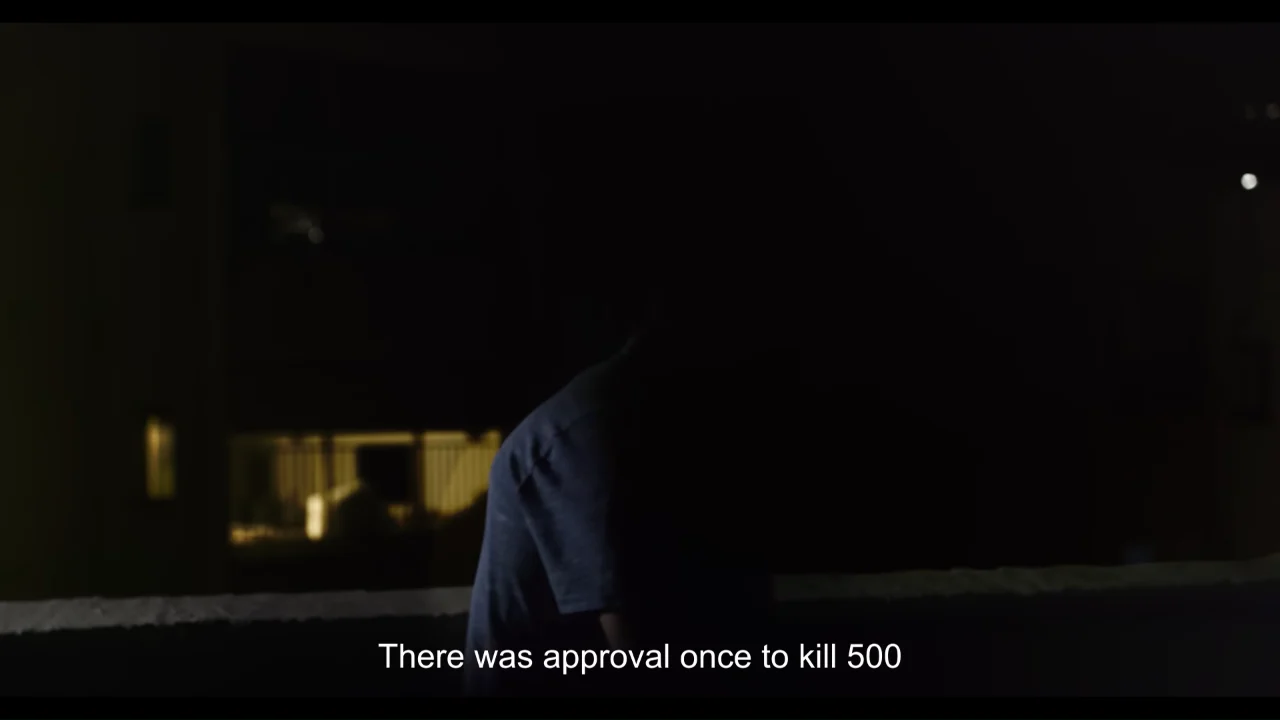
The paper also found that the subtitles (intentionally?) harden and mistranslate what was said. “There was an approval of, like, 500 for a single person” became, on screen, “There was approval once to kill 500 for one human target.” “Ahmad and his entire family” became “Ahmad and his entire family will die.”
The IDF says it never planned, approved or carried out a strike in Gaza in which 500 civilians, or anything close to that number, were expected to be killed. I never saw a number anywhere near it. Neither did A. “I was responsible for planning and carrying out thousands of strikes,” he told Ynet. “I never encountered such a number, or anything close to it.”
Nor does the documentary’s portrait of us match the officers I worked with. What I saw in them was decency, ambivalence and the weight they carried with every decision.
In its October 1 response, the army makes two more points that match what I saw:
- An approval threshold decides who may sign off on a strike, not how many civilians might die.
- An analyst’s preliminary NAZA estimate is not the final assessment on which a commander decides.
Algorithms don’t pull triggers
Media coverage of the film focuses heavily on automated targeting systems and digital databases.
To confuse data processing with strike approval is to fundamentally misunderstand how modern air power operates.
Computational tools process vast arrays of signals intelligence to cross-reference data that no human team could analyze by hand in real time. But data aggregation is not authorization.
An algorithm does not assess proportionality, it does not select the munition size, and it does not sign off on an airstrike.
Every target surfaced by intelligence still must pass through the human funnel: planners, analysts, legal advisors, target-clearance officers, senior commanders, and ultimately the flight crew over the target. Actual targets are compiled and authorized by people.
Many of the film’s witnesses saw the first stage of the funnel. Not the rest.
What I won’t pretend
Early in the war, the rules were loosened. The New York Times reported that from October 7, 2023, mid-ranking officers could approve strikes on low-ranking operatives. It reported that the rules were tightened on November 5. The same investigation reported that a few strikes on senior Hamas commanders were approved knowing that more than 100 civilians were at risk.
I was not in those rooms. I won’t defend what I did not see.
Gaza’s Hamas-run Health Ministry counts more than 73,000 dead and does not separate fighters from civilians. Senior IDF officials, according to the Times of Israel, regard the overall toll as largely accurate. They estimate that around 20,000 – 25,000 Hamas fighters were eliminated, a ratio of two to three civilians killed for every operative. Those are not small numbers.
War is not clean. The fog of war is real. Intelligence is sometimes partial. People make mistakes. Every serious military does.
In August 2021, a US drone strike in Kabul killed 10 civilians, seven of them children. After investigating, the head of US Central Command, Gen. Frank McKenzie, said that the strike “was a tragic mistake.” Other Western democracies know firsthand what it’s like to fight asymmetric conflicts against jihadi groups.
Civilian deaths, which cannot be avoided in war, are not genocide. Genocide is defined by intent, and NAZA exists precisely because civilians are not the target.
Avoiding collateral damage was complicated further by Hamas’ attempts to block civilians from exiting active war zones and by co-opting kindergartens, hospitals, mosques and UN shelters as military bases. The Hamas tunnel and data center found beneath UNRWA’s Gaza City headquarters in February 2024 is a case in point.
Aerial surveillance and ground reconnaissance along the Netzarim corridor repeatedly captured Hamas checkpoints turning back civilians attempting to heed IDF evacuation warnings and move south – something that friends of mine that were stationed there witnessed first hand.
The IDF does not claim perfection. War in urban density against an enemy embedded in homes, schools, and hospitals produces agonizing outcomes and tragic errors.
But the moral test of a modern military is whether it maintains legal boundaries and operational self-restraint even when severely tested. The measure of an army is not whether it errs. It is whether it has procedures in place to fight morally and responsibly. It’s whether it counts, investigates and corrects.
NAZA is how the IDF counts before planning a strike.
Compare this to those we are fighting:
Hamas has no concept of NAZA and rest assured that no documentary made about how they prosecute war would ever receive as much fanfare: Embedded deeply amongst civilians (by design), treating their deaths as gains while obscuring the military nature of their own operatives that were killed in battle.
Hamas’s then-leader in Gaza, Yahya Sinwar, called Gazan civilian deaths “necessary sacrifices,” according to messages reported by the Wall Street Journal in June 2024.
On October 7, he set out to kill as many of us as he could, as painfully as possible, while live-streaming the atrocities to widen their psychological effects on Israeli society.
The word came first
Throughout the past three years, I took part in a civilian initiative that tracked how the war was playing out on social media. We kept a heat map of the words that came up again and again in tweets, posts and videos.
Within days of October 7, while we were still clearing Hamas gunmen out of our kibbutzim and fields and before our ground forces had entered Gaza, the word “genocide” was already being sprayed across social media. It started small. Then the term grew bigger every week as it was mentioned more and amplified over and over. The verdict arrived before the evidence.
I saw how the claim that Israel is committing genocide came instantly and reflexively and finally ballooned into an automatic truth. A word repeated often enough begins to sound like a finding. Commissions and advocacy groups – hostile to Israel to begin with – eagerly adopted it, providing it with a tinge of legitimacy.
There is clear precedent for rush-to-judgment verdicts on Israel that outrun the evidence. Following the 2008–2009 Gaza war, a UN mission led by Judge Richard Goldstone issued a damning report accusing Israel of intentionally targeting civilians. In 2011, after reviewing internal military investigations and evidence that was unavailable in the immediate aftermath, Goldstone acknowledged that Israel did not have a policy of targeting civilians.
Early accusations made in the heat of conflict do not always survive rigorous forensic review. He wrote: “If I had known then what I know now, the Goldstone Report would have been a different document.”
What would you have done?
Col. A. has one question for the filmmakers: “What would you have done in my place?”
“War is real hell,” he said. “But the alternative is a white flag, and that is not an alternative.”
Three years ago, in uniform, just days after Oct 7th, I wrote that we play by the rules. Rules drawn up in the sterile corridors of Geneva and New York, but only really tested in Gaza and Lebanon.
I have spent hundreds of days since then in environments where those rules meet reality. I have watched strike plans die on the drafting table. I have watched my own requests come back denied. I have watched commanders choose to wait – and pay for waiting.
Criticize us. Investigate us. We should keep doing it to ourselves. But know what NAZA is.
A number written down so that someone will stop and ask: who lives next door?
In A.’s words: “We have not one millimeter to be ashamed of. But there is also not a shred of joy in us over what we were forced to do.”
Hamas came to break us. What they did could have changed us too, and made us more like them.
We did not become them.
The officers who sent my requests back, the aircrews who delayed strikes while our troops took fire, and the analysts who counted civilians block by block embody that refusal.
On this third anniversary of October 7, I feel no triumph in the tragedy of war. But I believe, with deep conviction, in an army that kept measuring collateral damage even in its darkest hour.
We fought for our lives and our hostages. We kept our values. Even when they cost us dearly.
No narrative, repeated however often, will change that.