
CEO of Time to Stand Up for Israel
If They Only Knew the Real Israel
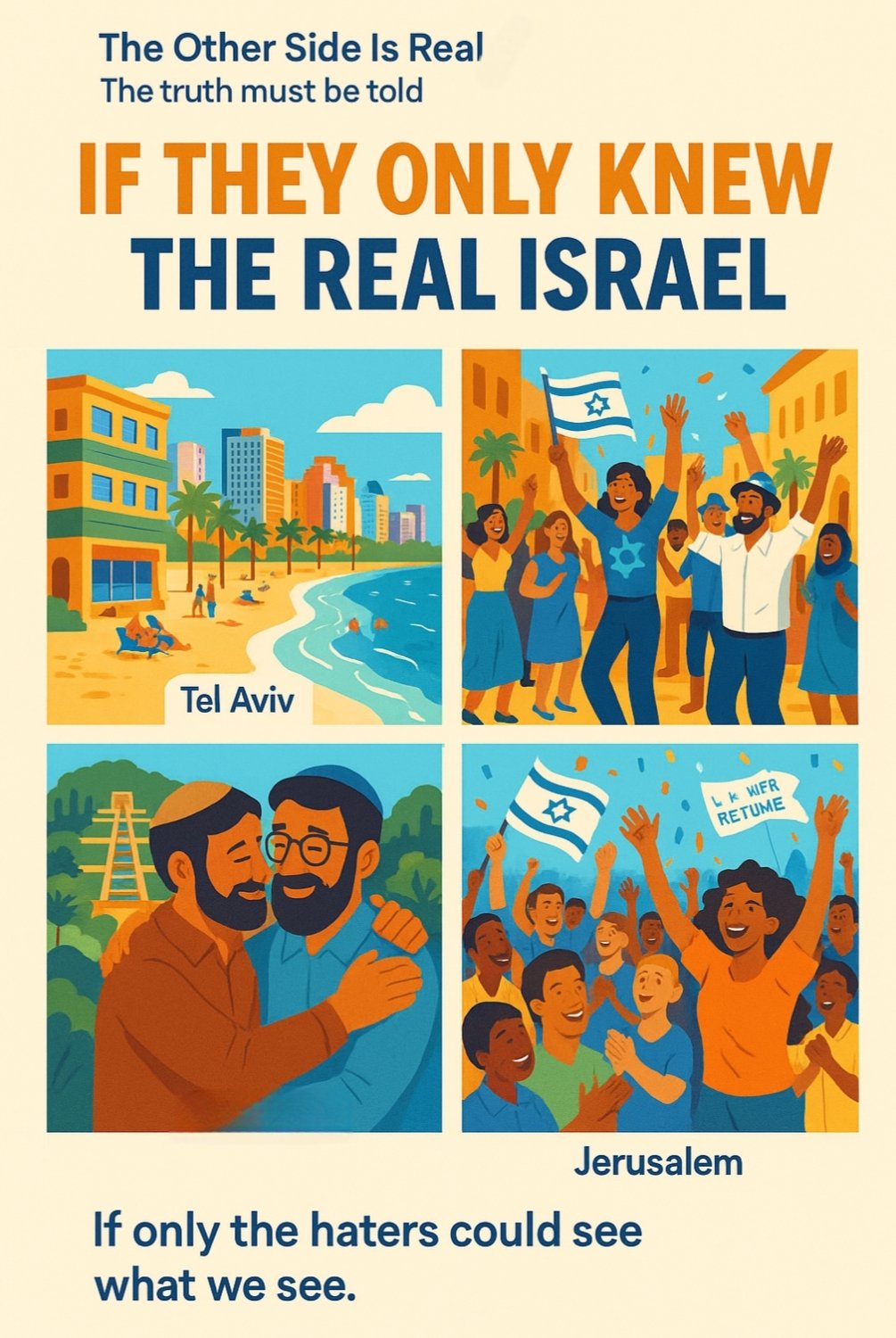
Photo Credits: Sabine Sterk(AI)
There is a country, no larger than New Jersey, with beaches that rival the Mediterranean’s finest, deserts that bloom, and a population pulsing with life, diversity, and resilience. This country is Israel. To the outsider, Israel is too often reduced to a headline or a controversy. But those who have walked her streets, talked to her people, and felt her heartbeat know the truth: Israel is not just a country, it’s a miracle of coexistence, color, creativity, and community.
Every time I arrive in Israel, I feel joy rush through my veins. The moment I touch her soil, something awakens in me. When I leave, I feel a physical ache, as if part of my soul remains behind. It’s not just nostalgia ,it’s love. A love born not only from history or heritage, but from the vibrant, modern reality that so many outside its borders never get to see.
In Tel Aviv, I stayed at the Crown Sea Hostel, a welcoming, warm place just steps away from the beach. Here, you don’t just find budget travelers. You find stories. Stories of first-timers from across the globe, Germany, Brazil, Australia, even Arab countries, who expected to find a warzone and instead found a celebration of life.
In that hostel, I met an Arab real estate mogul named Abu Lafia, a kind and humble man who owns not only property in the area but the beloved Abu Lafia Bakery in Jaffa. Every day he stops by to greet his friends, Dudi and Barak, the Jewish owners of the hostel. When I visited his bakery with a Russian tourist, we were gifted bread and drinks with a smile. How can anyone claim this is an apartheid state? Here, Jews and Arabs live, work, and laugh together.
One evening, I spoke to a Jewish-American tourist from Texas. Left-wing, skeptical, even ashamed to tell others he was visiting Israel. But after days in Tel Aviv, seeing Jews, Christians, Muslims, Africans, Asians, religious and secular people sharing public spaces, music festivals, and marketplaces he broke down in tears. “I was wrong,” he said. “I’ve been lied to all my life.” By the end of our conversation, he joined the Time To Stand Up For Israel initiative and vowed to become a voice of truth.
These moments are not isolated. They are daily life.
In Jerusalem, thousands gather on Ben Yehuda Street for Shabbat dancing. In Haifa, Arab and Jewish teenagers learn music together at the Beit Hagefen Arab-Jewish Center. In Rahat, a Bedouin city, tech startups bloom with the support of Israeli innovation funds. In Gaza-border communities like Sderot, despite the sirens, life bursts forth, children play, cafes are full, and art installations line the walls of once-battered kindergartens.
During Tel Aviv Pride, over 200,000 people of every color and faith parade through the streets. During Yom Ha’atzmaut (Independence Day), the skies are lit with fireworks, and strangers dance in the streets as Hebrew, Arabic, American, and Russian voices join in celebration. Even during war, Israelis find ways to live. To dance. To dream.
And just recently, amid the shadow of conflict, Israelis gathered by the thousands to celebrate the return of hostages, to mourn together, to sing together. There is no place on earth where joy and pain intertwine so closely, yet neither defeats the other. Israelis choose life, again and again.
If only the haters could see what we see.
The distorted media image, the biased reports, the international campaigns calling Israel an “apartheid state” they collapse when you walk through the Shuk HaCarmel in Tel Aviv, or visit Druze villages on Mount Carmel, or pray beside an Ethiopian Jew at the Western Wall.
This is the real Israel: A place where Holocaust survivors celebrate their great-grandchildren’s bar mitzvahs. Where Christian pilgrims walk the same paths Jesus once did. Where Arab doctors treat Jewish patients, and Jewish engineers develop apps that serve the entire Arab world.
We don’t ask the world to blindly support us. We ask the world to see us.
Maybe, just maybe, the solution isn’t more UN resolutions or social media activism. Maybe it’s as simple as inviting people in. Bring the skeptics. Bring the students. Bring the curious. Let them walk our streets, meet our people, and discover the truth for themselves.
If only the haters could see the real Israel; her beaches, her schools, her soldiers giving up their seats to the elderly on a bus, perhaps they would understand.
Because this land, this people, are so much more than politics.
They are a symphony of hope.
And I, for one, will never stop singing her song.
Am Yisrael Chai.
Related Topics
Related Posts