
Professional Indian author and strategic affairs writer.
IMEC as the Ultimate Insurance Policy
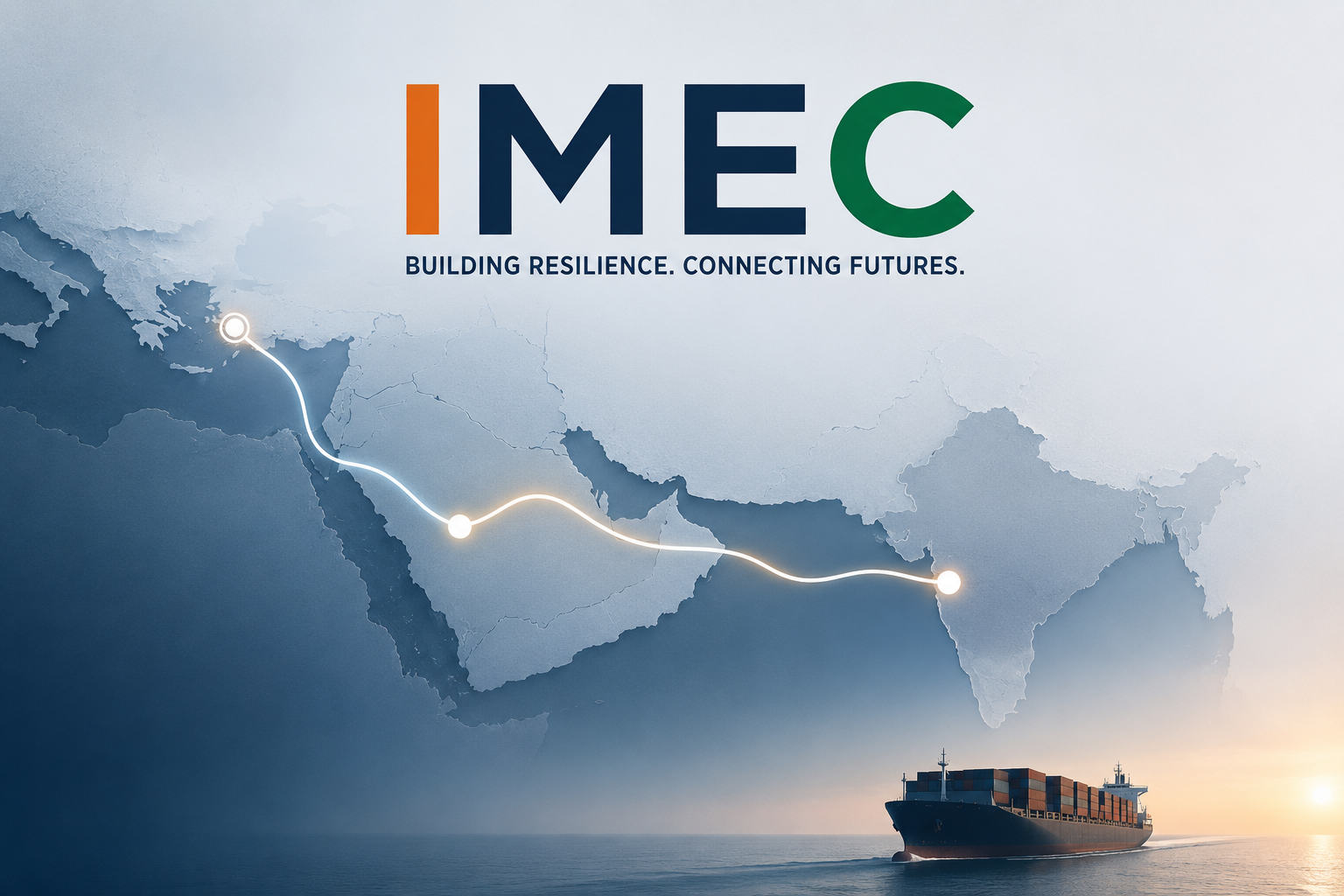
Conceptual illustration: A minimalist map traces the India-Middle East-Europe Economic Corridor (IMEC) from India across the Arabian Gulf to the Mediterranean, with a cargo vessel navigating the foreground. The image symbolizes India's push to diversify trade routes, strengthen supply chain resilience, and reduce dependence on vulnerable maritime chokepoints amid growing geopolitical uncertainty. Image: AI generated (Google).
The ongoing maritime disruptions in the Red Sea and the escalating conflicts in West Asia have exposed the severe fragility of traditional global trade routes. The Middle Eastern war proved exactly why the India-Middle East-Europe Economic Corridor, commonly known as IMEC, has transitioned from a diplomatic ambition into an urgent strategic necessity.
During the 11th Raisina Dialogue in New Delhi this March, IMEC dominated the strategic conversation. The discussions accurately diagnosed the current geopolitical reality. The old logistics routes are dangerously vulnerable. The corridor aims to link India’s western ports directly to the Arabian Gulf and onward to Europe. This ambitious multimodal initiative bypasses the most vulnerable maritime chokepoints, serving as a resilient alternative logistics spine for global trade.
The economic logic of this corridor is impossible to ignore. IMEC is projected to reduce freight time on India-to-Europe routes by up to 40 percent. Simultaneously, it promises to slash logistics costs by up to 30 percent. A project delivering those specific metrics guarantees supply chain resilience in an era where global shipping costs can multiply overnight due to regional instability.
India has spent decades relying heavily on the Strait of Hormuz and the Suez Canal. The current disruptions demonstrate that relying on those narrow waterways carries massive economic risk. A single geopolitical crisis thousands of miles away inevitably translates to higher domestic fuel prices and delayed manufacturing shipments.
IMEC solves this structural vulnerability. The East Corridor will seamlessly connect crucial Indian ports, such as Mundra and JNPA, to the Arabian Gulf. From there, the Northern Corridor establishes a land bridge across Saudi Arabia and Jordan, culminating at the Mediterranean port of Haifa in Israel. Indian enterprises already control critical infrastructure along this route, anchored by the strategic acquisition of the Haifa Port.
The strategic value of this network goes beyond simple transportation. It represents a fundamental de-risking of India’s foreign trade. By creating a multimodal network of railways, sea lines, and energy pipelines, India secures a permanent insurance policy against maritime blockades and regional wars.
The diplomatic heavy lifting is already underway. The coalition, including India, the United Arab Emirates, Saudi Arabia, the European Union, and the United States, signed the initial agreement during the G20 Summit. Translating that agreement into physical infrastructure requires navigating complex regional animosities. However, the exact war causing India’s current supply chain crisis is creating the political urgency to finalize the corridor.
India is rewriting Middle Eastern diplomacy through minilateralism. The country is moving away from isolated bilateral agreements and leaning into comprehensive frameworks that prioritize connectivity. IMEC acts as the physical manifestation of that strategy. It provides India with unprecedented strategic autonomy in West Asia.
The era of cheap, frictionless globalization has ended. Global supply chains will increasingly face weaponization and disruption. Building IMEC serves as the only guaranteed method to protect India’s economic rise from external geopolitical shocks. The blueprints exist. The economic incentives are clear. The only remaining task is accelerated execution.
Related Topics
Related Posts