
Middle East Analyst
Impact of the Blue Tsunami: Israel, Iran, and Gaza
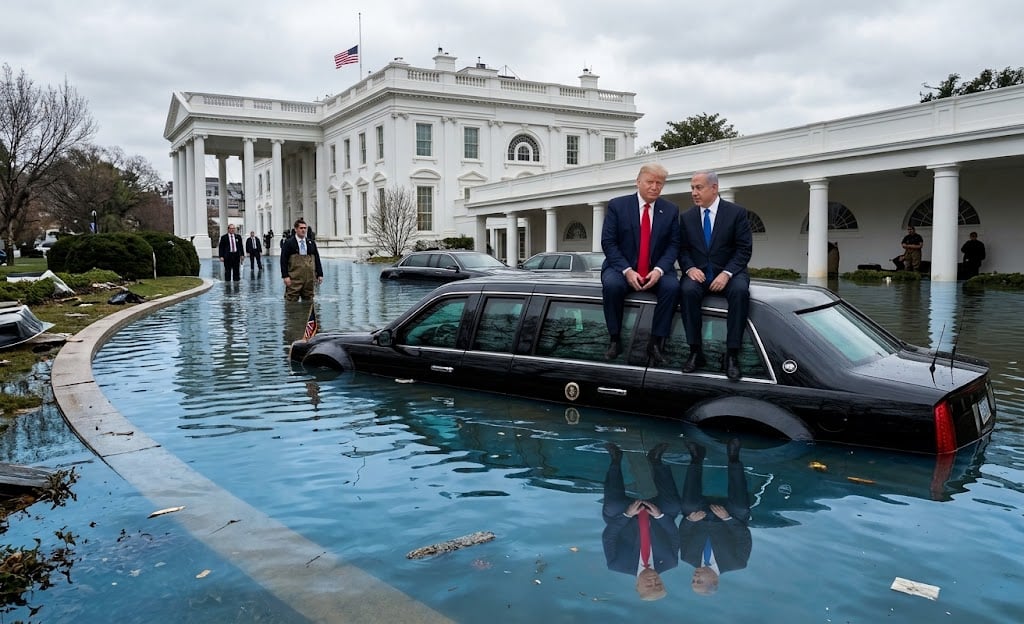
by author (AI)
A change in presidential incentives
The conventional interpretation of a Democratic midterm landslide is straightforward: Republicans lost Congress, Democrats gained leverage, and Israel faces a more challenging political environment in Washington. That assessment is not necessarily wrong, but it may be incomplete. It assumes the primary significance of the “Blue Tsunami” lies in congressional arithmetic. The more consequential effects may emerge indirectly through changes in presidential incentives, regional diplomacy, and Israeli domestic politics.
The election itself was not fought primarily on Iran, Gaza, or Middle East strategy. It was fought on kitchen-table economics. High gasoline prices became a daily reminder of the costs associated with an increasingly unpopular war. Voters may have expressed concerns about immigration, healthcare, culture-war issues, and perceptions of leadership competence, but those concerns landed in an economic environment already shaped by energy prices and war fatigue. Remove the economic shock associated with sustained high fuel costs, and many of those other grievances likely lose much of their political force.
In that sense, the Iran war sits closer to the center of the midterm result than many observers acknowledge.
The Political Cost of the Iran War
For many voters, the problem was not merely that the war was expensive. It was that the rationale never fully connected with the American public. Administrations can sustain public support for military action when voters believe a compelling national interest is at stake. The challenge for the White House was that the Iran conflict increasingly appeared detached from immediate American concerns while simultaneously increasing economic pressure at home.
As the political costs mounted, another narrative began to gain traction: that Israeli Prime Minister Benjamin Netanyahu successfully persuaded President Trump to enter a conflict that Washington may not have otherwise pursued.
Whether that perception is fair is almost secondary. In politics, perceptions often matter more than precise historical causality.
If growing numbers of Americans conclude that the United States entered a costly conflict primarily to advance Israeli strategic objectives, the result is not merely dissatisfaction with the war. It becomes dissatisfaction with the relationship itself.
That creates potential risks for both countries.
The Relationship Question
For decades, Israeli leaders have benefited from a broad bipartisan consensus supporting the US-Israel relationship. While disagreements emerged over settlements, Iran policy, and peace negotiations, the underlying strategic partnership generally remained insulated from partisan battles.
The Blue Tsunami threatens that insulation.
If voters associate economic hardship, high energy prices, and military costs with a war perceived to have been encouraged by Israel, questions naturally emerge:
- Was the war necessary?
- Were American interests clearly served?
- Did Washington adequately define its objectives?
- Did Israel ask too much of its most important ally?
Once these questions enter mainstream political discourse, repairing political confidence becomes increasingly important.
This is particularly true because a damaged relationship affects more than immediate security cooperation. It affects public trust, congressional attitudes, and the long-term sustainability of bipartisan support.
Trump’s Strategic Dilemma
The Democratic landslide creates a dilemma for President Trump.
One option would be escalation and confrontation. The other would-be legacy-building diplomacy.
Historically, presidents suffering domestic setbacks often seek opportunities in foreign policy where executive authority remains comparatively strong. A weakened president can still negotiate agreements, shape alliances, and pursue diplomatic breakthroughs.
Under this framework, the midterm election could encourage a reassessment of the Iran war itself.
The political question changes from:
How do we win the war?
to:
What is the best strategic exit that preserves American interests while restoring political stability?
If the war becomes politically unsustainable, ending it may become more attractive than expanding it.
Why Gaza Matters
This is where many analyses stop too early.
Ending or stabilizing the Iran conflict is not simply an Iran issue. It potentially unlocks movement elsewhere in the region.
For the last two years, I have argued in multiple analyses that Gaza now represents the Middle East’s de facto strategic center of gravity.
The concept is relatively simple.
Saudi normalization, Abraham Accord expansion, Arab legitimacy, regional diplomacy, reconstruction, and long-term security arrangements all eventually converge on Gaza.
Iran may command headlines.
Lebanon may dominate military planning.
Normalization agreements may dominate diplomatic discussions.
But Gaza remains the issue that repeatedly determines how far regional actors are willing or able to move.
The Iran war effectively pushed Gaza into the background. Diplomatic bandwidth became consumed by crisis management. Political leaders focused on conflict rather than implementation.
A reduction in tensions with Iran would therefore do more than end one war. It would create space for policymakers to revisit issues that were already awaiting action.
The Return of the Trump Gaza Peace Plan
A frequently overlooked reality is that significant Gaza planning has already been mandated by the UN under UNSC Resolution 2803.
Hamas has agreed to disarm.
Governance frameworks have been established.
Reconstruction mechanisms have been proposed.
Regional diplomatic frameworks have been explored.
Normalization pathways have been outlined.
The primary challenge increasingly appears to be implementation rather than design.
The question is no longer whether a framework can be imagined.
The question is whether political conditions exist to activate it.
A post-midterm environment could create precisely those conditions if Washington decides that regional stabilization serves US political and strategic interests better than indefinite conflict.
Implications for Israeli Politics
This shift would have important consequences inside Israel.
During wartime, coalition politics tends to reward leaders associated with security maximalism and military resolve.
During a diplomatic phase, different qualities become valuable:
- Security credibility.
- Political flexibility.
- Regional engagement.
- Ability to work with international partners.
- Capacity to implement complex agreements.
This is where opposition figures such as Gadi Eisenkot could become more significant.
If the strategic agenda shifts from military operations toward implementation of regional arrangements, Eisenkot’s combination of military credentials and centrist positioning may become increasingly attractive to voters seeking both security and stability.
The Arab Parties Question
The impact may be even greater for coalition formation.
Much discussion of Arab parties focuses solely on mathematics: how many seats they contribute and whether Jewish parties are willing to cooperate with them.
A Gaza-centered diplomatic environment changes the equation.
Arab parties cease being merely coalition partners. They become potential stakeholders in a broader regional project involving reconstruction, coexistence mechanisms, economic development, and normalization.
Their participation can then be viewed through a strategic lens rather than exclusively an ideological one.
That shift could materially alter coalition-building possibilities for the Israeli center.
Conclusion
The Blue Tsunami may ultimately be remembered less for changing Congress than for changing presidential incentives.
High fuel prices and war fatigue transformed the Iran conflict into a domestic political liability. That liability could encourage President Trump to reconsider the costs and benefits of continued military engagement. A reassessment of the Iran war could reopen diplomatic space around Gaza. Progress on Gaza could revive normalization efforts and regional diplomacy. And changes in regional diplomacy could reshape Israeli coalition politics in ways that were previously difficult to imagine.
Viewed from this perspective, the midterm election is not simply an American political event.
It is potentially the first domino in a chain linking the future of the Iran war, the implementation of Gaza’s long-delayed framework, the expansion of the Abraham Accords, the repair of U.S.-Israel political confidence, and the emergence of new governing possibilities inside Israel itself.
The true significance of the Blue Tsunami may therefore lie not in who won Congress, but in whether it changes the strategic calculations of the leaders who now must decide what comes next.
Related Topics